

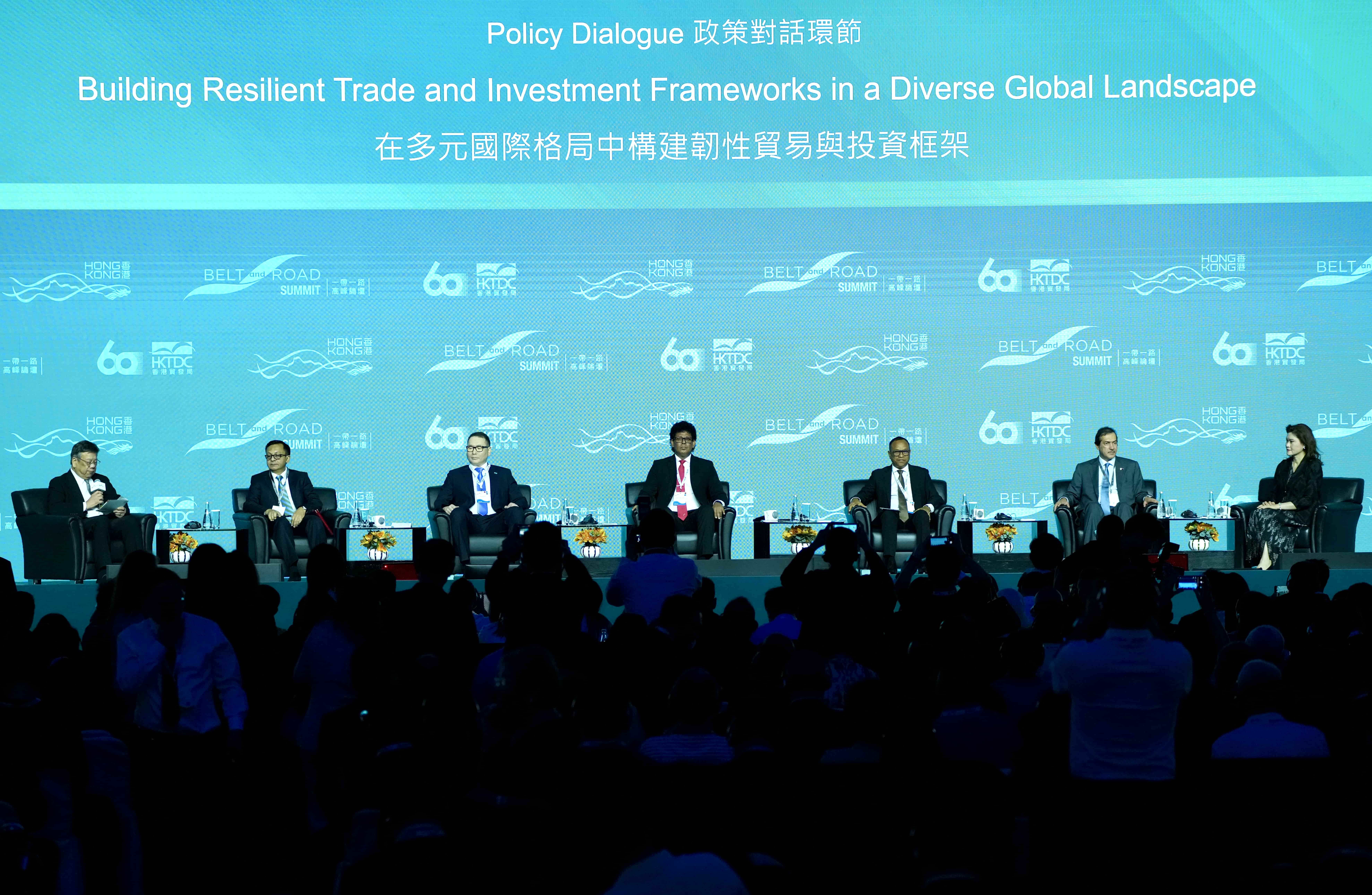
Trade ministers from countries in Central Asia, South Asia, Southeast Asia and the Middle East all highlighted Hong Kong’s strategic connectivity roles in finance, professional services and business opportunities that can help these countries forge greater economic integration and enhance value chains.
They made their remarks at the 11th Belt and Road Summit, co-organized by the Hong Kong Special Administrative Region government and Hong Kong Trade Development Council. The two-day event, held on Wednesday and Thursday, has drawn some 100 policymakers and business leaders from Belt and Road countries and regions to deepen local, regional economic and trade ties.
A policy dialogue session themed “Building Resilient Trade and Investment Frameworks in a Diverse Global Landscape” was chaired by the Hong Kong SAR’s Secretary for Commerce and Economic Development Algernon Yau Ying-wah on Wednesday, during which discussions were held on how to strengthen cross-border trade and investment cooperation and enhance economic resilience.
With rising protectionism in the form of tariffs and shifts in the global supply chain, Yau said that “Hong Kong plays its part by providing comprehensive financial, legal, advisory, as well as logistics and strategic support services to everyone.”
ALSO READ: A new journey of high-quality development
He added that Hong Kong always facilitates trade by improving customs periods and procedures; supports the Authorized Economic Operators program promulgated by the World Customs Organization; and supports the digital transformation of Hong Kong’s small and medium-sized enterprises through funding, thematic seminars and research sharing.
“We must uphold a rules-based bilateral trade system, promote transparent and nondiscriminatory regulations, facilitate customs and digital connectivity, as well as ensure that the benefits of trade are shared,” Yau said.
At the dialogue session, trade ministers of several Belt and Road countries said that they are embarking on economic transformation, moving away from being infrastructure or resources-driven economies to economies that are better integrated with global value chains.
In this context, these countries all lauded Hong Kong, saying it can play an important strategic connectivity role in their economic transformation.
Arman Shakkaliyev, minister for trade and integration of Kazakhstan, said the country’s task is to move beyond infrastructure-based activity toward deeper economic integration, stronger industrial cooperation and development of regional value chains.
“We believe combining Hong Kong’s financial expertise, Kazakhstan’s investment potential and Central Asia’s growing market could provide a strong a foundation for growth,” he said.
Ahmed bin Mohammed Al-Sayed, minister of state for foreign trade affairs of Qatar, said Qatar and China will enhance their strategic partnership beyond the energy industry, and are forging cooperation in areas such as logistics, technology and other industrial sectors.
Wasantha Samarasinghe, minister of trade, commerce, food security and cooperative development of Sri Lanka, said the Belt and Road Initiative has created opportunities for dialogue and cooperation among countries with diverse economic structures and development priorities.
“Sri Lanka welcomes great engagement with Hong Kong and international partners in areas of trade, finance, logistics, technologies, investment and innovation,” he said.
Thailand’s vice-minister for commerce Kirida Bhaopichitr also highlighted the role that the Belt and Road Initiative plays in bringing connectivity and diversification into reality.
READ MORE: Hong Kong eyes role as BRI resource allocation hub
“Hong Kong plays a very important role in connecting businesses and people on a global scale. I really appreciate having the opportunity to be here in the connected world in Hong Kong,” she said.
In a world of fragmented global trade, the Thai commerce official said that “countries should build even stronger bridges through rules-based trading systems as well as through more connectivity, inclusivity and diversification.”
All the trade ministers agreed that long-term value, inclusivity and diversification are three important principles for economic development. In terms of policy direction, these countries are diversifying their export product mix and markets to ensure they are less vulnerable to external shocks; making regional integration more inclusive; and attracting investment that brings productive capacity, technology transfer, skills development, and integration with global value chains.
READ MORE: China, Central Asia seek more cooperation
Khandakar Abdul Muktadir, minister for commerce, industries, textiles and jute of Bangladesh, said the country’s priority is to diversify the export basket and market, as well as move toward higher-level products and services.
“Hong Kong has a unique role to play as an international business, financial, logistics and professional services hub, connecting the Chinese mainland with Asia. A resilient economy cannot be built through isolation. It must be built through diversification, connectivity, cooperation and trust,” he said.
Timor-Leste was admitted as the 11th member state of ASEAN (Association of Southeast Asian Nations) in October 2025. Filipus Nino Pereira, the country’s commerce and industry minister, said Timor-Leste needs the cooperation of ASEAN member states to build economic resilience.
“We see Hong Kong as an important partner in this process because of its strong position in international trade, finance, logistics and business connectivity,” he said.
Timor-Leste is interested in developing value-added products from its agriculture, fisheries, and natural resources that can enable the country to have greater participation in global value chains.
