

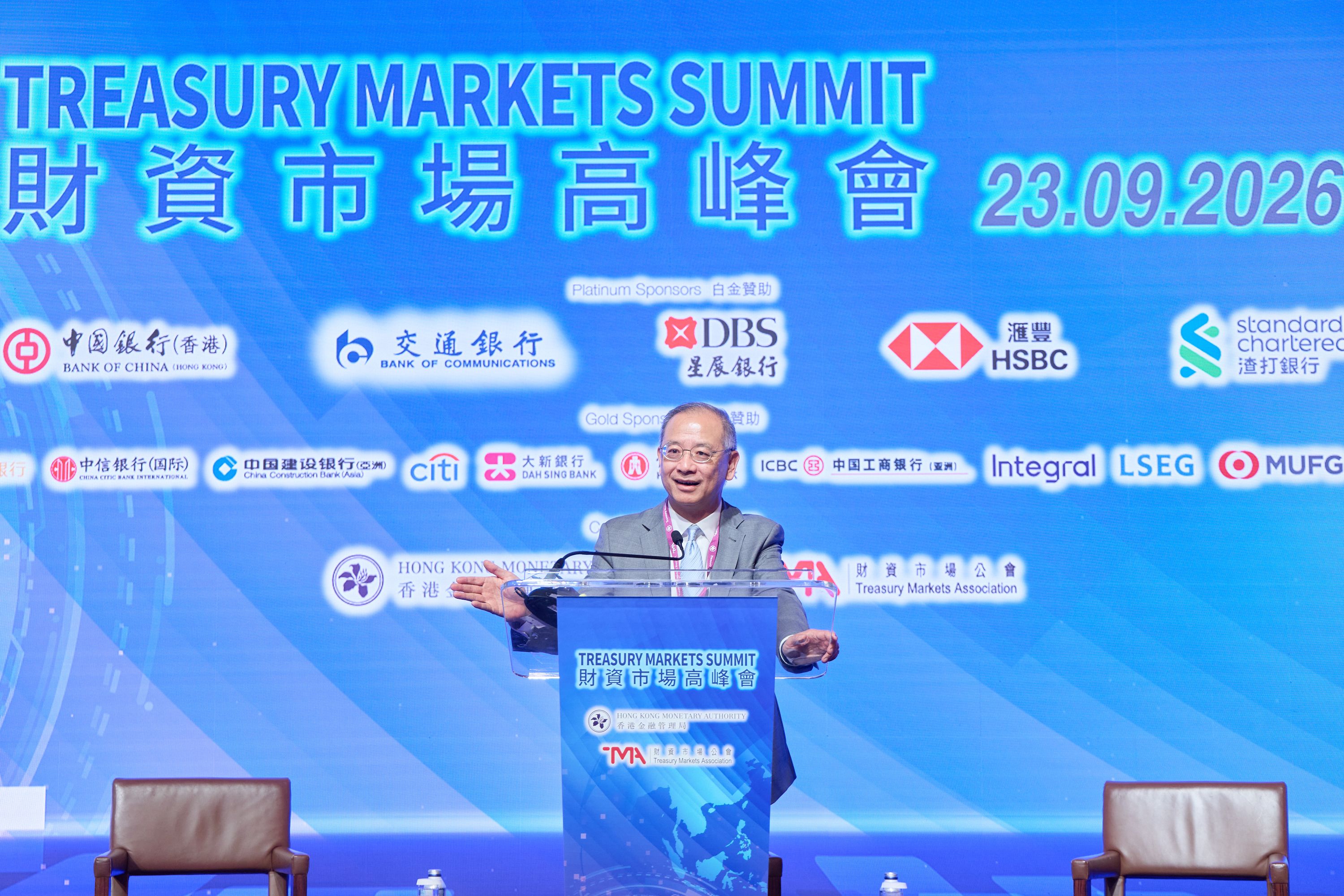
The Hong Kong Monetary Authority (HKMA) is spearheading the development of a robust fixed-income and currency market in the special administrative region, with targeted initiatives to diversify market participation, boost liquidity, and modernize infrastructure.
At the Treasury Markets Summit 2026 — coorganized by HKMA and the Treasury Markets Association (TMA) on Wednesday — officials and industry leaders highlighted these efforts. They also addressed topics such as renminbi internationalization, the macroeconomic outlook, and the transformative role of technology in treasury market operations.
Eddie Yue Wai-man, chief executive of the HKMA and honorary president of the TMA, said that Hong Kong’s bond market has expanded at a compound annual growth rate of 20 percent over the past two decades. Last year, the city accounted for one-quarter of all international bond issuances across Asia, driven by strong growth in dim sum bonds.
“With improved liquidity conditions in the Hong Kong dollar market, Hong Kong dollar-denominated wonton bonds have also seen significant growth, with global institutional issuances of such bonds increasing 64 percent year-on-year in the first half of the year,” Yue said.
ALSO READ: HK follows Fed to hike base rate for first time in over three years
The HKMA is working to attract more issuers and investors from Central Asia, the Middle East, the United States, and Europe to make the overall ecosystem attractive to international issuers. The city’s banking regulator is also expanding the tenor of offshore RMB- and Hong Kong dollar-denominated bonds issued by the SAR government, diversifying private sector issuances while deepening the long-tenor segment of the bond market, Yue said.
Regarding market infrastructure modernization, Yue said CMU OmniClear, which operates the Central Moneymarkets Unit on behalf of the HKMA, will launch a digital asset platform by the end of this year. The platform will support settlement with digital Hong Kong dollars, and may integrate with tokenized deposits and regulated stablecoins.
READ MORE: HKMA leaves base rate unchanged following Fed decision
Hong Kong is positioning itself as a leading hub for global tokenized bond issuance, accounting for half of the world’s digital bond issuances in the first half of this year.
“The HKMA will continue supporting the government’s issuance of digital bonds on a regular basis and will also conduct tests on the tokenization of Exchange Fund Bills, facilitating banks to further optimize their asset-liability management,” Yue said.
During a forum on RMB internationalization, panelists agreed that the next stage hinges on improving financial infrastructure.
HKMA Executive Director (External) Daryl Ho Hon-kit said, “When corporations get RMB receipts from exports, they … need tools to run the surplus liquidity to earn returns. The solutions offered by banks are not ready yet to integrate the use of RMB into the operations of corporations.”
Hong Kong holds approximately 1.1 trillion yuan ($164.1 billion) in RMB liquidity. In July, the HKMA expanded the RMB Business Facility to 500 billion yuan, equivalent to 40 to 50 percent of the RMB deposit base in Hong Kong. “This provides strong support to our banking system, satisfying corporations’ liquidity needs in working capital, trade finance, and financing for investment activities,” Ho said.
Gregory Yu Hock-ken, managing director and head of markets at Hong Kong Exchanges and Clearing, highlighted the importance of enriching the RMB product ecosystem.
“Since the launch of the Five-Year China Government Bond Futures in August, there has been significant growth in open interest contracts,” he said. The number increased from 900 contracts in the first week to 3,000 now, attracting market participants from the Middle East, Europe, America, Southeast Asia, and beyond.
Yu also said that an RMB-denominated gold futures contract, settled in Hong Kong, is expected early next year, along with more RMB-denominated investment products for precious metals and other commodities.
Patrick Wu, managing director, head of macro and co-head of trading for Asia-Pacific and the Middle East at Credit Agricole Corporate and Investment Bank, highlighted the development of an RMB repurchase market that improves connectivity between onshore and offshore markets.
Annie Zhu, deputy head of RMB business and general manager of global markets at Bank of China (Hong Kong), said, “The volatility in RMB yield has been relatively stable and lower versus other major mature currencies, and there is a narrowing of onshore and offshore market spread for the RMB.”
Justin Chan, advisor to co-chief executives at the Hongkong and Shanghai Banking Corp and chairman of the market development committee at the TMA, highlighted Hong Kong’s infrastructure and talent capacity to deliver RMB services globally. “We should think of how to use this capability in this regard,” he said.
Contact the writers at oswald@chinadailyhk.com
