

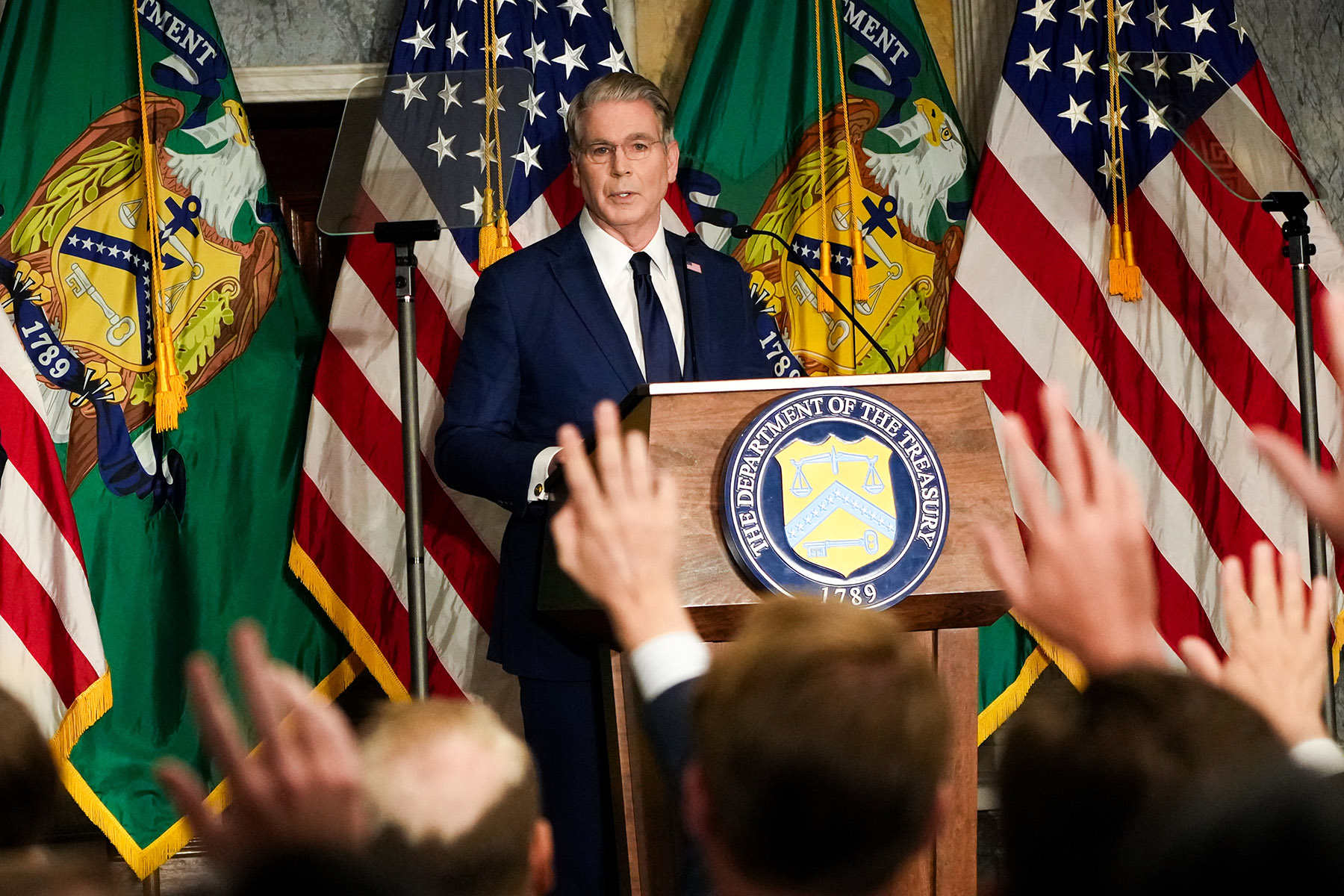
The United States imposed a new wave of sanctions on Iran on Monday, which it said would cut off the economic lifeline that sustains the country. Experts said the move appears unlikely to force Tehran to bow down, but will further strain the global economy.
US Treasury Secretary Scott Bessent said in a news release on Monday that the new sectoral sanctions target five critical sectors: digital assets, technology, gold, aviation and shipping.
According to the department, starting on Monday, "the actions of Treasury and other agencies will tighten the noose and block every potential source of revenue that funds the Islamic Revolutionary Guard Corps and the Iranian regime".
READ MORE: Pressure mounts as US sanctions set to kick in
The department added that countries and entities continuing to do business with Iran will face heightened secondary sanctions risks.
"Every country has a defined timeline to shut down activities we have identified. If they do not take action, we will do so unilaterally through Treasury authorities," it said. "Any entity that facilitates money laundering on behalf of Iran will be removed from the US dollar system."
China firmly opposed on Tuesday these illegal unilateral sanctions, which it said lack any basis in international law and the authorization of the United Nations Security Council.
Foreign Ministry spokesman Lin Jian said at a regular news conference that China's cooperation with Iran has always been conducted within the framework of international law and should not be disrupted.
The country will take all necessary measures to firmly safeguard its own rights and interests, he added.
The spokesman stressed that economic warfare and maximum pressure will not help resolve the issue, but only further escalate tensions, create spillover risks, disrupt the global economic and financial order, and harm the legitimate rights and interests of other countries.
The top priority now is to ease the tensions and return to dialogue and negotiation as soon as possible, Lin said.
Iranian President Masoud Pezeshkian said in his meeting on Monday in Tehran with Pakistan's Army Chief Field Marshal Asim Munir that the US must change its tone and approach in dealing with Iran, Mehr News agency reported.
In a separate meeting with Munir on Monday, Iranian Parliament Speaker Mohammad Baqer Qalibaf said that Tehran remains determined to pursue implementation of the provisions of the US-Iran peace memorandum of understanding signed in June, Tasnim News Agency reported.
Washington and Tehran have been at odds since the 1979 Islamic Revolution and the hostage crisis, in which Iranian students seized the US embassy in Tehran and took US diplomats hostage. Washington has imposed a slew of sanctions on Tehran and steadily expanded them over the past four decades.
Experts said the latest move is likely to add fresh layers of disruption and complexity to the global economy and diplomatic efforts, particularly as Tehran maintains close communication with regional neighbors and mediators such as Oman and Pakistan.
Jawaid Iqbal, vice-chancellor of Baba Ghulam Shah Badshah University in India, told China Daily that the US has been blowing hot and cold over the past several weeks with regard to Iran.
"This in itself is proof that the US is not in a position to dictate its peace terms with Iran," Iqbal said. "The latest threat of sanctions shows that Washington is trying to somehow extricate itself from a messy situation of its own making."
"Iran, on the other hand, will not bow down to Washington' sterms and conditions so easily. It knows that by retaliating against America's regional allies, it can submerge the entire Gulf into chaos, which will in turn create turmoil in the world economy," he added.
ALSO READ: US needs an exit ramp for itself, not an 'economic D-Day' for Iran
Deniz Istikbal, an assistant professor and economics researcher at Istanbul Medipol University in Turkiye, noted that the economic dimension of the Iran-US conflict is intensifying, posing challenges for the global economy.
Conducting business with Iran is becoming increasingly challenging, as Washington seeks to isolate Tehran and push the government to the negotiating table by exerting financial pressure, he said.
"These developments are making the conflict increasingly costly for the global economy, while interest rates are rising and inflation is once again becoming a major concern.
"Ultimately, the cost of the conflict is creating additional burdens for the entire world, particularly for energy-importing countries, leading to higher taxation and increased borrowing needs," Istikbal noted.
Contact the writers at jan@chinadailyapac.com
