

Officials and tech company startup founders from Hong Kong and Hunan province expressed hopes for stronger ties between the two regions’ science and technology sectors on Tuesday.
They pointed to complementary factors - including Hong Kong’s research savvy, global connectivity and market-service infrastructure, alongside Hunan’s manufacturing scale and industrial supply-chain heft - as a solid bedrock for expanded engagement.
Their remarks came during the “Hunan Day” Industrial Innovation Matchmaking Conference, one of the anchor events of the GIS Global Innovation Show and Global Innovation Summit Hong Kong 2026. The technology exhibition and conference, which commenced on Tuesday at AsiaWorld-Expo, includes a packed three-day agenda that wraps up on Thursday.
The two-hour matchmaking session — co-hosted by the Hong Kong and Macao Affairs Office of Hunan Province, the China Council for the Promotion of International Trade Hunan Sub-council and the Hunan Xiangjiang New Area — attracted over 160 officials, corporate executives and applied-technology innovators.
ALSO READ: Doubling R&D spending likely a ‘key part’ of HK’s five-year plan
The event saw senior officials from across Hunan outline their investment landscapes, with speakers including: Wang Wei, deputy director-general of the Hunan Xiangjiang New Area Management Committee; Li Ming, director of the Changsha High-Level Talent Service Center; and Wang Jizhong, director of the Loudi Economic and Technological Development Zone Management Committee.
An enterprise roadshow then focused on five Hunan-based high-tech companies — each operating at the cutting edge of robotics, chip technology, artificial intelligence, new energy, or environmental protection.
Hosting Tuesday’s event was Guo Ning, director-general of the Foreign Affairs Office of Hunan Province and director of the Hong Kong and Macao Affairs Office of Hunan Province. “Its goal is to further deepen Hunan-Hong Kong cooperation, and to promote the deep integration of their innovation pipelines, industrial supply chains, capital flows, and talent pools,” she said.
READ MORE: Major scientific event deepens Hong Kong's status as global I&T hub
Hong Kong’s Under Secretary for Innovation, Technology and Industry Bureau Lillian Cheong Man-lei, in her remarks, held up the session as a “template” for initiatives aimed at helping to pull together policymakers, business leaders, researchers, and end-users from both places to share resources and build industries in lockstep.
“I believe there’s considerable room for complementarity between the two places,” Cheong said, noting Hunan’s solid manufacturing capabilities and rich industrial resources, as well as Hong Kong’s advantages in research and development, innovation, global market access, and world-class financial and investment services platforms.
“I hope we can jointly explore a new collaboration pathway,” she said. “One in which manufacturing stays on the Chinese mainland, while Hong Kong provides the value-added inputs and secure global market access.”
READ MORE: Hong Kong banking on AI, robotics acumen
She added that the SAR government is prepared to create additional platforms to support engagement between industries, academic institutions and innovation parks in Hong Kong and their counterparts in Hunan.
The event also heard from Li Zexiang, a professor at Hong Kong University of Science and Technology, who serves as chairman of the Xiangjiang Science and Technology Innovation Institute; Yao Zhen, vice-chairman of the Hunan Association for Science and Technology, and Lei Hong, founder and executive chairman of the Silicon Valley Technology Innovation and Entrepreneurship Forum, a prominent international platform for technology and venture-capital deal-making.
They spoke of Hunan’s newest homegrown technologies, the province’s strategic geopolitical location, its modern industrial system and world-class industrial clusters — notably in construction machinery, rail transit equipment, and small-to-medium aero engines and aerospace systems — and were upbeat about working with Hong Kong to continue building an innovation hub, coordinate the development of strategic industry, improve the business climate, and break into new markets.
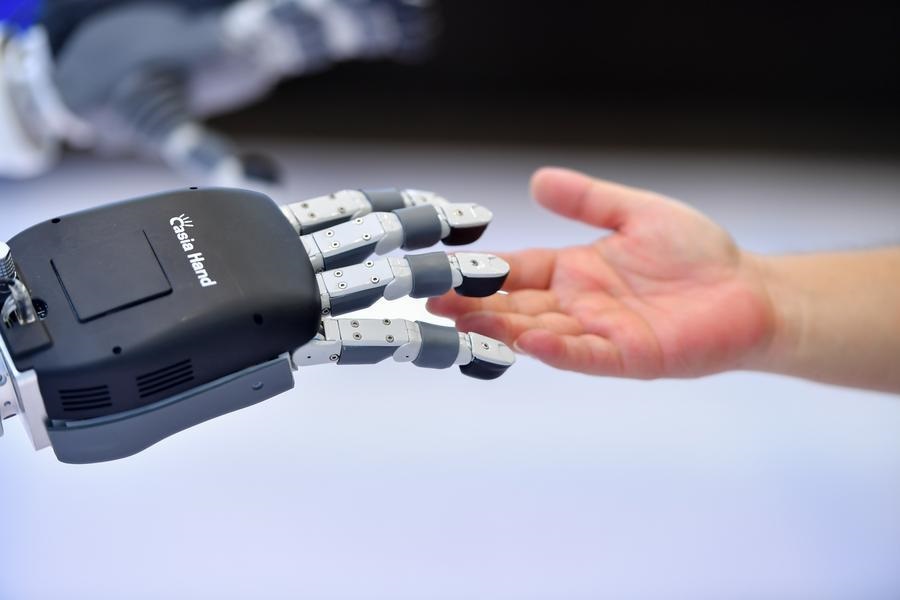
At this year’s GIS, Hunan made a concerted effort to promote itself with a government delegation, industrial-park administrators, and 13 local companies highlighting the province’s frontier technology sectors — from AI and embodied robotics to smart manufacturing, new energy, and biomedicine.
Contact the writer at wanqing@chinadailyhk.com
