

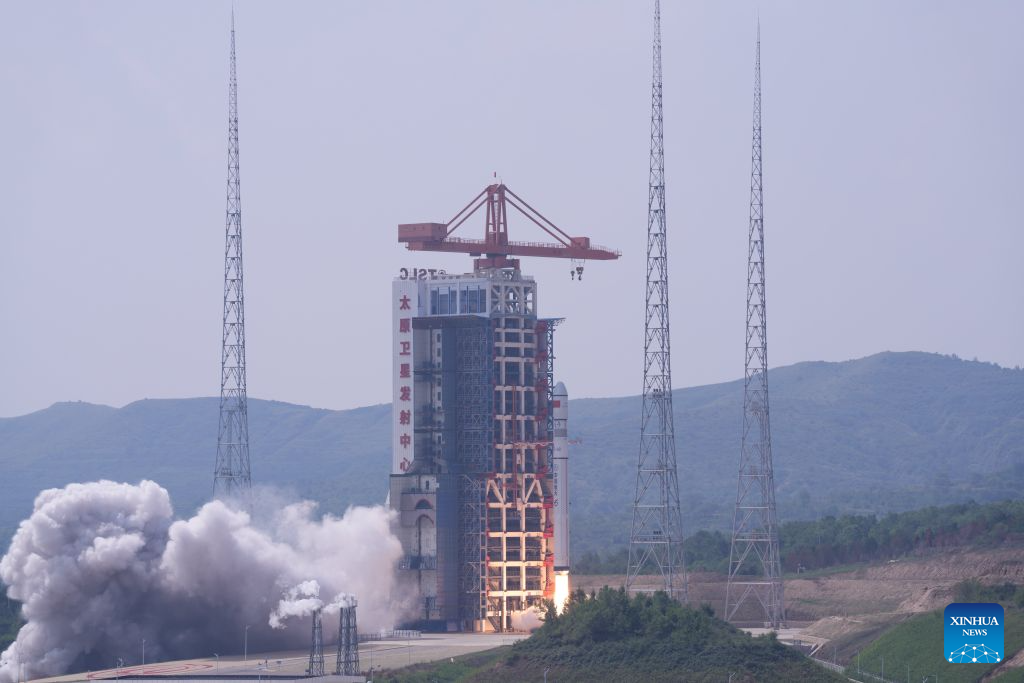
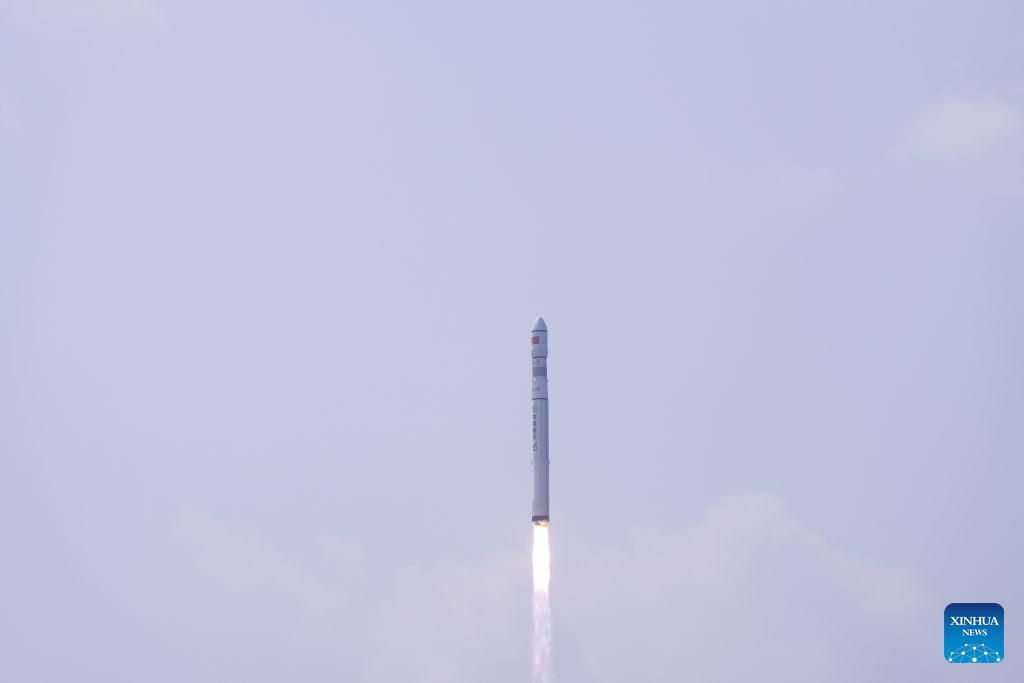
China launched a carrier rocket from a northwestern spaceport on Tuesday morning, sending seven satellites into orbit, according to China Aerospace Science and Technology Corp, the nation's leading space contractor.
The 43-meter-tall rocket blasted off at 11:21 am at the Taiyuan Satellite Launch Center in a mountainous region in Shanxi province and soon placed the satellites into their preset orbital positions, the State-owned conglomerate said in a news release.
Developed by the Shanghai Academy of Spaceflight Technology, the two-stage Long March 6C model has a diameter of 3.35 meters and is propelled by three engines consuming liquid oxygen and kerosene.
ALSO READ: China's Smart Dragon-3 rocket successfully launches 2 satellites from sea
With an overall liftoff weight of 215 metric tons, the rocket is capable of transporting spacecraft with a combined weight of about 2.4 tons to a typical sun-synchronous orbit with an altitude of 500 kilometers, or 4 tons of payloads to a low-Earth orbit 300 km above the ground.
Three of the nine launched satellites — AirSat 14, AirSat 15 and Lingzhi-09 Thai CubeSat — were developed and built by Beijing-based commercial space firm GalaxySpace.
The Lingzhi-09 Thai CubeSat marks GalaxySpace's first export of a complete satellite and ground system to a foreign user. It is also the first time a Chinese commercial space enterprise has delivered a full-service package, covering satellite development, launch and in-orbit delivery, to a Southeast Asian nation, according to GalaxySpace.
READ MORE: China launches new batch of low-orbit internet satellites
The AirSat 14 and 15 satellites were built for AirSat, a satellite operator headquartered in Jinan, Shandong province. Fitted with high-resolution synthetic aperture radars and dedicated space-based cloud payloads, they are tasked with forming an integrated space-based information platform. The mission represents a key breakthrough for GalaxySpace in space-based computing.
To date, GalaxySpace has successfully launched more than 10 SAR satellites, bringing its total number of independently developed satellites to 49.
