

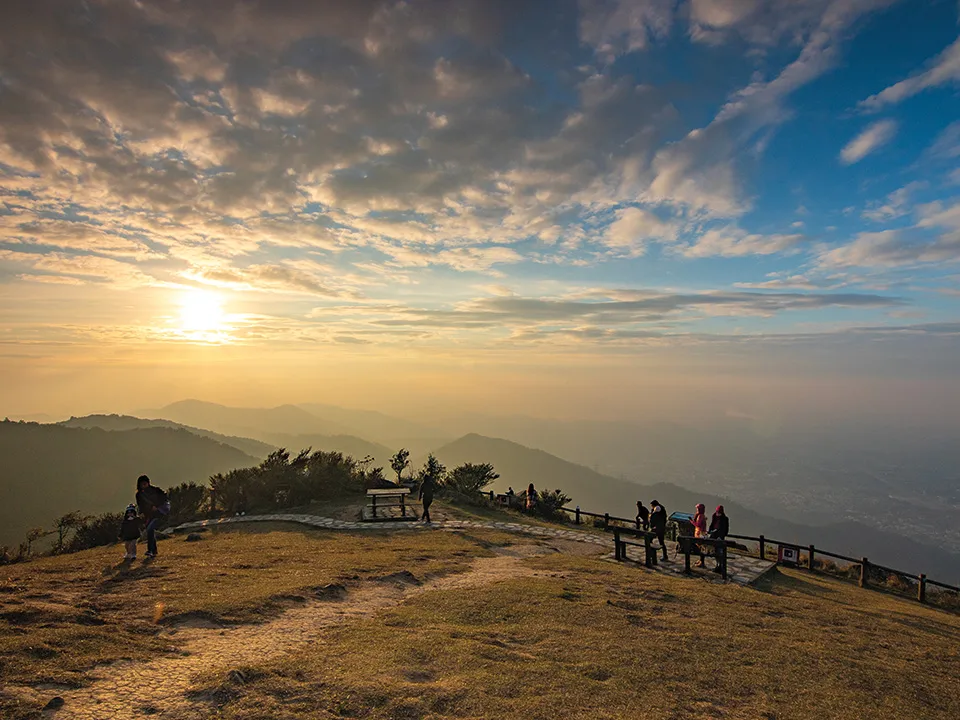
HONG KONG – Restoration ecologist Fernanda Cardoso grew up hearing grim stories about forest degradation in her home country Brazil and other places worldwide, which got her interested in studying plant ecology and forest restoration. Now she is trying to piece together a fully functional and diverse subtropical forest on the hillsides of Hong Kong's highest mountain Tai Mo Shan.
The forest restoration site Cardoso works on is a part of Kadoorie Farm and Botanic Garden (KFBG), a 70-year-old local non-profit organization dedicated to natural conservation. In 2013, it launched a project to turn its degraded grassy slopes into a diverse native forest that can support a wide variety of wildlife.
So far, over 50,000 seedlings representing hundreds of native species have been planted. Mammals, birds and insects are returning, including rare species like the butterfly Burmese Bush Blue.
Maximum diversity
"A good forest is one that's alive at every level," said Cardoso. It is not just a canopy of trees, but the constant exchange of energy between hundreds of species – different plant life forms, animals, fungi, pollinators and seed dispersers.
Unfortunately for the restoration site, hundreds of years of agricultural history as well as frequent wildfires had eroded the soil and deprived it of enough seed dispersers to restore biodiversity naturally, said Zhang Jinlong, senior ecologist at KFBG's Flora Conservation Department.
ALSO READ: Chinese researchers uncover sinkhole evolutionary trap
The missing links have to be reconstructed artificially, and ecologists at KFBG are doing it by mimicking the end result of natural succession. Based on extensive flora surveys on local natural forests and some others in south China, they drew up plans to plant diverse life forms including trees, shrubs, epiphytes, herbs, and climbers to recreate the structure of the best south China-Vietnam subtropical evergreen forest.
A big part of the restoration plan is nurturing seedlings of native plant species in KFBG's nursery, for which the Flora Conservation Department's fieldwork teams scour wild areas of Hong Kong to collect seeds under local government permission. To preserve genetic diversity, they make a special effort to source seeds from diverse mother trees from as many populations as possible.
"Hong Kong is incredibly rich in species, many of which have rarely if ever been cultivated," said Craig Williams, horticultural manager who used to work at botanic gardens in Britain and Singapore. The metropolis is home to over 2,200 documented plant species.
Williams and his team make it their mission to propagate and conserve rare and threatened species. Sometimes the job entails huddling with co-workers on a small pink boat, or "Barbie's boat," as Williams called it, on a field trip to a tiny island to take cuttings of the only known wild Lofty Strangling Fig (Ficus altissima) mother trees in Hong Kong. Now the fig tree is growing in the KFBG nursery.
When the seedlings become strong enough, they are taken from the nursery and planted in the restoration site, where arborists have developed practical tools to overcome the substandard conditions of degraded land.
READ MORE: World stands at climate crossroads
The team strengthens the soil with a mixture of biochar, dead branches and fallen leaves and uses tree guards made from plastic mesh and steel poles to protect seedlings from over-foraging by animals, said Cyrus Cheung, senior arborist at KFBG's Flora Conservation Department.
Back with life
Over a decade of efforts has helped bring wildlife back to the slopes. KFBG's Fauna Conservation Department has detected activities of almost all native mammal species, as well as the chirping of over 50 kinds of birds.
Zhang expects the canopy on the restoration site to keep expanding over the next five to ten years while self-regeneration begins for some species. To completely restore the function and structure of natural forests, however, is a matter of at least a century.
The Forest Declaration Assessment 2025 found that 8.1 million hectares of forest were lost in 2024, a level of destruction 63 percent higher than the trajectory needed to halt deforestation by 2030. Ecologists worldwide are calling for more restoration efforts.
"Conservation directly benefits everyday living. Just look at how much Hong Kong residents enjoy hiking and spending time outdoors," said Cardoso. She appreciates that local residents make full use of their country parks, which cover about 40 percent of the city's expanse, to maintain a healthy lifestyle.
Williams called his job a "privilege" because it is a rare opportunity to focus on growing native plants as well as participating in ecological restoration.
"The seedlings we plant will grow into massive trees that, long after I pass away, I wouldn't even get my arms around. It feels great to imagine that," said Williams.
