

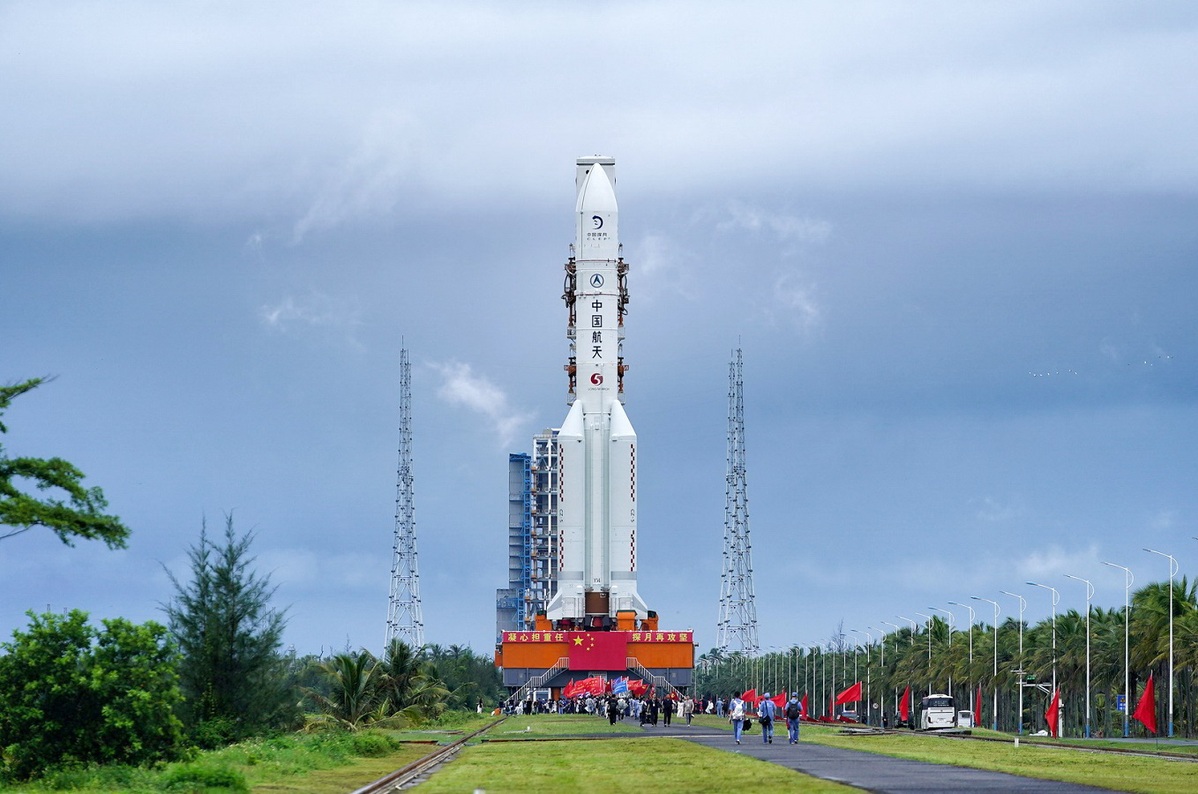
The Chang'e 7, China's next robotic mission to the moon — tasked with searching for a trace of water on the silver celestial body — has been scheduled to set out on its journey soon, the China Manned Space Agency announced on Wednesday.
A Long March 5 carrier rocket, with the Chang'e 7 probe on top of it, was moved to its launch service tower at the Wenchang Space Launch Center in Hainan province on Wednesday morning, the agency said in a news release, noting that the flight will take place in due course in the coming days.
The Chang'e 7 was transported by air to the coastal spaceport in April, while the Long March 5 rocket arrived in July by ship. They were assembled and tested at the spaceport.
READ MORE: Carrier rocket for China's Chang'e-7 lunar probe arrives at launch site
Over the next few days, engineers will conduct final functional examinations and pump propellants into the rocket, the release said.
According to information published previously by mission planners, the Chang'e 7 consists of an orbiter, a lander, a rover, and a small flying robot capable of hopping into permanently shadowed pits on the lunar surface to look for ice.
If everything goes according to plan, after entering its moon-bound trajectory, the Chang'e 7 spacecraft will make a series of flight maneuvers before deploying its rover and flying robot on the lunar south pole.
ALSO READ: China to accelerate lunar mission plans this year
To date, China has conducted six robotic missions to explore the moon.
The most recent mission, the 53-day Chang'e 6, took place in the summer of 2024, representing the world's first attempt to bring back samples from the far side of the moon.
The historic mission successfully retrieved a total of 1,935.3 grams of samples from the far side. The space authorities have been distributing those precious substances to scientists to enable them to better study the little-known "dark side" of our moon.
