

Leading figures slam the pact with US and UK as not in Canberra's interests
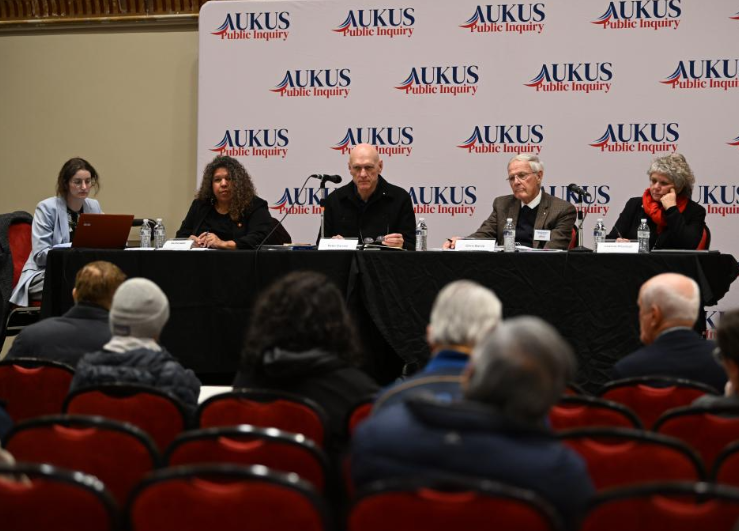
An independent public inquiry in Australia has raised sovereignty, safety and other concerns over the major trilateral security pact the country has with the United Kingdom and the United States, AUKUS, a deal that includes Australia's acquisition of nuclear-powered submarines and the collaborative development of advanced military technology and capabilities.
Speaking on the sidelines of the Sydney hearing of the inquiry held in the New South Wales Parliament House complex on Monday, Peter Garrett, the inquiry's lead commissioner, told China Daily that the hearings are aimed at giving "everyday Australians the opportunity to ask questions and be heard" on the "largest-ever defense decision, AUKUS, that any Australian government has made".
"It's a large sum of money to be spent in partnership with other countries but with no guarantees that it will actually provide any more security for us, so it deserves to be fully examined," said Garrett, who was Australia's environment minister from 2007 to 2010.
READ MORE: AUKUS faces public pushback at inquiry hearing in Australia
According to Australia's Department of the Prime Minister and Cabinet, the country, through AUKUS, is "steadily building capabilities across government and industry to steward and operate our own fleet of conventionally-armed, nuclear-powered submarines from the early 2030s".
The public inquiry, coordinated by the Australian Peace and Security Forum think tank and including hearings in other cities such as Melbourne and Adelaide, features former members of parliament, retired military officers, academics and union leaders. It has also received more than 500 written submissions from the public.
Key issues and areas of AUKUS that the inquiry is examining include the viability of an estimated A$368 billion ($260 billion) price tag over the next few decades that covers the submarines, making it the most expensive defense project of its kind for Australia.
'Sacrifice of sovereignty'
The inquiry is also asking whether AUKUS is "locking Australia further into the US war machine at the expense of our independence as a middle power".
At the Sydney hearing on Monday, former Australian prime minister Malcolm Turnbull said, "AUKUS involves a colossal sacrifice of sovereignty, there's no question about that."
"The argument has been that in return for this sacrifice of sovereignty Australia will get more security, but everything points to the fact that we will be less secure," said Turnbull, who was prime minister from September 2015 to August 2018.
"And what exquisite timing; AUKUS has made Australia more reliant, more dependent on the United States right at that time in history when the United States, not by accident, not by carelessness, but by design, has become less dependable," he said.
"If the goal of this project is to acquire nuclear-powered submarines, every indication is that we won't get them. The Americans are not producing enough for their own navy, let alone ours. The British shipbuilding industry is in disarray, the British are more aware of that than anyone," Turnbull said.
Former Australian foreign minister Bob Carr also expressed concerns over the AUKUS deal, saying Australia faces "the prospect that we may end up in the 2030s without a sovereign submarine capacity".
"A huge miscalculation … would leave us in that position," he said.
In May, the three AUKUS defense ministers said in a joint statement that Australia would acquire three secondhand Virginia-class nuclear-powered submarines from the US, rather than at least two used and one new Virginia-class submarine as expected following the 2021 AUKUS deal announced during then-Australian prime minister Scott Morrison's tenure.
ALSO READ: China firmly opposes AUKUS submarine deal
The ministers also acknowledged Australia's planned investments in related infrastructure and logistics support at naval facilities in the states of Western Australia and South Australia.
Eminent academic Jocelyn Chey told the public inquiry on Monday that she too was against AUKUS.
"Without any reservations, I think AUKUS should be scrapped. That might seem a little provocative in today's security climate, but I don't say this without reason," said Chey, whose work covers international relations.
"My life's work … it tells me that if there is hostility, that creates suspicion; and that a focus on common concerns is the way to dispel misunderstanding and build trust," she said.
Contact the writers at xinxin@chinadaily.com.cn
