

As shopping centers evolve into entertainment hubs, quirky competitions like pea shelling and rice planting offer stress relief and unexpected rewards for consumers seeking more than just retail therapy, Bai Shuhao reports.
On hot summer days, many Chinese consumers seek refuge in air-conditioned shopping malls. But these days, they may find more than just stores and restaurants inside. They might discover an unexpected talent and perhaps even win a tiny gold bean.
A month ago, Qian Jinfeng, a resident of Jiaxing, a city in Zhejiang province, unexpectedly became the champion of a pea and garlic peeling competition held at a shopping mall near her home.
She defeated nearly 100 competitors, including a "professional" rival sitting next to her — a middle-aged homemaker with years of kitchen experience.
The rules were straightforward. In the first round, contestants shelled green peas, with the fastest 50 advancing to the final. They were then required to peel 40 cloves of garlic completely and neatly. The winner would receive a small piece of pure gold shaped like a bean.
Even Qian was surprised by her victory. She had little experience in the kitchen and entered the competition almost by chance. She had accompanied her niece to the mall when she noticed a crowd gathering around a poster promoting what she considered a "ridiculous" contest.
"I just thought it looked fun," she says.
Such seemingly pointless competitions are becoming increasingly common in shopping malls across China. From office "slacking competitions" and "nonsense presentation contests" to auctions of strange-looking objects, malls are turning ordinary, even useless, everyday activities into public spectacles.
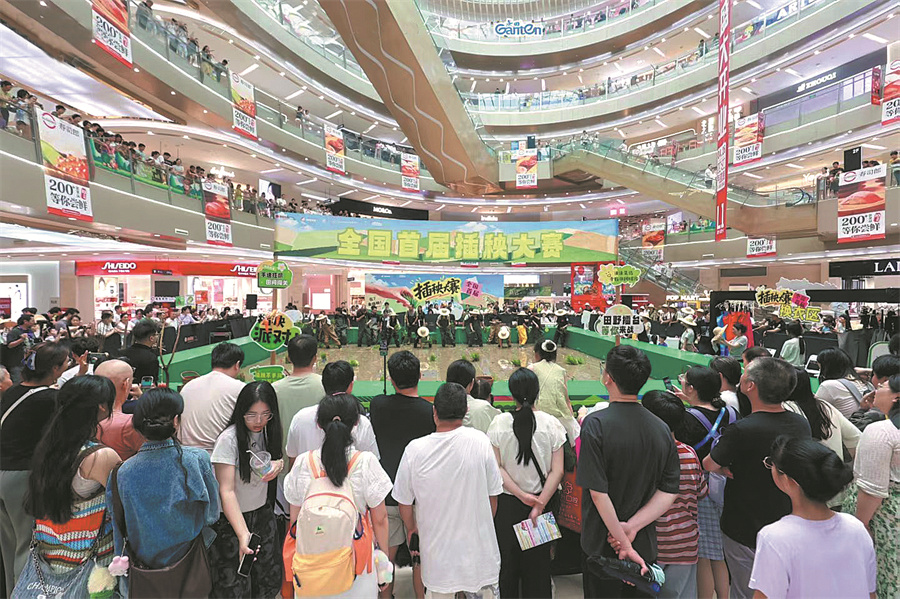
Bao Ciguang, an event planner at a shopping mall in Ningbo, Zhejiang, describes the trend as "the year of folk competitions". "People are looking for simple happiness," he says.
His mall was among the early adopters of the trend. After posting videos of its competitions on social media, the mall's account attracted more than 10 million views in the first half of 2026.
The turning point came in March, when Bao's team organized a "bead puzzle competition", a handicraft activity popular among young people. They expected 200 to 300 participants. But after the event spread online, more than 780 people signed up almost immediately.
"My first reaction was, 'Are we getting ourselves into trouble?'" Bao recalls.
The team quickly adjusted its budget and logistics. Eventually, more than 2,000 people took part.
"It showed that these small competitions could provide young people with stress relief and emotional value," Bao says.
The mall then developed a standardized approach and launched a series of similar events. As Bao puts it, the formula was simple: "Go viral, then replicate."
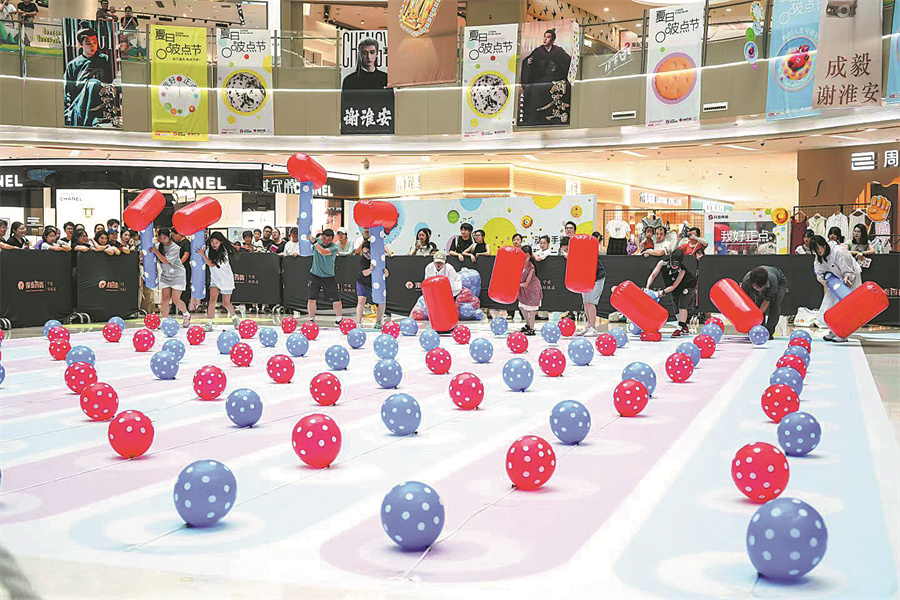
His inspiration came partly from casual games played in small bars in Beijing and Shanghai. Such activities had never been scaled up into large public events inside shopping malls.
"These games don't really have copyrights. We simply expanded them into bigger experiences," he says.
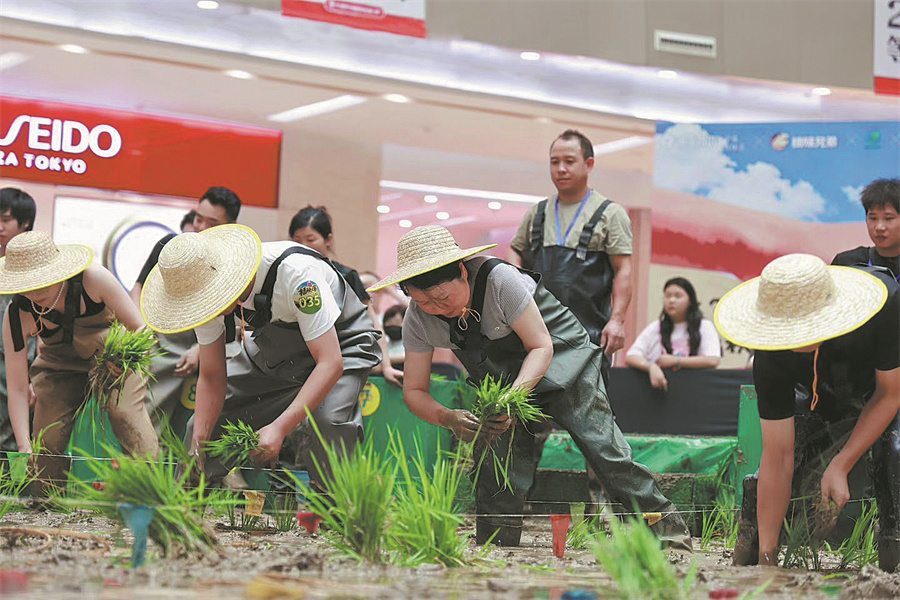
Television programs also offered inspiration. The reality show Become a Farmer, which features young celebrities experiencing rural life, inspired the mall to organize the "first 'national' rice planting competition" during the Dragon Boat Festival.
Inside the shopping mall, organizers built a simulated rice field. Contestants had to plant seedlings within a limited time while keeping them straight and stable. Each group had 10 participants, but only one could advance. Over two days, about 1,000 people joined the event, with 40 finalists selected.
The organizers even invited experienced farmers to serve as judges. "So the competition felt fair. Nobody questioned the results," Bao says.
Participants wore waterproof farming clothes and straw hats, creating an almost authentic rural scene. The competition attracted people of all ages, with the oldest participant reaching 78.
At first, organizers hesitated to allow the elderly contestant to join. But she insisted. "I work in the fields every day. Don't worry about me," she told them.
Bao noticed that older participants with farming backgrounds often moved through the muddy field with ease, while younger contestants struggled.
"They walked as if they were on flat ground, while young people looked like they were trapped in a swamp," he says.
Zhang Chao, a 31-year-old participant, experienced this firsthand. Having planted rice only once as a child, he was quickly defeated by the older woman competing beside him. She even offered him tips during the race — but he still lost.
After the competition, participants received another reward: catching crayfish in the artificial field. They could take their catch to a restaurant in the mall and have it cooked free of charge.
Zhang, however, was unlucky. He won no prize and caught no crayfish.
For Bao, the appeal of these competitions goes beyond entertainment.
"As society becomes wealthier, many people no longer have direct experience with agricultural work," he says. "Young people can learn where rice comes from and understand the importance of food. Older visitors may reconnect with memories from their childhood."
The events have also benefited mall businesses. Many competitions are linked to stores inside the mall. Some prizes are sponsored by retailers, while merchants livestream the events to attract customers.
According to Bao, the competitions have increased overall foot traffic by about 12 percent, while restaurant sales have grown by 10 percent to 12 percent.
Zhang, who lives in Ningbo, says he rarely visited the mall before. But because it frequently hosts events, the mall has become increasingly popular among local residents.
For years, shopping malls relied on familiar promotional formats, such as coffee festivals, music festivals and pet events. But many of these activities struggled to create lasting engagement.
"Customers might spend an hour shopping and dining before leaving. Small competitions can extend their stay to three hours, creating more opportunities for consumption," Bao says. "More importantly, they provide low-pressure entertainment for young people facing academic and workplace stress."
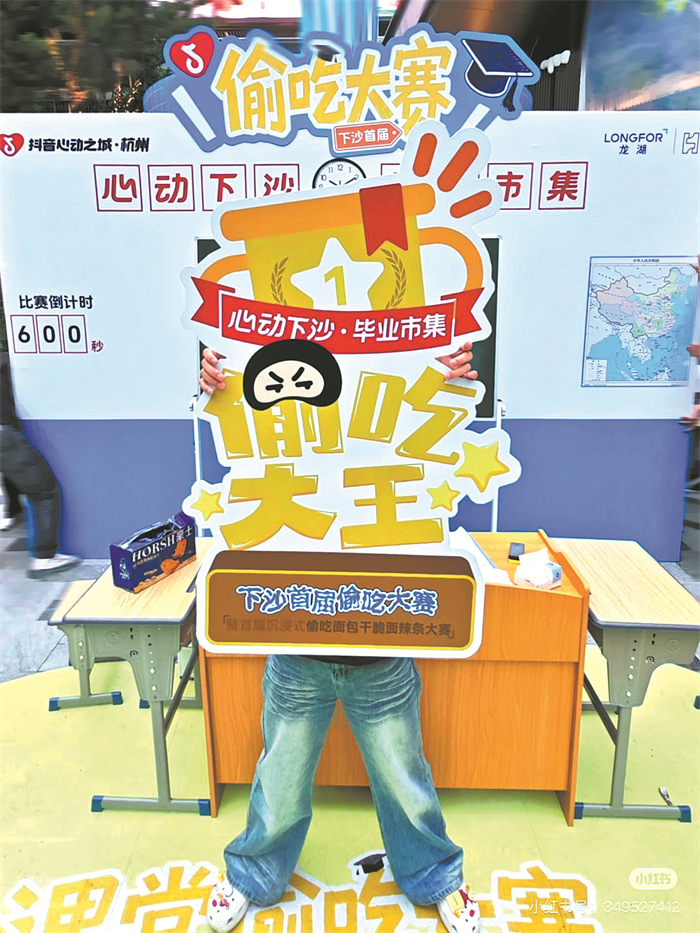
Yu Kemeng, who graduated from university two years ago, recently won a "classroom snack-eating competition" at a shopping mall in Hangzhou.
Participants played students trying to finish snacks at their desks without being noticed by a "teacher".
She joined the event shortly after arriving in Hangzhou to find a job. "When you live alone in a big city, you may not go out much," Yu says. "Usually, I would just walk around a mall by myself. But activities like this give young people a small outlet for entertainment."
Wang Peng, a researcher at the Beijing Academy of Social Sciences, says the transformation of shopping malls into experience-based spaces represents an irreversible industry trend.
"Malls are no longer simply places where transactions happen. They have become open urban spaces embedded in people's daily lives, carrying social, cultural and re-creational functions more than before," he says.
By turning ordinary skills and everyday humor into public entertainment, these competitions allow ordinary people to become participants rather than consumers.
After organizing dozens of competitions, Bao says he has learned one lesson: "Sincerity is the ultimate weapon." He compares organizing these events to hosting a family celebration.
"For these small competitions, happiness comes first. The contest comes second. So what if you don't win?" he says.
This summer, Bao is still designing new contests to ride the wave. His latest idea is a shopping price-estimation competition.
Participants can put any product they want into a shopping cart. The person whose estimated total price comes closest to the actual amount wins a mobile phone.
It is a familiar game from television shows that many people watched growing up — now re-created inside their neighborhood shopping malls.
