

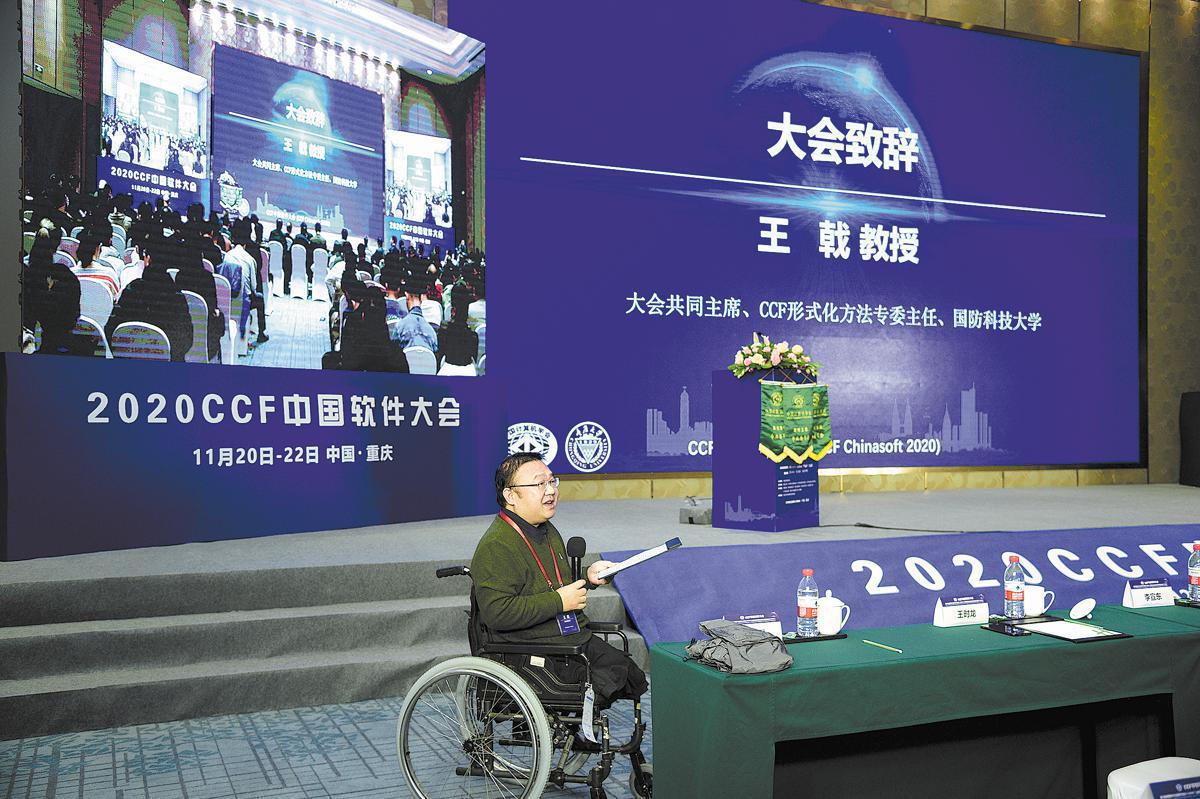
Despite having battled a serious illness and undergone a double amputation, Senior Colonel Wang Ji, a researcher at the National University of Defense Technology's College of Computer Science and Technology in Changsha, Hunan province, has focused with dedication on the niche yet critical field of high-confidence software, which uses mathematical methods to verify the correctness of core codes in major software used by the armed forces.
As a pioneer of China's high-confidence software technology, he was recently honored with the title of "Role Model of the Times".
READ MORE: Xi: Advance modernization of military
Wang is one of a group of military science and technology personnel who have devoted themselves to research and committed to overcoming challenges, providing the Chinese military with a substantial array of advanced equipment that is at the forefront of global standards, thereby aiding the development of a world-class military force.
Observers said that the past decade has been an unprecedented time in which the Chinese military commissioned a long list of high-tech weaponry and equipment, as the country has set the goal of basically realizing the modernization of national defense and the armed forces by 2035.
President Xi Jinping has always attached great importance to the development of hardware and technology for the Chinese military.
As early as 2017, at a conference to celebrate the 90th anniversary of the founding of the People's Liberation Army, Xi, who is also general secretary of the Communist Party of China Central Committee and chairman of the Central Military Commission, emphasized fully implementing the strategy of strengthening the military through science and technology, adhering to the strategic foundation of independent innovation, keeping pace with global military technology frontiers, enhancing forward-looking planning, and accelerating the development of strategic, cutting-edge and disruptive technologies.
While visiting the Academy of Military Sciences in May 2018, Xi stressed the need to uphold the strategic foundation of independent innovation and steadfastly accelerate the pace of independent innovation, in order to achieve breakthroughs in core technologies as soon as possible.
In the report to the 20th National Congress of the CPC in 2022, he required the implementation of major projects in national defense science, technology and weaponry, and acceleration of the transformation of technology into combat capabilities.
In the latest group study session of the Political Bureau of the CPC Central Committee on Thursday, Xi called for efforts to deepen innovation-driven development to advance the high-quality modernization of national defense and the armed forces.
World-class hardware
Over the past several years, guided by Xi Jinping Thought on Strengthening the Military and the Party's road map for building technology-empowered armed forces, the PLA has achieved landmark progress in defense technology innovation, next-generation weaponry deployment and the building of new-quality combat capability.
Centered on integrating cutting-edge technologies into operational systems, the massive transformation has upgraded combat capability across the Ground Force, Navy, Air Force, Rocket Force, Space Force and other PLA branches, driving a fundamental shift from quantity-focused growth to quality-centered, tech-led development.
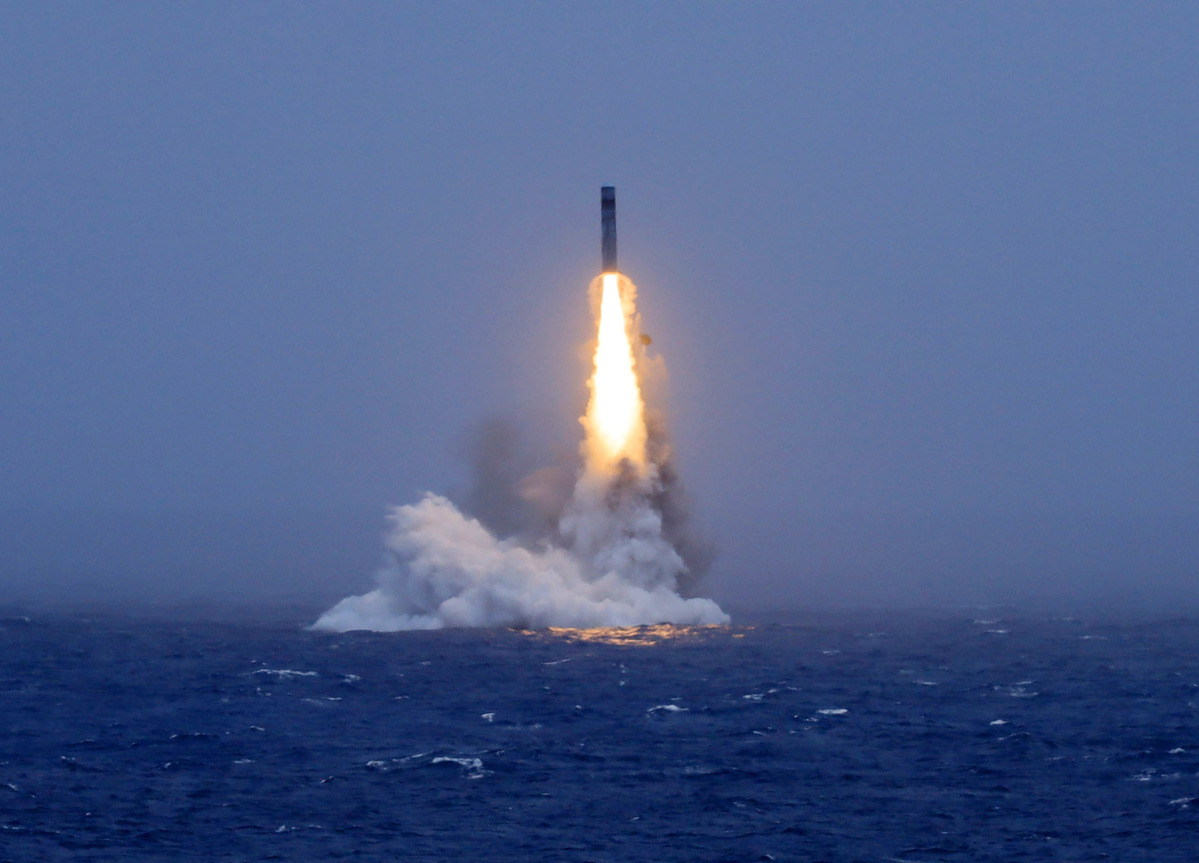
In early July, China successfully conducted a flight test of its nuclear-capable intercontinental ballistic missile, or ICBM, from a nuclear-powered strategic submarine — the first such public trial in nearly four decades — marking the farthest such trial of any Chinese naval missile to date.
The latest missile test and an ICBM test conducted by the PLA Rocket Force in September 2024 have become major symbolic events showing the significant enhancement of the Chinese military's strategic deterrence capability in recent years and its achievement of world-class weaponry and equipment.
The PLA has also accelerated the application of artificial intelligence, unmanned systems, big data analytics and electronic warfare technologies across all branches. The goal is not merely hardware upgrades, but also the building of an integrated combat system that enables precise, coordinated operations across multiple domains, turning technological edge into tangible combat strength.
After years of relentless efforts, the PLA now boasts a great deal of world-class hardware, ranging from stealth fighter jets to hypersonic missiles. Compared with old weaponry, the new types feature greater firepower, stronger protection, higher information-processing capacity and better mobility.
ALSO READ: Forging shields with code
Beyond hardware upgrades, the most profound transformation has been the growth of new-quality combat forces powered by interdisciplinary technologies.
Combat support robots, electronic warfare units and cyberspace defense teams have been integrated into joint operational systems, breaking down traditional service boundaries. AI is now applied in command decision-making, target recognition and logistics planning, cutting response times and boosting operational accuracy. Space-based support systems, including satellite communication and navigation networks, provide a critical information backbone for cross-domain joint operations, turning geographically dispersed forces into a unified, highly efficient combat system.
Wu Peixin, a military affairs observer, said that China has consistently maintained that its national defense policy is defensive in nature, and its military modernization is solely aimed at safeguarding national sovereignty, security and development interests.
"Our armed forces' tech-driven upgrades are not intended for military expansion or hegemony, but to provide a reliable security foundation for China's peaceful development and contribute to regional and global peace and stability," he said.
Contact the writers at zhaolei@chinadaily.com.cn
