

In Gansu's Zhangye Danxia park, nature's palette defies belief and attracts global visitors
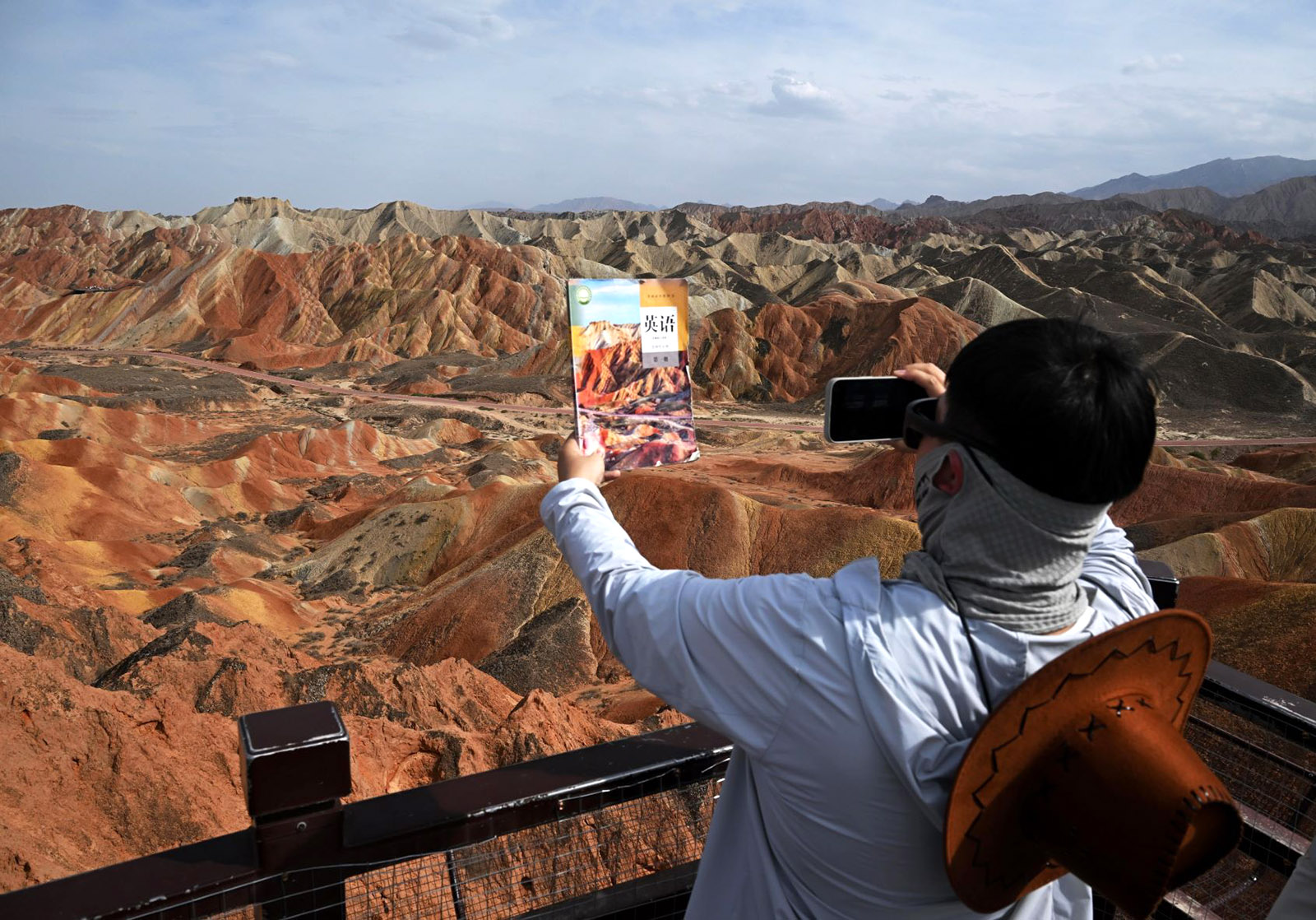
As dawn breaks over the Zhangye Danxia Geological Park in Gansu province, the first light reveals rolling mountains bathed in myriad hues. As the ribbons of crimson, ocher, sage green and pearl gray grow brighter in the morning sun, it becomes obvious why these are known as the Rainbow Mountains of China.
The stunning natural palette looks almost unreal — so much so that on the lifestyle platform Xiaohongshu, or RedNote, the viral refrain is: "Were these painted?"
Photos of the hills taken after summer rains, when the colors deepen dramatically, have drawn millions of views, waves of disbelief and quiet pilgrimages from travelers determined to see the wonder for themselves.
READ MORE: Desert discoveries are a history buff's dream
The landscape was recognized as a UNESCO Global Geopark in 2020. Voted one of CNN's "24 Most Unusual Landscapes in the World" in 2025, the park is renowned for its otherworldly display of colors.
The Chinese name for the landscape, danxia, literally means "rosy clouds". It evokes the colors of the sky at dusk. First appearing in an ancient verse, the term was borrowed by Chinese geologists to describe these colorful landforms, conjuring up an image of the heavens spilling onto the earth.
A hashtag roughly translated as "Nature's Canvas" on social media has seen visitors from across China and beyond posting their own unedited proof of what they saw.
"The landscape is entirely natural," said Li Junling, deputy director of the scenic area's comprehensive management department.
Beneath the multicolored surface lies a geological epic: The thick layers of sandstone and mineral deposits from the time when dinosaurs still roamed the Earth were thrust upward by tectonic forces over millions of years and were then sculpted by wind and rain.
Some 35 distinct colors can be found in the park, each a page from the Earth's own diary — telling the story of a dry season, a flood, a shallow sea — a record of an ancient climate system.
The park, covering around 1,290 square kilometers, also straddles ancient Silk Road routes. Zhangye, known in ancient times as Ganzhou, was a crucial oasis in the Hexi Corridor, where merchants from Persia, Sogdiana and the Mediterranean once rested their camels and traded silk for spices. Centuries later, the Venetian merchant Marco Polo lingered here, describing a city adorned with temples and monasteries.
Today, travelers retrace his route on tour buses, yet the sense of wonder remains unchanged.
Mao Guodong, a Mexico-based traveler who returned to China for a two-month journey to explore its natural wonders, was awestruck.
"The landscape is breathtaking. It's truly one of nature's masterpieces," he said. Understanding how geological forces shaped the terrain turned a sightseeing stop into the highlight of his entire journey.
ALSO READ: Tourists to explore variety of attractions in China
Chloe Choo, a visitor from Singapore, described the landscape as "absolutely breathtaking".
"I could hardly believe these colorful rocks were formed entirely by nature," she said. "The vibrant colors and straight layers look like the Earth painted itself."
Depending on the weather, season and angle of the sun, the views shift continuously, making the park a paradise for photographers. After rains, the colors deepen into jeweled tones; at sunrise and sunset, the hills blush as if lit from within.
For some families, the park serves as an outdoor classroom. At the No 4 viewing platform, Yang Ziwei from the Ningxia Hui autonomous region watched her daughter hold up a textbook — the cover image an exact match for the view before them. "Travel brings knowledge that can't be found in the classroom alone," Yang said.
Contact the writers at huyumeng@chinadaily.com.cn
