

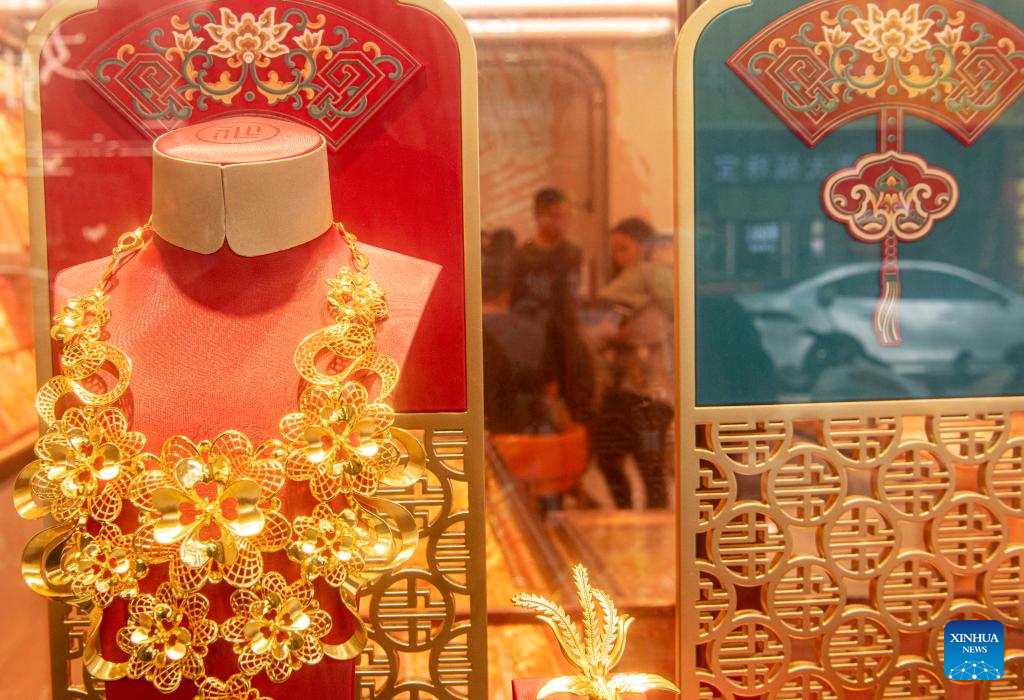
The wave of gold rolling eastward has never been bigger, as Asian markets continued to be the dominant drivers of demand in jewelry and investment through the second quarter despite the global appetite having eased alongside softer prices.
The dynamic coincides with Hong Kong’s two newly launched infrastructures tailored for the gold trade — a government-run central clearing system and a home-market price ticker, HAU. Analysts say the tools add a fresh piece to the global gold trading ecosystem long anchored in London and New York, enhancing Asia’s visibility in real‑time liquidity and supply‑demand trends while paving the way for more new financial products.
Global gold demand, including in the over-the-counter (OTC) market, held steady year-on-year at around 1,269 tons in the second quarter of 2026, according to the World Gold Council’s latest report.
The Chinese mainland and India remained the top two in jewelry demand in the second quarter, together consuming 125 tons — roughly 45 percent of the sector’s total. They also together represented more than half, or about 51 percent, of global demand for investment gold bars and coins, with the Chinese mainland accounting for over 107 tons and India 50 tons.
ALSO READ: Gold flows to Hong Kong hit decade-high before clearing launch
“China remains the largest bar and coin market globally,” the council said. Despite demand dropping in the second quarter from the exceptional 207 tons recorded in the first, the period was still historically strong and helped deliver the Chinese mainland’s strongest first half on record at 314 tons in the first six months of 2026, according to the report.
As for the OTC market, gold demand surged 91 percent year-on-year to 327 tons over the period buoyed by robust Asian investment. Looking ahead, the WGC expects investment demand to stay constructive over the remainder of 2026, with OTC activity and Asian investment inflows playing a bigger role, while gold ETF flows in North America and Europe may be more episodic.
Jia Shuchang, WGC’s head of research (Asia-Pacific, excluding India), highlighted the ongoing eastward tide of gold investment.
“Since 2020, Asia’s share of gold bar and coin investment has continued to expand, while Western markets such as North America and Europe have been steadily declining,” he said, citing Asian consumers’ high demand to use gold as a means to preserve wealth and hedge against global financial uncertainty.
Capitalizing on this booming demand, Standard Chartered Bank (Hong Kong), one of the Hong Kong Precious Metals Central Clearing (HKPMCC) Co Ltd’s provisional direct participants, says it is planning to establish its own gold vault in the city.
READ MORE: HKSAR, Laos ink MoU to foster gold market cooperation
“Clients’ demand has increased, and with opportunities shifting East — which is essentially a matter of risk diversification … They need a comprehensive value chain, so we are certainly actively considering setting up a storage facility,” Mary Huen Wai-yi, chief executive officer for Hong Kong and Greater China & North Asia at Standard Chartered Group and executive director of Standard Chartered Bank (Hong Kong), said on Thursday.
Riding the tide, the Hong Kong Special Administrative Region is pressing to expand its influence in gold trading. In early July, the SAR launched a trial run of its new central clearing system for this precious metal, operated by the wholly government-owned HKPMCC.
Liu Yang, associate professor and co-director at the Wealth Management Academy of the University of Hong Kong Business School, said that while Hong Kong’s gold market remains OTC, the new infrastructure makes “the plumbing centralized, standardized and more secure” compared with previous fragmented practices.
“The central clearing system can make Hong Kong’s OTC gold market more efficient by providing a common ledger, standardized settlement and, potentially, delivery-versus-payment,” Liu said. Delivery-versus-payment is a settlement method that ensures assets and cash change hands simultaneously, so buyers receive gold only when sellers are paid, creating a safeguard against default.
READ MORE: First gold ETF allowing physical gold redemption makes debut in HK
“This should reduce settlement failures, reconciliation costs and unnecessary physical movements, while improving liquidity, transparency and connectivity,” Liu added.
Liu also pointed out that the HKPMCC fits into a broader shift toward a more diversified global commodity-market architecture. He believes the renminbi could gain a larger role in pricing, financing and settlement if more offshore renminbi-denominated products and settlement channels are developed around the infrastructure.
“Over time, the HKPMCC could evolve into a multilateral clearing utility for precious metals across Asia, settling in renminbi as readily as US dollars,” he added.
Aiming to build a more comprehensive gold trading ecosystem, Hong Kong also partnered with Bloomberg to develop a new price ticker, HAU, offering an institutional gold price reference that reflects indicative bid and offer prices contributed by participants in the local market.
Jia said HAU is expected to complement the global gold pricing system and enable supply-demand dynamics to be captured more effectively.
“Investment demand in Asia is continuously growing. Whether for ETFs, gold bars or coins, the establishment of a new regional pricing benchmark will better reflect changes in the global market’s supply and demand dynamics,” the WGC researcher added.
Liu described HAU as a “foundational layer”, likely to spur novel derivatives, structured products and digital assets, fostering a more vibrant financial market.
Using HAU-linked futures, options, forwards, and swaps as an example, Liu said these instruments could allow Asian institutions to hedge against a benchmark that better mirrors regional conditions, thereby reducing the basis risk created by relying solely on XAU, the global gold price reference largely determined by the London and New York markets.
Private banks, asset managers and ETF providers could also create HAU-linked notes, funds and wealth-management products that are more suited to Asian currencies, interest rates and regional investor demand, he added.
Contact the writer at gabylin@chinadailyhk.com
