

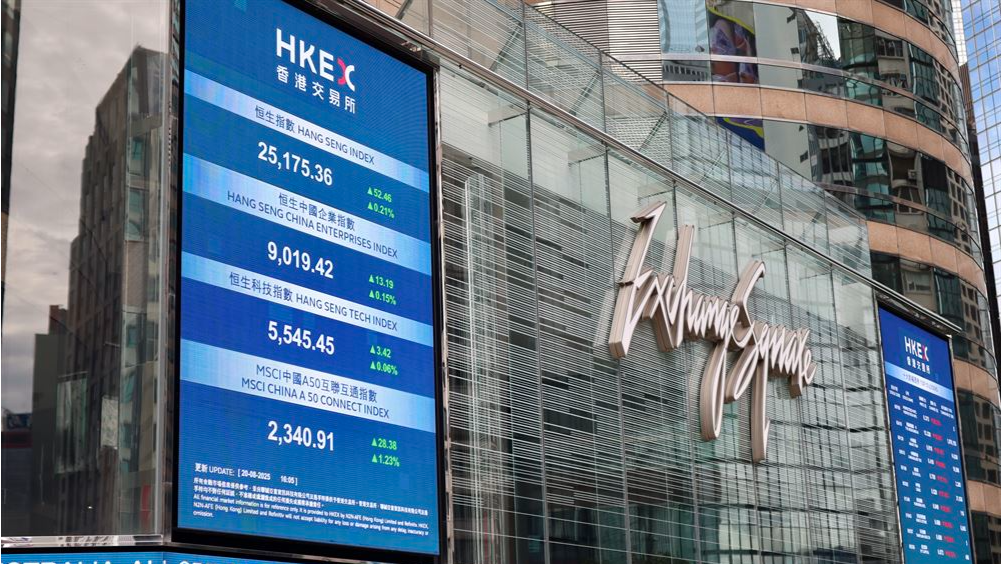
The first gold exchange-traded fund, which facilitates physical gold redemption at a bank, was listed in Hong Kong on Thursday, and the tokenized unlisted fund unit option for this ETF will be launched in the first quarter of this year.
Hang Seng Investment Management, the investment arm of Hang Seng Bank, listed the Hang Seng Gold ETF on the Hong Kong Stock Exchange, which tracks the London Bullion Market Association (LBMA) gold price. With a low entry threshold of a board lot size of 50 units, this arrangement aims to elicit retail investor participation.
Securities and Futures Commission Chairman Kelvin Wong Tin-yau said the SFC welcomes “more innovation to expand market participation and enhance market resilience, and to utilize cutting-edge tools such as blockchain”.
Secretary for Financial Services and the Treasury Christopher Hui Ching-yu said the listing, “represents strong support for this vision and contributes to the growth and innovation of Hong Kong’s gold market”.
“This enables smooth trading, secure storage, and flexible redemption — all conducted entirely within Hong Kong. The exploration of distribution through licensed digital asset exchanges will help bridge traditional and digital finance, unlocking new opportunities,” he added.
The value of global gold demand surged 44 percent year-on-year in the third quarter of 2025, reaching a record $146 billion, Hui said. Gold ETF holdings also rose substantially, climbing 222 metric tons in that period to over 3,800 tons, underscoring robust investor appetite amid geopolitical uncertainties and market volatility.
ALSO READ: HK’s super-connector role in focus at transpacific summit
The Hong Kong Special Administrative Region government signed a cooperation agreement with the Shanghai Gold Exchange at the Asian Financial Forum on Monday, laying the basis to connect the Hong Kong's gold central clearing system with its mainland counterpart.
Investors can redeem physical gold through Hang Seng Bank by selling gold ETF units, with physical gold trading, gold storage and redemption all conducted in Hong Kong. The gold ETF is backed by physical gold held in storage at the Hong Kong International Airport.
Regarding the impact of increased demand on gold storage space, Rosita Lee, director and chief executive of Hang Seng Investment Management, said she expects airport storage facilities to be expanded soon, adding that the bank will communicate with policymakers on the issue.
Gold continued its rally on Thursday, soaring close to the historical high of $5,600 per ounce, and has risen 28 percent this year. The precious metal delivered an investment return of 65 percent in 2025.
Shaokai Fan, head of Asia-Pacific (ex-China) and global head of Central Banks at the World Gold Council, said: “Gold prices have gained strong momentum and reached record highs amid investor repositioning, persistent geopolitical uncertainty, and sustained demand for portfolio resilience. We believe gold’s safe-haven and diversification attributes will continue to attract investor interest as we move into 2026.”
Data from the World Gold Council showed that gold demand hit an all-time high of 5,002 tons last year. Investment demand reached a landmark 2,175 tons and was the main driver behind a record-breaking year.
US-based fund manager State Street Investment Management said that US Federal Reserve easing, robust central bank and retail demand, ETF inflows, elevated stock/bond correlations, and global debt concerns will create structural tailwind forces supporting gold prices this year.
Hang Seng Investment Management says there is a high chance of the gold price remaining near $5,600 in the short term as the market expects the US dollar to be weak, central banks to reduce their holdings of US Treasury bonds, and market concerns about global sovereign debt level.
The fund manager recommends investors allocate 5 percent to 10 percent of their portfolios to gold for risk diversification, but warned that gold is similarly volatile to the equity market.
The gold ETF closed at HK$17.44 ($2.23) per unit on Thursday, 9 percent higher than the issue price of HK$16. The ETF price rose 15 percent at one stage.
