

Artificial intelligence has become an indispensable force in shaping and building business. As Iris Muk reports, the technology has been pivotal in driving drug development from academic feats to commercialization and industrialization in the Guangdong-Hong Kong-Macao Greater Bay Area.
The “double 10 rule” — a decade-long development cycle paired with a $1 billion investment — was what pharmaceutical developers used to have to put up with when creating new drugs.
For Ren Feng — a seasoned scientist who has spent more than 10 years in the field — developing drugs had been fraught with lengthy processes, astronomical costs, and low success rates. The breakthrough came in 2019 when the potential of artificial intelligence in transforming drug discoveries caught his eye.
He immersed himself in learning the cutting-edge technology and built up confidence in the emerging AI-driven drug discovery industry, believing it could significantly accelerate the process while cutting risks.
In 2021, Ren joined Insilico Medicine — a biotech firm that deploys AI to speed up drug development. As the company’s chief scientific officer and co-CEO, he was at the forefront of the evolution.
ALSO READ: Cyberport unveils ‘AI for All’ to drive digital inclusion in HK
Earlier this month, Rentosertib, a drug candidate developed by Ren and his team, entered the third phase of clinical trials, which will involve 320 participants across 47 centers in China and aims to obtain preliminary efficacy results by late 2029 or early 2030, according to Insilico Medicine.
Rentosertib is widely recognized as the first drug candidate for which both the biological target and the therapeutic compound were discovered and designed using generative AI, leading to its identification with the synthesis of only 78 molecules — a stark contrast to traditional methods that typically require synthesizing thousands of molecules to find a viable candidate.
The project took 18 months from target identification to nominating a clinical trial candidate, compared with traditional methods that might take four to five years.
AI accelerates discovery
The advantage of AI-driven drug development is its potential to significantly enhance innovation. Ren says traditional drug development largely depended on the experience and judgment of biologists and chemists, giving long-established pharmaceutical giants a first-mover advantage due to their history and knowledge.
AI-enabled drug development shifts the focus to a data-driven approach, minimizing reliance on individual expertise, Ren explains, adding that with its vast data resources and competitive algorithmic capabilities, China is well-positioned to capitalize on this shift, offering the opportunity to leap forward in addressing more original targets and molecules.
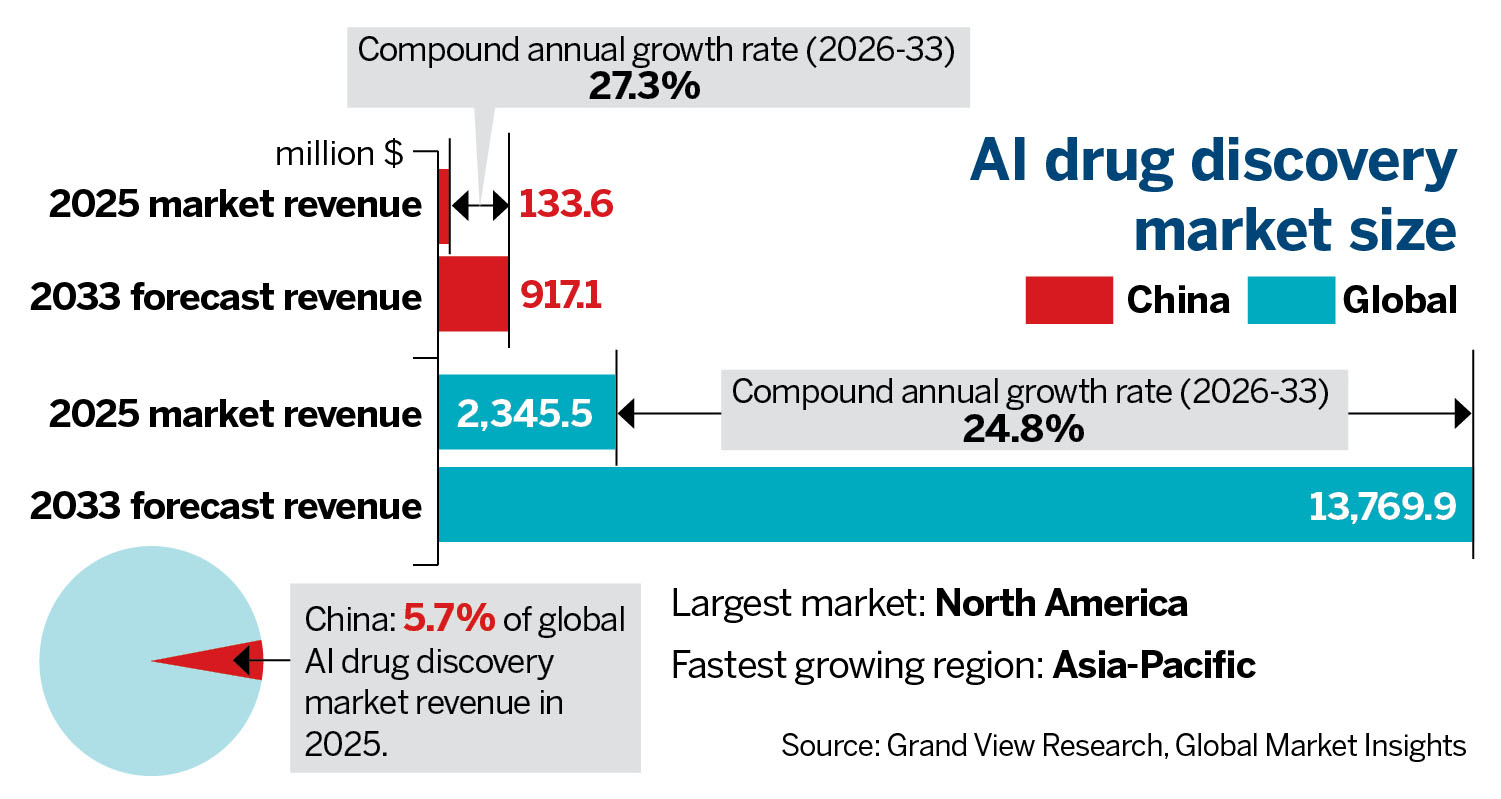
According to United States-based market research and consulting firm Grand View Research, China accounted for 5.7 percent of the global AI drug discovery market last year, generating revenues of $133.6 million — a figure expected to reach $917.1 million by 2033.
The Guangdong-Hong Kong-Macao Greater Bay Area is emerging as a pivotal force in propelling the industry’s transition from academic breakthroughs to commercial success and industrialization, while Hong Kong’s role as a “superconnector” bridges pharmaceutical innovation and global markets.
According to Alex Zhavoronkov, chief executive officer of Insilico Medicine, the company, founded in 2014, opened its Hong Kong branch in 2019 to harness the city’s global connectivity and expedite the validation and implementation of AI-designed molecules.
He says Insilico’s Hong Kong team has played a key role in AI platform development, as well as in drug research and creation, noting that in April this year, it published a research paper, entitled “Target Identification and Assessment in the Era of AI” in Nature Reviews Drug Discovery — a premier monthly peer-reviewed journal covering drug discovery and development.
The research represents a top-tier achievement in finding, validating, and selecting specific biological targets, providing a strategic roadmap for transforming drug discoveries into a systematic, data-driven science while incorporating AI, he says.
According to Zhavoronkov, Hong Kong’s key strengths include its world-class universities and a deep talent pool that create a foundation for collaboration among academia, facilitating enterprises’ speedy integration with the local research and development ecosystem, and accelerating joint research for faster translation into real-world applications.
The special administrative region is also a strategic platform for fundraising and investor engagement that strengthens the global visibility of entrepreneurs. It is a key gateway for international pharmaceutical partners in licensing and collaboration, supported by a mature professional services ecosystem that helps drive efficient execution of deals and partnership progress, he says.
Insilico Medicine went public in Hong Kong last year as the largest biotech initial public offering by proceeds, raising HK$2.28 billion ($294 million).
Sherman Fung — a veteran industry expert and overseas fellow of the Royal Society of Medicine — says that Hong Kong Investment Corp Ltd, as an investor in Insilico Medicine, strategically backs the company as a bridge between Eastern and Western pharmaceutical ecosystems, attracting talent and partnerships that neither framework could sustain by itself.
Hong Kong’s scientific research institutions are increasingly focusing on transforming academic achievements into practical applications and commercial opportunities. Innovative companies based in Shenzhen, Guangdong province, are drawing greater investment and international attention through Hong Kong, the financial hub, thereby hastening research initiatives and their industrialization in the real world.
XtalPi — a Shenzhen-based firm specializing in AI-powered research services for pharmaceutical development — generated revenues of 803 million yuan ($111 million) in 2025, marking a 201 percent increase from the previous year. The achievements make XtalPi the first profitable “AI for Science” company listed on the Hong Kong market.
XtalPi is located in the Hetao Shenzhen-Hong Kong Science and Technology Innovation Cooperation Zone (Hetao Cooperation Zone). “The core value of Hetao lies in its ability to rapidly transform scientific research concepts into real productivity,” the company’s co-founder, Ma Jian, says in a report.
He highlighted Shenzhen’s forward-thinking entrepreneurial policies, demonstrating its commitment to long-term planning and support for research companies, particularly in AI and biotechnology.
While “AI-driven scientific innovation” is being accepted across industries, Shenzhen recognized the strategic importance of cutting-edge technologies like AI a decade ago when such concepts were still in their infancy. The foresight allowed the city to proactively develop its industrial strategy, says Ma.
Ma says he thinks that Shenzhen’s strength in the biotech and life sciences field is driven by the southern boomtown’s financial resources, talent pool, and an efficient supply chain. Such synergy facilitates the integration of advanced manufacturing and digital intelligence, fostering a unique and highly competitive industrial ecosystem. “While others were exploring possibilities, we were able to integrate technology and industry, achieving outcomes,” he says.
XtalPi became the first company to list under Chapter 18C rules on the Hong Kong stock exchange’s main board in 2024.The rules enable high-growth companies in cutting-edge sectors, such as AI and robotics, to go public without meeting traditional revenue thresholds.
Synergy powers innovation
Ma says this landmark achievement not only enhances XtalPi’s visibility among investors, but also offers vital support for building technological advantages. “We’ll keep focusing on creating value by rooting our efforts in the real economy. This involves integrating AI into the heart of industrial operations and tackling major challenges to unlock more industrial value.”
Fung, who is also a Hong Kong-based life sciences content creator, tells China Daily that the Greater Bay Area’s distinctive advantages in global innovative pharmaceuticals are plain for all to see.
In early 2020, China’s State Commission Office for Public Sector Reform approved the establishment of two regulatory centers — the GBA Center for Drug Evaluation and Inspection of the National Medical Products Administration (NMPA), and the GBA Center for Medical Device Evaluation and Inspection of the NMPA. In December the same year, both facilities were registered at the Hetao Cooperation Zone.
Regulatory bodies and clinical approval processes act as critical gatekeepers in the pharmaceutical business, ensuring that medications meet their claimed standards of efficacy and safety. The two centers set up in the Greater Bay Area as a dual-track regulatory gateway aim to strengthen collaboration with the Hong Kong and Macao SARs and speed up the approval of innovative drugs and medical devices, says Fung.
ALSO READ: Analysts bullish on Hong Kong AI infrastructure, internet stocks in H2
He believes that under the “one country, two systems” framework, a drug development pipeline can simultaneously leverage Hong Kong’s international capital markets and legal environment while accessing the NMPA’s two Greater Bay Area sub-centers’ review channels, thereby shortening clinical trial application timelines. “The demand for such an integrated approach is rapidly increasing in the industry.”
Fung sees the integration of AI in drug discovery reshaping the sector in two significant ways — risk mitigation and the economics of rare diseases. By slashing the high costs of unsuccessful trials, companies can avoid investing hundreds of millions of dollars in less productive ventures. Such a reduced risk profile makes the business increasingly appealing to venture capitalists.
In addition, the traditionally low return on investment for rare diseases therapies, or orphan drugs, had been a barrier due to the small patient populations that didn’t justify the extensive research and development costs over a decade. However, AI is changing this narrative by reducing upfront overheads and development timelines, making it financially feasible to create treatments for diseases affecting only a few thousand people.
“It’s transforming into something much more calculated and accessible,” says Fung. While AI has radically transformed the speed and efficiency of drug discovery, human expertise remains the authority in decision-making and research direction.
“Humans decide which AI model is to be used, where to apply it, and what unmet medical needs it ultimately aims to fulfill,” he says.
Contact the writer at irismuk@chinadailyhk.com
