

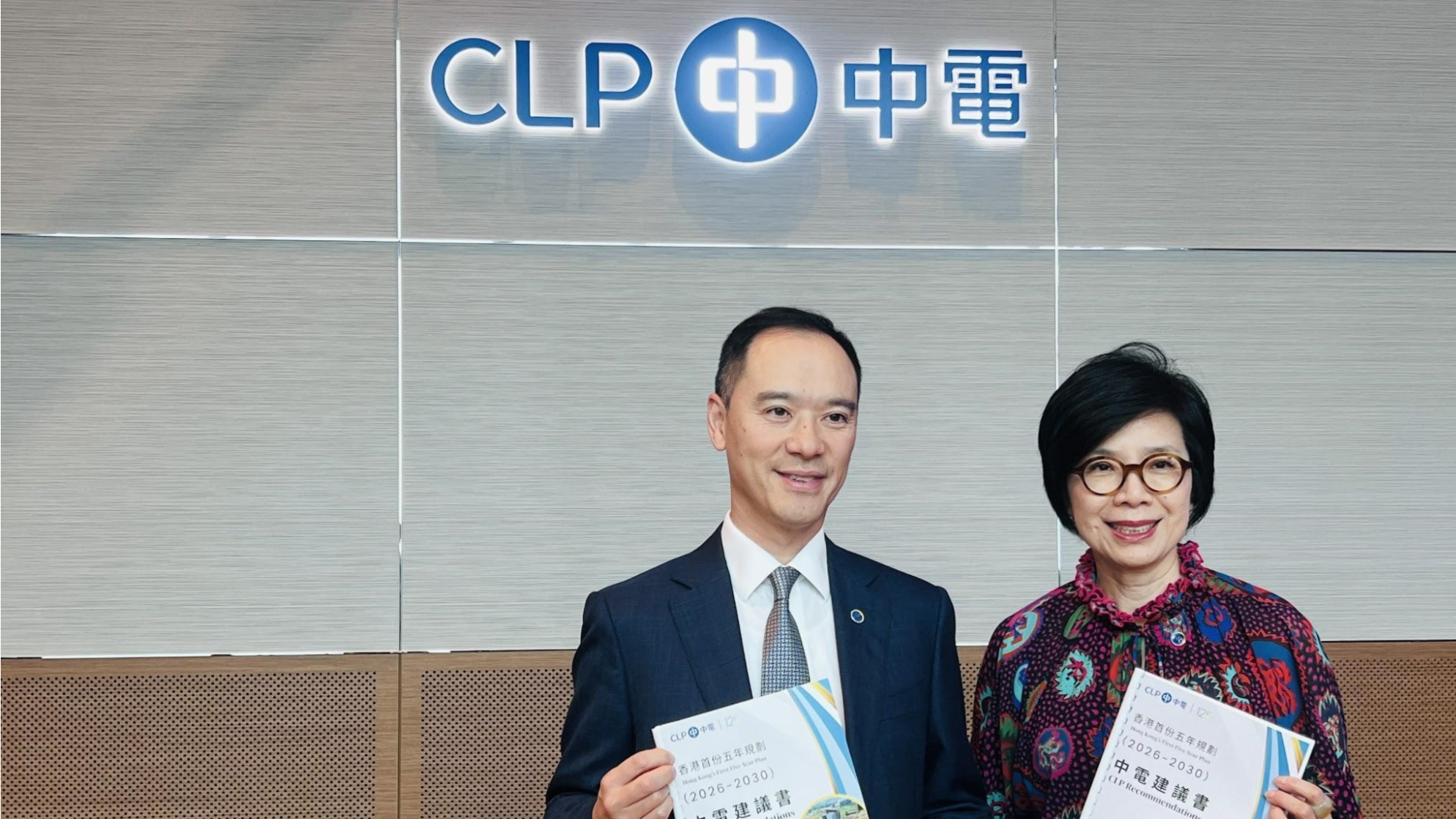
Joseph Law Ka-chun, managing director of CLP Power Hong Kong, is on the show this week to tell us how resilient Hong Kong's power system is today and whether it is ready to power the city into the future.
Check out the full transcript of TVB’s Straight Talk host Eugene Chan’s interview with Joseph Law:
Chan: Welcome to Straight Talk. I'm Eugene Chan. With me is Joseph Law, the managing director of CLP Power Hong Kong. Law has been with CLP since 2001 and has held a number of senior leadership positions, including chief operating officer of CLP Power and being on the CLP Group Executive Committee. So, he's going to tell us how resilient Hong Kong's power system is today and whether it is ready to power us into the future. Welcome back to the show, Joseph!
Law: Thank you, Eugene.
Supply reliability
Chan: Time flies. You were here last August and since then, we have talked about how resilient Hong Kong is to the weather, especially. But if you look at the past months, there have been a lot of extreme temperatures, black rainstorms and even typhoons. So, are we still on the right track to say that Hong Kong's power system is very resilient?
Law: You're right, Eugene. Not only Hong Kong but the world in general is also facing more extreme weather in recent years. I think you might remember from last year we had 14 typhoons that hit Hong Kong, including a record number of five black rain warnings within a very short period of time, which caused a lot of flooding and strong winds that affected Hong Kong. So, I think we can safely say that we would expect extreme weather to be here to stay. And from an energy operator's perspective, we need to be prepared and anticipate these extreme weather will come. And we need to reinforce and make sure our network can be resilient so that we can continue to provide a high level of supply reliability to our customers.
Chan: Joseph, as I know that CLP has always been very proud to say that you have a 99.999 percent sort of reliability. But having said that, maybe you can tell the viewers what you have done to ensure you maintain such a high level.
Law: Yes. We have done reinforcement and resilience preparation in a number of areas. For example, in anticipation of super typhoons on our overhead line towers, we would do reinforcements to make sure that they can withstand stronger wind speeds. On certain low-lying substations where they are more prone to flooding risks, we would install water gates and floodgates to prevent water from coming in. These are on the preparation side. And then on the operational side, we also have used advanced technologies to monitor our network and our equipment. And then also on our emergency preparedness side, on our emergency teams, we have to be more resilient and we have to be more prepared so that we can react to any upcoming threats in a faster way to recover the power faster to our customers.
Chan: Right, Joseph, as we know that for the viewers who have been watching Straight Talk, we know that technology is playing a very big part in Hong Kong's everyday life, especially even in your work. I read that you have sort of AI systems and all these drones and all that to help you. But I'm sure everyone could ask, will there be a limit of what technology can prevent? Because nature is quite a powerful source and there are always unexpected sort of natural power coming through. So, how do you ensure that we are at that secure level?
Law: Yes, Eugene, I think you're right that Mother Nature is … the force is quite … is something that we need to be quite serious in how we prepare ourselves. So, we would use different advanced technologies to increase our preparedness. For example, one system we've put in is called a “Grid V” system, a grid visualization system that would collect data from over 3,000 points to make sure that we have a good handle on how our systems are operating and detect any impending threats.
For example, this “Grid V” system can detect wildfires using AI. So, it does not require anyone looking at the screen constantly. The AI system would detect the wildfire and issue an alert to our operators so that we can take preventive measures to make sure that we minimize the impact to our customers. Another example you also talked about is the use of drones, right? In the old days when drones were not available, we would have to use manual human patrols to make sure that the system is intact either before or after a typhoon. Right now, we can use drones, which can be four times more efficient compared to the traditional method.
Chan: Yeah, let's come back to a recent incident in the Tsuen Wan Centre where there is sort of a power outage whereby I think nearly 1,000 households, not only for hours but actually for days, not only for the lift that are not working, also the, not only the lights that are not working, also the lift and also the power, the water supply is being been affected. I know that the cost has been traced to what we call the customers' owned equipment, but to most residents, the power is out. So, can you explain to us what actually happened and how we can prevent that from happening again? Because I know even at 99.999 percent, having that is something that is out of your control.
Law: Yes, Eugene. I think the Tsuen Wan Centre case is a wake-up call for the whole city. Despite the CLP's electricity supply was normal, what happened was that with the electricity circuits within the building that the building owners have to keep up and maintain, right? And what happened was that on that evening, the internal circuitry, the electrical system of the building inside the building, was out of service. Though the electricity supply going into the building is normal, if the electricity system within the building, going up to each floor of the residence, if they are not in service, then customers are affected.
Chan: Right.
Law: So, this is quite an important wake-up call for everyone in the community in the sense that Hong Kong as a whole, we are facing an aging building stock.
Chan: Right. So, not only are populations aging, the buildings are aging as well.
Law: Of course. So, it requires attention to make sure that the buildings themselves can be resilient to extreme weather. And how can we do that? I think it's a shared responsibility. The building owners, the incorporated owners, the management office, and the property management companies all need to work hand in hand to make sure that the internal electrical circuits of the building can be resilient even in extreme weather.
Chan: Right, so what you're saying is, as normal residents, even if you're in aged buildings, we have to look at all these sorts of aging supplies that could actually affect our livelihood. We just can't rely on the power supply like your good self. So, if I'm going to ask you, where does the responsibility of the power supply end? And where is it sort of, where do the building owners begin? How will you tell the owners?
Law: Right. So, the typical example is like this: if you can imagine a building 30 stories, 40 stories high, right? Typically at the bottom there is a room that takes the power from the CLP side, from the grid, into that room. After that room, then all the electrical equipment feeding the rest of the building up to all the 30 floors or 40 floors, that internal circuitry is the customer installation.
Chan: Right. So, do you think the government should have new rulings to have mandatory regular inspections of such circuits? Is it practical?
Law: I think that's a very good point, Eugene. As you know, electrical circuits, just like any electrical appliances, are like our human body. What we need to do is that we need to have regular checkups to make sure that everything is working fine. And we have to do proper maintenance to make sure that our organs and the electrical circuitry, in this case, work well. And also, if there are signs of aging of any particular components, the buildings need to go about replacing them to make sure that it can be resilient even in very hot weather or very wet weather.
Demand Response implementation
Chan: Right. Let's move on to something else. I mean, we have talked about extreme weather; we've talked about what you have done to prepare for improving the resilience. Beyond that, as you know, Hong Kong's population is growing, the electrical demand is sort of rising. So, especially in periods of extreme heat, everybody's going to turn on the air conditioning and suddenly there's a great surge in power demand. So, how does Hong Kong cope with that? And do we have enough reserve to make sure everything will stay as normal?
Law: In short, yes, we do. And that's really the bread and butter of what we do every day, right? So, as an energy provider, a key part of our process is that we would project the future demand of the city as a whole and make sure that we have sufficient capacity and capability to serve all demands. That's point No. 1. But point No. 2 is that, if you can imagine, we would also want to engage our customers to make sure that in times of extreme heat or near the peak demand of the system, we would want to engage customers to encourage them to save energy so that the total peak demand of the city can be reduced. And that would make the whole electrical system run in a more efficient way.
Chan: Okay, let's go for a short break now. We'll be back with more Straight Talk.

Chan: Welcome back to Straight Talk. We continue our conversation with Joseph Law, managing director of CLP Power Hong Kong. We have talked about building resilience and actually managing peak demand. So, let's take it a bit deeper into managing the high demand. As I've also read up that climate experts predict there’s El Niño that could develop later this year. And that means even a hotter summer and more heatwaves are coming to Hong Kong. So, are you going to expect another even higher demand this summer?
Law: Typically in an El Niño year, heatwaves would become more intense and would be more prolonged. So, yes, we expect the electricity demand would be higher in such years. Now, CLP is well prepared to meet all the electricity demand, even in these extreme weather. So, I think the residents should derive comfort from that.
Chan: Right.
Law: But there's one thing that we do is that we try to engage our customers to reduce their peak demand on these very hot days. The reason for that is that not only can the customers save themselves some, become more efficient in their electricity use, it also helps to increase the efficiency of the electricity system. So, we would have measures; we would engage commercial and industrial customers to reduce their demands, including that they can probably turn off some of their air conditioning or turn off some non-essential electrical equipment in those critical peak hours, right? That will help them reduce their demand. And we also do the same with residential customers through what we call a summer rebate program.
Chan: Right.
Law: So, we give points to customers who actually reduce their demand. In return, then they can use those points to buy different things, right?
Chan: I suppose you are, what you mentioned earlier, I think you're referring to what we call demand response, isn't it? You're trying to get the industry, sort of businesses, to reduce the demand as well. But that seems a bit ironic to the viewers because when we need to make sure the air conditioning is on because it's so hot and you suddenly ask us to turn it off just to reduce the demand. How do you balance the actual needs compared to the actual system?
Law: Well, we can meet all demands. So, just point number one, that's to be clear, don't worry about not having enough electricity supply. That's point number one. But I think if you look at it from a macro perspective, in the whole city, there are discretionary decisions that different parts of the community can make. So, for example, say in a factory in Hong Kong, they can reschedule their production to lower times of, not in the peak time of the year, or in the shopping mall. They can choose to pre-cool the shopping mall before the peak period.
And then during the peak period, maybe turn off several of their air conditioners while keeping the customer experience the same. So, these are smarter ways and more technologically advanced ways to maintain the comfort of the whole city while we can be more energy efficient.
Chan: Then how about for the sort of households? What can they do? I mean, how would they anticipate it's going to be a very hot day coming up? Because sometimes you have to rely only on the observatory to tell us it's going to be a hot day. But sometimes it all depends on which part of Hong Kong you are at. Sometimes it may not be as hot as it is. Sometimes it can be very hot. So, how can we pre-cool our flat?
Law: Well, the comfort is that we don't need to bother the customers every day. What we do is that, typically in a whole year, there will be a few days, actually, and in those few days, there will be a few hours that are extremely stuffy and hot, which would push the peak demand up, right? So, in those days, what CLP would do is that we would engage our customers; we would send out a WhatsApp notice or our customer app notice to alert the customers: “Ah, there is a peak demand day coming up this evening. It would be great if you can participate in an energy efficiency activity and in return you can gain some points”.
Chan: That's a very good way to serve your customers.
Law: Yes.
Northern Metropolis development
Chan: Right, let's move on to another area of interest that we often talk in Straight Talk is the Northern Metropolis development. It's kind of our Hong Kong's growth engine, especially with our 15th Five-Year Plan nationally and also the upcoming Hong Kong five-year plan. I can sort of anticipate that there is going to be even a bigger power demand because a lot of new industries and tech clusters are going to be developed there. I know you've been telling us there's enough supply, but how can you ensure this fast-growing industry sort of won't outpace your development?
Law: Now, yes, CLP has been serving the northern part of New Territories for many years. We have actually enhanced and grown our service from the 1960s, ’70s, and ’80s through a rural electrification program, right? Because that was the time when there was more population moving in and more economic activities. Recently, in the last few years, the government has designated the Northern Metropolis as an even more important economic engine for Hong Kong. So, we have prepared for that even back a few years ago when the government announced it. Right now we have over 20 substations to serve the whole area and we've recently built three more in that area to anticipate the higher demand from residential users, commercial and industrial users, and also technological users such as data centers and supercomputers. So, we are well prepared for that.
Chan: When you mentioned those data centers and supercomputers, which is the kind of future for Hong Kong as well, someone's going to ask you directly; I might as well ask you here, that does it mean that with all those developments, all those extra development costs, would it be passed on to the customers?
Law: I think the whole of Hong Kong, it's a growth engine for the whole of Hong Kong. It would bring value to the whole of Hong Kong. So, I would not be worried about the cost passing through. Because these new technological developments, they would bring new GDP growth, they would bring new employment to Hong Kong. The whole outlook for Hong Kong's future is actually at an even higher level and in a more positive light. So, that's the way that we look at the economic growth in the Northern Metropolis.
Chan: Right. I also read that there's an AI data center like the Sandy Ridge Data Facility Cluster that will consume an enormous amount of electricity. And actually, some cities have delayed or even rejected such projects because of the power grid could not cope. So, maybe you can tell the viewers, you've been reassuring us Hong Kong has been … we're going to have enough supply. So, what advantages does Hong Kong have overall so that we have all this spare capacity for development?
Law: Well, in CLP, we know that the Northern Metropolis development is an important part of Hong Kong and we've done proactive forward planning to anticipate what the future demand is and then make necessary preparations to make sure that we can meet that demand. So, if you look at the data center industry as a whole, I think Hong Kong has a lot of advantages in being a key data center hub in Asia. In fact, according to an independent consultant study, Hong Kong is amongst the top five data center hubs in Asia, along with Singapore, Sydney, and Tokyo.
Chan: Right, that's very encouraging. So, what would you say will be Hong Kong's single biggest competitive advantage compared to other cities?
Law: I think Hong Kong has a number of advantages. Number one, our electricity supply is extremely reliable and it's world-class. It's at world-class standards because data centers need a reliable supply of electricity to operate continuously on a 24-hour basis. Hong Kong also has a very unique role where it has free data flows from international and different areas. It has very good connectivity in terms of broadband and with very good latency, a very short latency. It's less than five milliseconds within Hong Kong, right? So, Hong Kong also has a very mature legal and intellectual property regime so that mainland and international data center operators will have confidence to operate a world-class data center in Hong Kong to serve their needs.
Energy security
Chan: Joseph, I'm going to ask you a last question, but it has to be very brief. Something I'm sure in the bigger picture we worry about is energy security. With all these geopolitical risks, especially in the Middle East, how exposed is Hong Kong and how worried should we be? Because it looks like all our fuel prices have been increased quite tremendously. So, do you see that cost will sort of eventually come down?
Law: One thing to note is that Hong Kong is a net energy importer. So, when there are energy crises like the ones we've seen in the past few months, it not only affects Hong Kong, it affects all the energy-importing jurisdictions that rely on these energies. But Hong Kong has a strong foundation and the reason why is that we at CLP have adopted a deliberate fuel diversification strategy. What that means is that we have allocated our fuel sources between different fuel types. We have coal, we have natural gas, and we have zero-carbon nuclear.
Chan: So, Joseph, sorry, we have to leave it there.
Law: Okay.
Chan: And thank you very much for that fascinating explanation to us. I'm sure the viewers will be assured. As we have heard, powering a resilient, future-ready Hong Kong means reinforcing our grid and also making smarter use of energy, something we all have a role to play.
Have a good evening and see you next week.
