

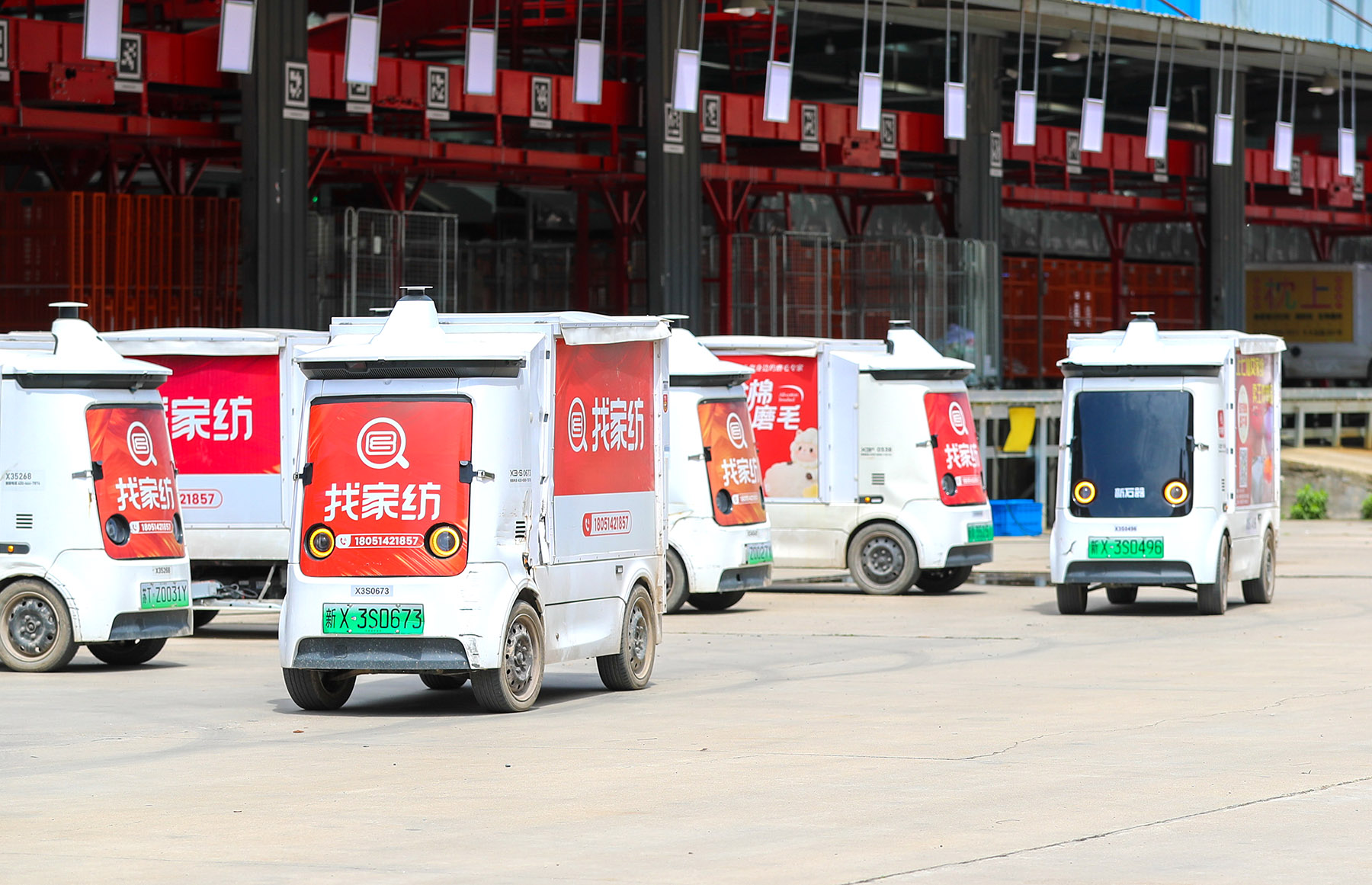
Automakers are entering the unmanned delivery vehicle market, with many launching products this year. Experts predict 2026 will be a watershed year as self-driving delivery technology evolves from early trials to profitable commercial operations.
Data from the China Communications and Transportation Association shows the nation's unmanned delivery fleet surged to 47,000 units in the first quarter of 2026, up from just around 10,000 units in 2024, with over 100 cities permitting these vehicles on public roads.
Zelos led the market with a 53.2 percent share and 25,000 units in operation, followed by Neolix at 36.2 percent and 17,000 units.
READ MORE: WeRide ramping up driverless mobility operations abroad
Soochow Securities projects the national fleet will exceed 100,000 units by the end of 2026.
Collaborating with leading players has become the primary strategy for traditional automakers to accelerate their presence in the sector.
Dongfeng Motor debuted its unmanned logistics brand Open-VAN earlier this month, alongside four Level 4 robovans covering cargo volumes of 2 to 60 cubic meters and loads from 1 to 13.6 metric tons.
All models feature highly automated driving technology jointly developed with Zelos, with a cumulative operational validation of over 130 million kilometers.
Dongfeng secured over 4,000 orders from eight partners including China Logistics Group at launch, with the first deliveries scheduled for August.
GAC Commercial Vehicle reached an agreement with Neolix in March and rolled out RoboTruck, RoboVAN and RoboBUS platforms that can serve trunk logistics, urban delivery and urban passenger transport at the Beijing auto show in April.
The X6T, the first unmanned logistics vehicle jointly developed by the two sides, debuted at the show. It focuses on urban last-mile delivery and branch logistics, featuring a 6 cu m cargo space that combines high load capacity with long-range capabilities. This makes it suitable for express delivery, cold chain logistics and supermarket supply.
The automaker plans to launch 3 and 6 cu m unmanned logistics vehicles in 2026 for urban deliveries, and introduce 12 and 20 cu m models in 2027 to cover all logistics scenarios.
Startups including Zelos and Neolix have dominated the sector with mature algorithms and operational data, yet they are constrained by insufficient mass-production and supply chain capabilities. Traditional automakers make up for these shortcomings through solid R&D experience and mature manufacturing systems, turning experimental prototypes into market-ready products at scale, experts said.
"Let vehicle specialists build the cars, and L4 experts safeguard them," Zhou Qing, co-founder of Zelos, said at the OpenVAN's launch.
Changan LCV has cooperated with JD Logistics to develop robovans, which have completed full-scenario validation and achieved mass delivery in April. The automaker has established 820 service stations and over 3,000 rescue points nationwide, providing support for large-scale operations.
Meanwhile, Wuling's subsidiary, Guangxi Yuankong Zhiqu, rolled out its first batch of mass-produced unmanned logistics vehicles at the end of May. These vehicles are designed for urban last-mile delivery, material transfer within industrial parks, restocking for supermarkets and community deliveries, catering to various short — to medium-distance logistics scenarios.
Robovans have demonstrated prominent cost-saving value. A ZTO Express outlet in the Guangxi Zhuang autonomous region cut delivery costs by more than 50 percent by deploying 12 Neolix robovans to handle 70 percent of local transit cargo, also solving the widespread shortage of night-shift couriers.
ALSO READ: Nvidia works with Chinese automotive giants to accelerate self-driving vehicles
Beyond logistics, such vehicles are expanding to public service scenarios, including municipal sanitation and medical transport. Nationwide, 24/7 unmanned cleaning vehicles have been deployed, each replacing three to five sanitation workers and reducing costs by more than 40 percent.
A new national regulation targeting L3 and L4 autonomous vehicles will take effect on July 1, unifying nationwide rules on road access and accident liability. The policy is expected to eliminate fragmented regional regulations and clear obstacles for large-scale commercialization.
Li Keqiang, professor at the School of Vehicle and Mobility, Tsinghua University, noted unmanned delivery is the most commercially viable use within smart connected technology, with the potential to be the first to achieve a complete commercial loop.
Zhang Tao, professor at the Department of Automation, Tsinghua University, predicted China's unmanned delivery vehicle demand will hit 1 million units by 2030, creating around 5 million tech-related jobs.
Contact the writers at caoyingying@chinadaily.com.cn
