

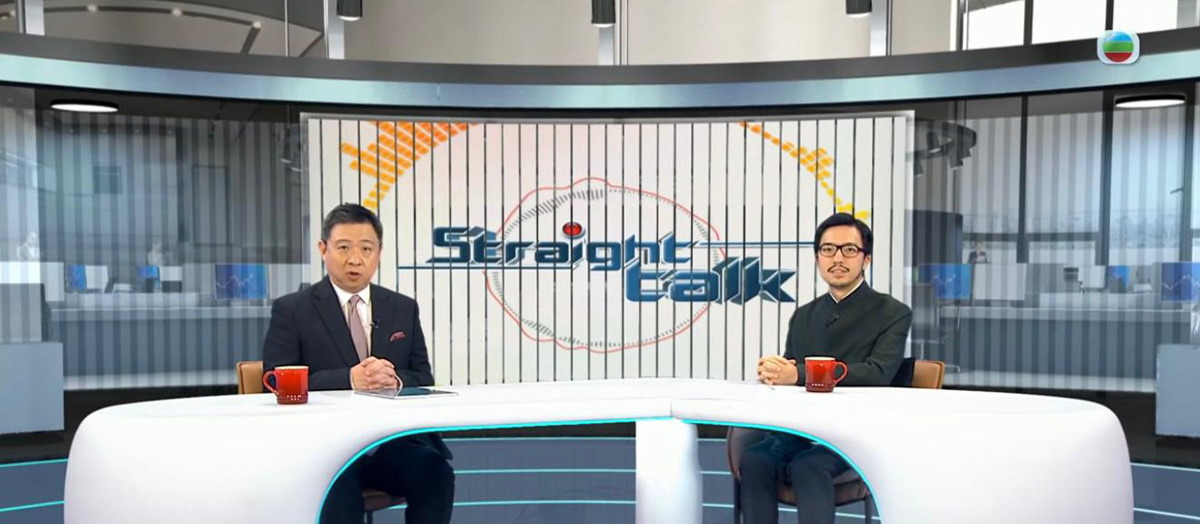
Chan: Welcome to Straight Talk. I'm Eugene Chan. This evening, we welcome back Commissioner for Belt and Road, Nicholas Ho, to the show. Appointed in 2023, Ho has extensive private sector experience as an architect involved in Belt and Road projects, including Smart City Development and Green Building initiatives. He has also represented Hong Kong, China on the APEC Business Advisory Council, bringing available regional and international perspectives to the role. Commissioner, welcome back to Straight Talk.
Ho: Thank you for having me again.
HK’s Belt and Road Strategy
Chan: You've joined us before, right at the start of your tenure, like nearly three years ago. For viewers who are less familiar with the Belt and Road Initiative, maybe it's a good opportunity for you to explain to us briefly what exactly Belt and Road is and what your job is.
Ho: So, the Belt and Road Initiative, first started back in 2013, has now become one of the largest international cooperation platforms with five main objectives.
Chan: Right.
Ho: Different types of connectivity such as infrastructure, trade, finance, people-to-people, and so on. And for us, the Belt and Road Office in Hong Kong, we have three main jobs. The first one is to coordinate the entire government in terms of its Belt and Road policies. So, we work with, and we coordinate with all 15 bureaus on how we can implement these Belt and Road policies and directions. Second is that we work with the central government and work with governments of Belt and Road countries to see how and what we can work on together. So, a lot of coordination there.
And third is because we are situated at the Commerce and Economic Development Bureau, our office also has our own flagship events and flagship programs, such as the annual Hong Kong Belt and Road Summit. We also have numerous outbound missions every year. And of course, we have the Belt and Road Capacity Building Platform to do standards interoperability as well as project-led approach mechanisms to see how Hong Kong can play a bigger role.
Chan: I thank you for giving us a very brief sort of bird's-eye view for the viewers. So, for most people, I would say I'm sure many have heard of the Belt and Road initiatives, but not many people actually can feel it. Since you mentioned it started in 2013, how has the whole Belt and Road initiative developed, especially amidst the geopolitical developments, especially until today with Hong Kong strategy? Has our strategy changed, or are we sort of getting better at it?
Ho: You're absolutely right. So, the initiatives started back in 2013. A lot of it is about building large-scale infrastructure connectivity and also policy, major policy initiatives to ensure that different Belt and Road countries, provinces and cities are seamlessly connected.
With these efforts in place, now in the golden decade, we're in the right time to pursue bankable, market-driven, commercially viable projects. And that is why, since the 10th anniversary of the Belt and Road Summit three years ago, the Hong Kong (Special Administrative Region) government has taken a much more pragmatic, much more specific approach to see how we can quantify and realize these Belt and Road opportunities. And of course, through our office, we have been coordinating multiple policy areas.
Chan: Another thing, the chief executive, he mentioned we have emerged as the superconnector into a super value-adder. So, what is the value added?
Ho: In a way, our position and strategy have been trying to accumulate or converge Belt and Road capital, talent, professional services, opportunities and events – all in Hong Kong. So, making Hong Kong the ideal resource hub for Belt and Road.
Chan: Since you mentioned that, I've been thinking: when you're telling us what Hong Kong can do, we know that the Belt and Road initiatives are sort of driven strongly by our mainland government. Where is our value? Because they can directly relate to those countries. What is Hong Kong SAR's value-added thing, as you just said, specifically? Because there are many regional, financial, or other logistical hubs as well. How do we do that?
Ho: Absolutely. So, riding on the unique advantages of Hong Kong under “one country, two systems”, of course, as an international financial center and trade and shipping center, we can empower a lot of Belt and Road projects to deliver high-quality development.
But, more importantly, now that we're in the golden decade, what we call the second decade of the Belt and Road Initiative, because of the first phase, we're seeing that a lot of market-driven, commercially viable, small and beautiful projects are now possible because of those massive infrastructure projects done.
Imagine in an area, in a country, they have incredible natural resources, right? Incredible economic potential, but they don't have railways, they don't have airports, they don't have seaports, they don't have electricity, they don't have water.
So, even if a city or country has that much potential, it still cannot be unlocked, especially cannot be unlocked through public-private partnership. But because of the work done in the first 10 years, now Hong Kong has a much more important role, I would say, as the public-private partnership hub, a PPP hub, in order to deliver market-driven projects.
Chan: Right, Nick, so what you're saying is, I kind of recall when we first had you on the show, like nearly two and a half years ago, you're just a few months into the job. Looks like you can feel a lot more has happened in progress in the last few years under your term. Can you even be more specific about, in terms of policies, trade and investments, what have you seen sort of being materialized in the last three years, so that the viewers would say, hey, this is something where we're getting some results from ongoing?
Ho: Yep, absolutely. So, on the policy side, we have been speeding up the process to sign more FTAs, more investment promotion agreements, more visa-free arrangements with Belt and Road countries, where the sole goal is to lower the threshold for cross-border business, especially for SMEs. In the past few years leading up to now, we have signed FTAs, free trade agreements, with 14 Belt and Road countries. We have signed investment protection promotion agreements with close to 20 Belt and Road countries.
And comprehensive avoidance of double taxation, which is very important for a lot of SMEs. We've signed agreements with almost close to 40 Belt and Road countries, visa-free agreements with more than 110 countries, direct flights, cargo passenger with close to 60 destinations. So, what did it all yield? All in all, we're seeing two phases. In the first phase, from 2013 to 2023, Hong Kong's trade with Belt and Road countries has surged close to 80 percent. And this growth is three times the average growth, our average trade growth, meaning Belt and Road markets is gaining a much faster growth rate than the normal mature developed markets.
And the second phase that we've seen is from 2024 to 2025, in a single year, Hong Kong's Belt and Road trade with Belt and Road market countries has surged 17 percent to 2.5 trillion Hong Kong dollars in a single year. So, we're seeing that this upward momentum, this trajectory, will continue. And that is why, I think, apart from trade, we will also continue to work across other areas.
Chan: Right. So, Commissioner, maybe that's the reason President Xi Jinping said that it's into the golden decade, because I'm sure in the past, I think a lot of emphasis was on government-to-government sort of infrastructure investments. So, now it's sort of filtered down to SMEs, as you've just said.
Ho: Yes, absolutely. And a lot of international public-private partnerships. And Hong Kong being an international financial center, we aggregate resources globally and then we can deploy into these quality projects.
Why Central Asia matters
Chan: See, last week the chief executive announced there would be a delegation organized by your office to Central Asia, namely Kazakhstan and Uzbekistan. So, what is the purpose of this trip? Is it riding on the successes, as you said, the tremendous growth even in one year alone? Is that why we're going?
Ho: The chief executive in this term has led multiple delegations to ASEAN, to the Middle East, and this year to Central Asia, where the sole focus is to open up new markets, new emerging markets where the opportunities and the conditions are mature. And in the first year, the Chief Executive led delegations to ASEAN and then the Middle East. And we feel like Central Asia is now getting more and more mature. And their governments are extremely committed to opening up to international investors and to partnering with Hong Kong. And I think because of this background, we see there are a lot of momentum, a lot of opportunities that Hong Kong can also invest in.
Chan: And I'm sure another area that people are going to ask is that Hong Kong is a very good connector. If you read what President Xi recently has said about mainland companies going globally, there's a role. And I say that in the delegation list, there are a lot of mainland companies. Is that exactly what we're doing?
Ho: Absolutely. From the 15th Five-year Plan, it's mentioned how we can assist and empower quality companies to go global. And of course, Hong Kong is the ideal hub. And you mentioned why Central Asia. So, when we look at Central Asia, overall, it has a population of 80 million people. Kazakhstan accounts for 60 percent of the GDP of the entire region, with a 20 million population. And its GDP growth last year was 6 percent. So, it's a fast-growing open market. And of course, Kazakhstan has a special place in my heart because it was where the Silk Road Economic Belt was first raised by President Xi, which became the Belt and Road Initiative.
Now, Uzbekistan is the most populous country in Central Asia, close to 40 million, right, 38 million people, with 60 percent of their population under the age of 30. So, it's a young, dynamic workforce. And it is also an important hub of the ancient Silk Road. And last year's its GDP growth is north of, is more than 7 percent. So, it's also a fast-growing region. That is why I think this delegation going to these two countries can capture a lot of potential opportunities.
Chan: Nick, let's go to a short break now. We'll be right back.
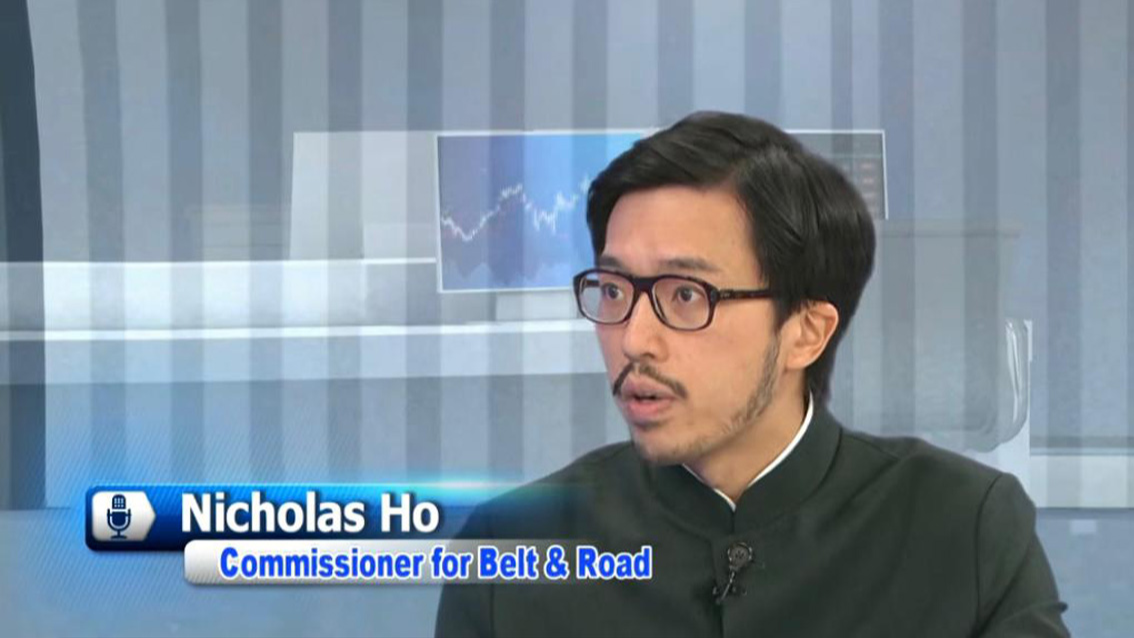
Chan: Welcome back to Straight Talk. We are talking to the Commissioner for Belt and Road, Nicholas Ho, about how he is strengthening Hong Kong's role as a functional platform in the Belt and Road initiatives and the opportunities that it brings to businesses and people in Hong Kong.
So, Nick, thank you very much for explaining to us the background of Belt and Road and what has happened in the last few years. And it's really exciting, especially when you hear that our volume of businesses actually has actually seen increases, especially in the last year. Is that why we're shifting now? Because we used to be a superconnector, meaning connecting the rest of the world to the mainland. Now, when you see super-value adder, does it mean that now also we call this going to be a hub to hub, sort of a new role for Hong Kong? Have I got that right?
Ho: Absolutely. So, being a superconnector is both ways, right? International through Hong Kong to the Chinese mainland and vice versa, a two-way flow. But super-value adder envisaged that there is value creation in the process. Value creation for Hong Kong SAR, value creation for our motherland, value creation for all the stakeholders along the Belt and Road. And what I mean by that is that if a company comes to Hong Kong, they can get the right financing option, the right professional services, the right dispute resolution solution that can help them mitigate risk or help them gain a better brand or sell for or command a higher price.
That is where the value creation comes in. So, I do believe that Central Asia is an important region. And in the past few years, in fact, our office has been growing the potential opportunity and project list with Kazakhstan and Uzbekistan. And we see that Hong Kong has a role to play in terms of structuring the right projects that can create the right value for both sides.
Chan: Right, Commissioner. I'm sure you have now stirred up the interest of the viewers in these two great Central Asia countries. So, what opportunities are there that you can see? Say, for example, the viewer said to Commissioner, right, sounds good, let's go and invest there. What will be the areas that we can collaborate? I think we discussed earlier, it's not going to be something like real estate; it will be something else. What will be the areas that you think we can actually help them, support them, and we get some good profit out of it?
Ho: I think there're five areas that we can work together on. First is financial services, especially working with their mining companies, working with their natural resources companies and commodity exchange.
Because both countries in Central Asia has fast natural resources and traditionally they look elsewhere for listing IPO or issuing bonds, so on and so forth. And increasingly they're looking at Hong Kong, and some of the projects actually landed in Hong Kong recently. And I think that is definitely one of the key areas that Hong Kong can help add value.
Second is green development. Both countries, in fact most of Central Asia, has an ambition to achieve carbon neutrality, but they neither have the capacity or the knowledge or the experience to do it. So, Hong Kong, given that we have a comprehensive green engine ecosystem, we have the green finance, we have the green technology and industries, green services, and also green standards that's internationally aligned. So, this platform can help empower Central Asia to get there faster, whether it is solar, wind, battery technologies, hydrogen, so on and so forth.
Third is the digital economy. They also have a target to achieve AI and digital development. And Hong Kong, given that we have a mature data center ecosystem, from financing to construction to operation to the highest international standards. And at the same time, we also have a vibrant startup community in fintech, in digital technologies, or digital logistics.
So, these kinds of components is exactly what Central Asia wants. In fact, a lot of the Central Asian students in Hong Kong, they said they don't have digital payments and they don't have digital basic online or e-commerce or digital services. And this is something that they hope Hong Kong can help them with.
And of course, fourth, I do believe tourism. Tourism is a big thing because Central Asia has a lot of beautiful scenery, a lot of hidden tourist assets and treasures, but they cannot be unlocked unless they have tourism infrastructure such as five-star hotels, tourism products, delegations or tourist groups going there. Otherwise, it cannot be unlocked. And lastly, education. In fact, Central Asia has many talents, and many of them look to Hong Kong to study at universities. So, I do believe that this is also one of the ways that we can lead to building a shared Belt and Road talent pool.
Chan: Commissioner, thank you for sharing the five areas that we can look at. I mean, people in Hong Kong are more sophisticated. While there are opportunities, they are also aware of the complexity of it because of the background or history of Central Asia. So, what will be the sort of the so-called barriers, practical barriers that you could see for Hong Kong companies to enter the market and be able to do well and bring profit home?
Ho: Absolutely. So, I think understanding a new market is always difficult. And in a few weeks when the chief executive leads a delegation with both mainland and Hong Kong SAR companies, I think this will open up big doors on a G2G level. At the same time, private companies, chambers, they can find their counterparts and build a mechanism to connect with.
Apart from government-to-government connectivity, we can build chamber-to-chamber, business-to-business activity. And I think one of the things is, apart from building that awareness and mechanism, is that for the risk involved, if the Chinese companies using Hong Kong to go global, working with Hong Kong companies and using Hong Kong's unique advantages as the finance, trade and shipping center, together as a consortium model, we can lower the risk of entering into new markets and have an improved appetite to enter into new markets because it's about complementary with each other.
Financial focus
Chan: Commissioner, you know, Hong Kong, one of our strengths is in our financial markets. I'm just thinking, do we have a role of sort of facilitating financing or even settlement in Belt and Road project, particularly in Renminbi usages? Do you see Central Asia as a potential growth area for reminbi usage where Hong Kong can play even a more direct role?
Ho: Absolutely. So, in the past few years, the Hong Kong financial market has been actively participating and innovating Belt and Road financial products. To give you an example, last year, you know, Hong Kong had two major milestones with Central Asia.
The first one is that the Development Bank of Kazakhstan raised a 2 billion RMB dim sum bond in Hong Kong. And this was significant because this was the first ever Central Asian entity to issue a RMB-denominated bond. And they chose Hong Kong to issue dim sum bond.
Secondly, last year, a Kazakh mining company did a simultaneous listing, both on the Astana International Stock Exchange and HKEX at the same time, building on that financial connectivity between the two regions.
Building long-term connectivity
Chan: So far, we've looked at all the financial possibilities and opportunities, and especially I think one thing that strikes me the most is the age of the population that will be our talent pool for Hong Kong's future because we need younger people, a younger population. I'm thinking even to think of making it more sustainable. You need more than just finances; you need your cultural thing, you need your people-to-people connections. Are you working on that as well?
Ho: Absolutely. In fact, this is one of our major focuses because people-to-people bonds are the fundamental element for long-term cooperation. It builds mutual understanding, mutual trust and respect, and that is essential for long-term business planning.
Now, in terms of people-to-people bond-related work, in Hong Kong every year we welcome close to 5,000 students coming in from Belt and Road countries to study at a university in Hong Kong. Some of them are supported by our Belt and Road scholarships.
And in fact, 10 percent of them, just over 500, actually come from Central Asia. So, we already have a significant portion of Kazakh and Uzbekistani students studying here in Hong Kong. And at the same time, building on that youth connectivity, placing them in internships, doing more exchange for Hong Kong youth to go to Belt and Road countries to do exchange. That's also part of that program. But at the same time, we also want the Hong Kong community to better understand the wide spectrum of Belt and Road cultures. And that is why we also have different cultural programs such as Asia Plus, which lasts for three months every year with 40-plus Belt and Road countries showcasing their culture through seminars, concerts, performances, dance, workshops, and a fun fair at the end in November.
And of course, throughout the year, our office also supports different B&R-related events, such as the Belt and Road Concert by the Hong Kong Phil, such as the Silk Road Concert by the Hong Kong Chinese Orchestra; all in all, we want to build a wider spectrum for the community to understand and build that mutual understanding. And of course, riding on the scholarships and the students, together we hope to build a shared Belt and Road talent pool.
Chan: Right. Commissioner, I'm going to ask you the last question. When I've sort of seen Hong Kong being Asia's events capital with all these events coming, how do you see all these events fitting into the actual overall development for Hong Kong's future, especially working with other countries?
Ho: Absolutely. So, a lot of these events right now coming in, we're seeing a growing proportion coming in from Belt and Road countries. For example, you mentioned sports, culture, arts. Apart from that, we also have trade shows.
The largest technology expo in Saudi Arabia called LEAP, they chose to come to Hong Kong as their first global edition, the first LEAP event outside of Saudi Arabia. They chose to come to Hong Kong, called Leap East. That means Hong Kong have that global road show impact.
Chan: I'm afraid that's all the time we have and thank you very much, Nick, for sharing with us your insights. As the Belt and Road enters a new phase, Hong Kong's role lies not just in finance and trade, but in building the connections, economic, cultural and human, which sustain long-term partnerships across that region.
Have a good evening and see you next week.
