

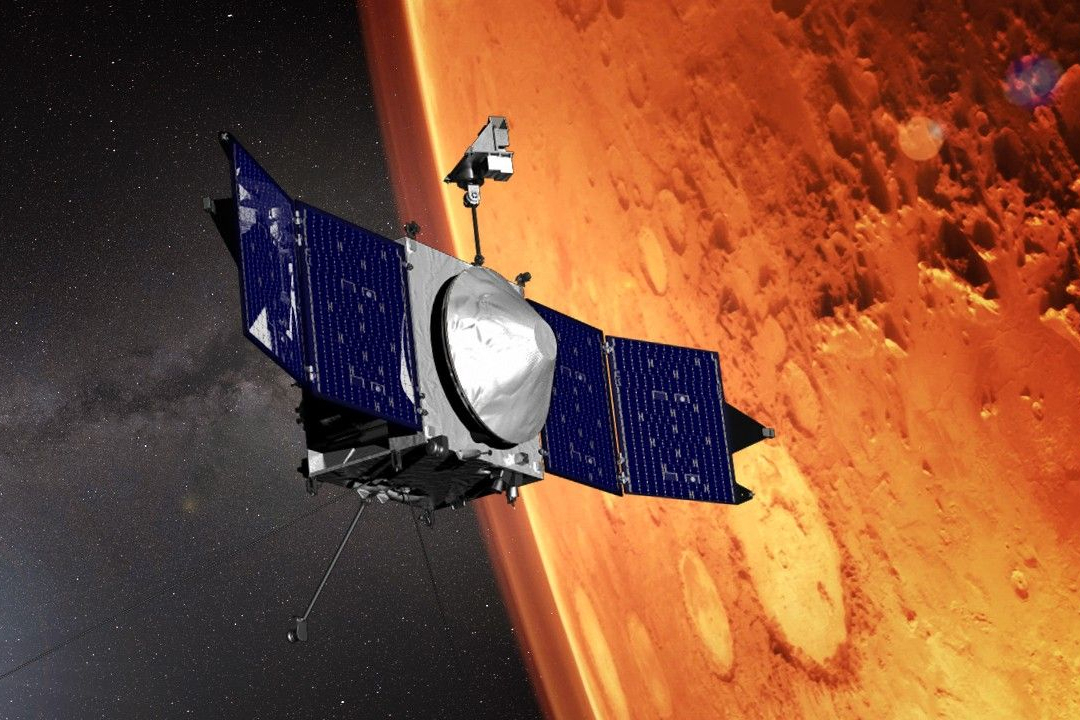
LOS ANGELES – The Mars Atmosphere and Volatile Evolution (MAVEN), NASA's first mission devoted to observing the Martian atmosphere and its evolution, has officially come to an end after losing contact with its spacecraft last December, the agency announced on Wednesday.
Blasting off on Nov 18, 2013, the spacecraft entered Mars' orbit on Sept 21, 2014. Originally designed for a one-year primary mission, the spacecraft operated at the Red Planet for more than 11 years and exceeded its planned mission life by more than a decade, according to NASA.
The spacecraft was last heard on Dec 6, 2025, when it experienced an unexpected loss of signal after it passed behind Mars.
NASA convened an anomaly review board in February to evaluate recovery efforts and assess the spacecraft's condition.
The review board has determined that the MAVEN spacecraft is not recoverable, and it is no longer capable of performing its science and data relay mission, which is consistent with the mission team's findings, NASA said.
ALSO READ: Artemis II crew heads back from Moon as NASA releases first flyby photographs
Preliminary findings suggest the spacecraft entered a high-rate rotation after passing behind Mars, disrupting its orbit trajectory and eventually draining its batteries. The resulting loss of power to the communications system left MAVEN unable to contact Earth.
The agency noted that the root cause of the anomaly remains under investigation, and a final report is expected later this year.
NASA has begun the formal process of decommissioning the mission, following standard procedures to archive the full mission dataset for the science and exploration communities.
"The science MAVEN has given us is key to informing what kind of radiation protection and safety measures we must take before sending humans to Mars," said Louise Prockter, director of the Planetary Science Division at NASA Headquarters in Washington.
