

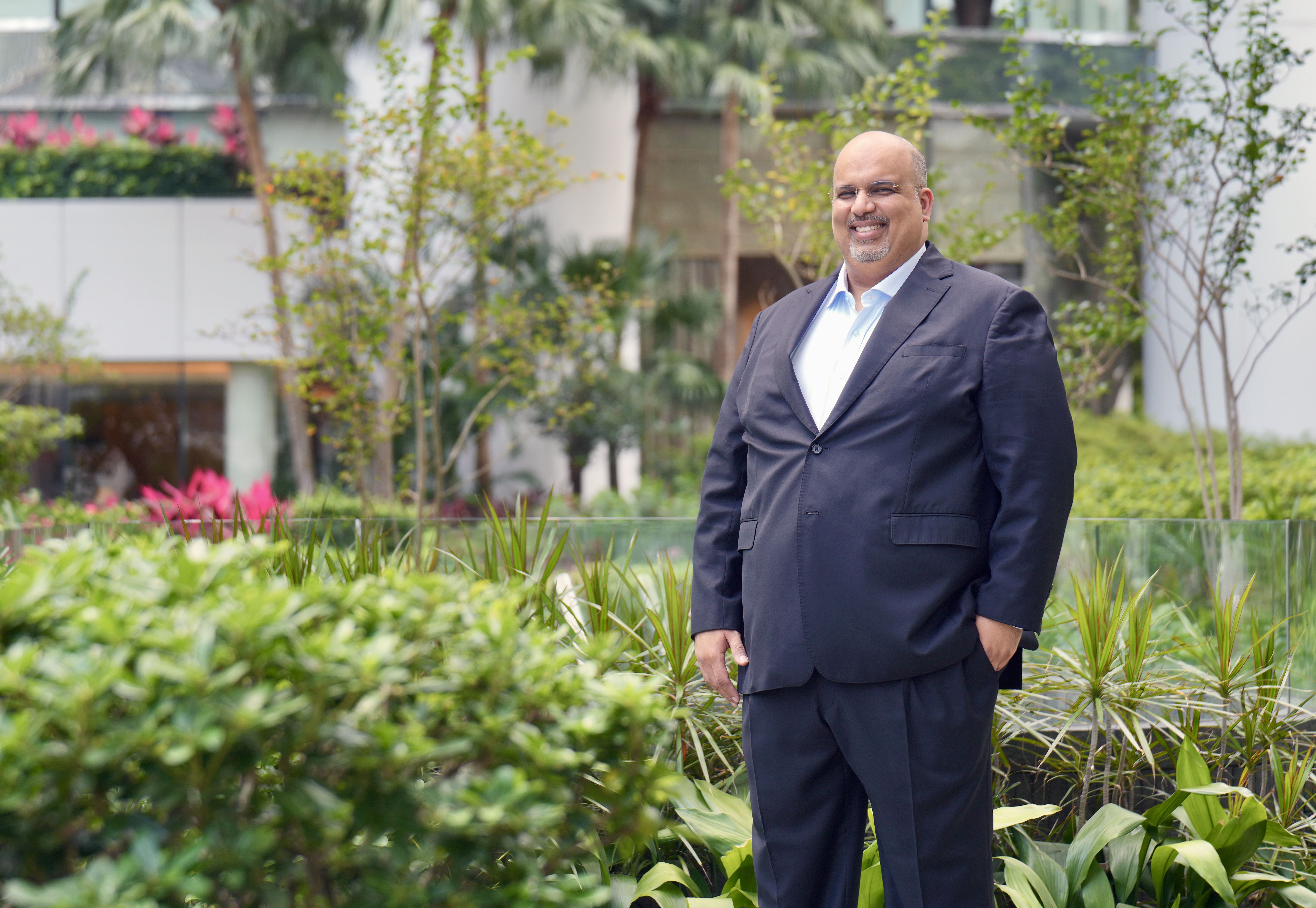
Saudi Arabia-based renewable energy and water desalination developer Acwa plans to accelerate its $30 billion investment program in China this year, with a major push into seawater desalination projects in northern cities to secure an early lead in what it sees as a nascent industry in the country, a senior executive said.
Investment in renewables is doing well, Acwa China President Saleh Khabti said in an exclusive interview with China Daily on Wednesday in Hong Kong. The company has secured a growing number of greenfield project quotas while also pursuing acquisitions of existing assets, several of which are in late-stage negotiations, he said.
“We should see a big jump this year compared with last year,” Khabti said, adding that more investment decisions will be made in the next 18 months, and the majority will be in renewables. Acwa previously announced an investment of no less than $30 billion in China by 2030.
The company is discussing at least four green hydrogen projects in the country, with one or more expected to “see the light” this year. It plans to deploy technologies and operational experience developed in Saudi Arabia and Uzbekistan, and then work with Chinese firms to expand into other markets involved in the Belt and Road Initiative.
“Green hydrogen will be the fuel of the future,” Khabti said. “China and Saudi Arabia will lead this sector because both have stable policies and a long-term outlook.”
Produced using renewable electricity, green hydrogen is listed as an emerging industry in China’s 15th Five-Year Plan (2026-30), unveiled in March. The plan “gives us a lot of hope that more micro-policies will come to help us”, he said.
The sector requires government support, subsidies and offtake commitments, like renewable energy 15 years ago, he added.
“If we rely on the shipping industry to buy or exports, I think this will cause a big slowdown in investment in green hydrogen. We believe demand will primarily come locally.”
ALSO READ: HKSAR overtakes Switzerland as top global cross-border wealth hub
Meanwhile, Acwa is replicating in China the desalination technologies and project models it has deployed in Saudi Arabia, targeting both industrial water supply for plants and the municipal drinking-water market.
The company is prioritizing North China’s Hebei, Liaoning and Shandong provinces, as well as the port city of Tianjin, and is in talks with local authorities to promote large-scale projects such as water transmission pipelines, Khabti said. Some of these projects are expected to be announced in the next three months, he added.
Khabti described 2026 as “the year of desalination for China”, as the country’s 15th Five-Year Plan also calls for expanding seawater desalination as part of ongoing efforts to advance marine economy. However, he acknowledged there are challenges, given that desalination is relatively new to many Chinese cities.
Most existing plants in China have daily capacities of between 40,000 and 100,000 cubic meters. To achieve the cost efficiency, scale and quality seen in Saudi Arabia and other Gulf Cooperation Council countries, facilities with daily capacities exceeding 500,000 cubic meters will be required, he said.
Khabti said China is one of the world’s most competitive markets, but also a fast-growing market. “With that growth comes opportunities.”
Renewable-power capacity additions have maintained rapid growth over the past decade, hitting another record last year, with renewables accounting for more than 60 percent of newly installed capacity. New wind and solar installations alone exceeded 430 gigawatts, according to the National Energy Administration.
