

From color analysis to museum guides and cultural dolls, young buyers are seeking services that feel personal and meaningful.
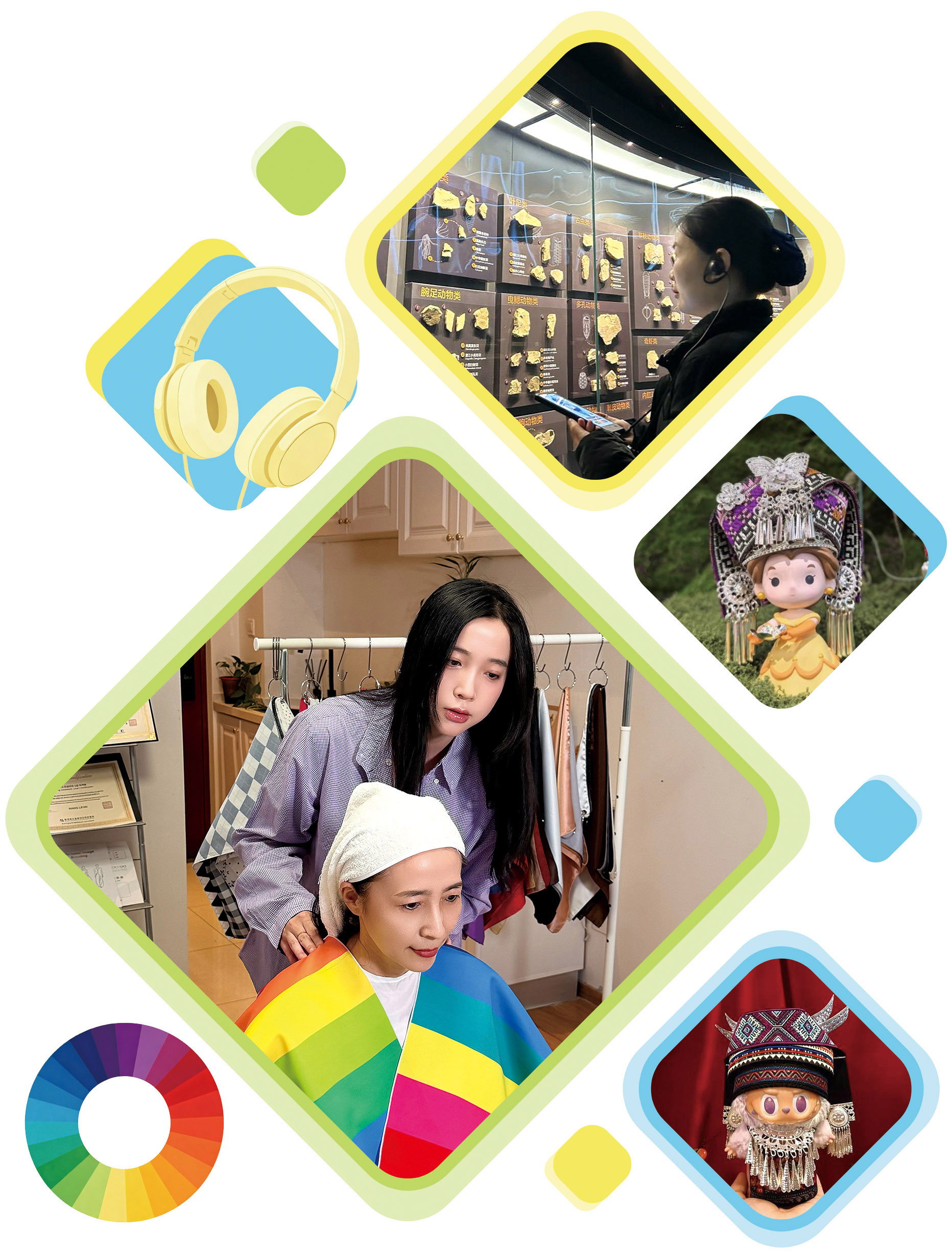
At Oni Color, a color analysis studio in Shijiazhuang, Hebei province, Wang Lifan drapes a white cloth over a client's hair and clothes, studying how different fabric swatches look against their skin.
She asks about the client's style preferences, makeup habits, and desired impression, then reviews their makeup bag to see what works and what does not.
As a film student in South Korea, Wang used to follow fashion trends, but none of them felt quite right. One day, a local friend asked her about her "personal color". After trying color analysis herself, Wang finally found a style that suited her.
After university, Wang worked as a photographer in China, then returned to South Korea for training after spotting a gap in the local market. She opened her studio in June 2024.
At first, Wang worried about whether the business would work in a smaller city. But after she posted about the studio on Xiaohongshu, also known as RedNote, she gained 2,000 followers in two weeks and was fully booked for three months before the studio even opened. "There is demand here," she said.
A one-hour session costs 680 yuan ($100) per person. According to Wang, her clients are not simply paying to follow trends. They are paying for a visible transformation, and many see the experience as a long-term investment. Clients who work in fields such as teaching and medicine, for example, often want to look more professional and confident.
Wang's studio reflects a broader shift among young Chinese consumers, who are increasingly willing to pay for products and services that feel personal, emotionally rewarding, and tied to identity. Across beauty, culture, and lifestyle consumption, value lies not only in what they buy, but also in what the experience helps them discover or express.
Wang said the phrases she hears most often from clients are "finding myself" and "it completely changed how I saw myself".
One client, a doctor under constant work pressure who rarely found moments of joy in daily life, told Wang that discovering a style that suited them brought genuine happiness.
To better adapt the Korean color analysis system for Chinese clients, Wang added facial structure and natural contrast to her assessments. For ethnic minority clients, she often recommends richer colors and warmer tones instead of the muted grays commonly suggested in South Korea.
Driven by customer demand, Wang has expanded into bone-shape assessment and bridal styling, aiming to build a one-stop service that combines color analysis, makeup, and professional photography.
Decoding culture
The desire for personalization is not limited to appearance. For many young people, the same expectation is now shaping how they learn, travel, and engage with culture.
At the National Maritime Museum of China in Tianjin, a marine biology student in his early 20s visited to study fossil patterns and artifact restoration. During the trip, he asked an AI digital guide developed by Aikesheng Digital Cultural (Beijing) Co Ltd more than 20 specialized questions and received clear, accurate answers. He said the guide made his visit more than twice as efficient, and later recommended it to his classmates.
The story was one that stayed with Chen Zhenfeng, vice-president of Aikesheng. Chen said the idea for the guide came during a museum research visit in 2023, when the team noticed that many young visitors struggled to engage deeply with the exhibits because suitable guided tours were unavailable. Some left within 20 minutes.
"That's when we realized that cultural communication in museums needs to adapt to the way people experience culture in the new era," Chen said.
The team turned that observation into a visitor journey built around curiosity.
After scanning a code, visitors can choose a digital companion and select a route based on their interests. They can stop at any point to chat with the guide or scan an object that catches their attention.
The guide can also generate captioned photos for social media, offer interactive games, and send visitors a personalized record of their museum journey.
"Youth are willing to pay for museum services, but not generic ones. They want something shareable, conversation-worthy, and novel," Chen said.
Crafting belonging
Beyond digital experiences, this search for meaning is also appearing in physical products, especially those that allow young people to project identity, emotion, and cultural pride onto objects they love.
Ji Yingqi, founder of a handicraft workshop in Nanning, Guangxi Zhuang autonomous region, has turned ethnic heritage into doll clothing. Her best-selling items include fridge magnets and plush toys featuring imitation Miao silver ornaments and Zhuang brocade.
Building on the popularity of the magnets, Ji's team adapted the motif into miniature Miao-style flower crowns and Zhuang-style headpieces. After testing them on Pop Mart figurines, they created their first line of doll hats.
While decorating their workspace, Ji's team dressed plush toys in Zhuang-style outfits. The outfits became an instant hit with visitors, who soon began asking whether the team could make similar clothes for their own dolls.
"That's when it clicked," Ji said. From there, the process became more interactive. Customer participation became central to the business. Ji describes the process as "cocreation".
"Every doll is different," she said. From necklines to accessories, each design is shaped by customer preferences.
"Many of them see their dolls as companions, even like 'children'. They bring them to meals, on walks and trips, even to concerts."
Meanwhile, designs were simplified to fit dolls of different sizes while still preserving key cultural elements. The range of designs now includes Yi, Yao, and Bai ethnic styles.
Bai-style hats, for example, draw inspiration from the natural scenery of Dali in Yunnan province — wind, flowers, snow, and moon — blending tradition with playful design.
"Growing national pride has drawn more young people to our products. They do not hesitate to express their love for ethnic cultural elements," Ji said.
"Some customers studying or living abroad come back and make a point of bringing their dolls to us," she added. "They take photos with the dolls around the world, bringing Zhuang-style clothing to more places."
Across a color studio, a museum, and a doll workshop, what young people are buying is not just color palettes, digital guides, or handmade accessories. In a market crowded with choices, meaning may be what keeps people coming back.
Contact the writers at xiongxinyi@i21st.cn
