


More than a year after the DeepSeek moment fundamentally shifted investor perception of Chinese artificial intelligence capability, that reassessment is now feeding into Hong Kong’s booming IPO market.
As China is rewriting the playbook on AI monetization, the special administrative region should take on renewed importance as a capital bridge for homegrown AI firms, helping unlock funding access and driving a broader repricing of Chinese AI assets, says Victoria Mio, head of Greater China Equities at Janus Henderson Investors.
“In a world where China’s AI firms face constrained funding channels versus United States peers, the SAR’s role as an IPO and follow-on financing venue becomes more important, because it’s one of the few scalable bridges between global capital pools and China-linked tech issuers,” Mio tells China Daily in an exclusive interview.
Two of China’s top six large language model (LLM) startups — Zhipu AI and MiniMax — and a pair of high-profile chip developers — Biren Technology and Iluvatar CoreX Semiconductor —made stellar debuts on the Hong Kong stock exchange during the first quarter of 2026.
The four companies collectively helped drive more than $22 billion in AI-related exit value over the quarter, heavily fueled by their blockbuster listings and highlighting a structural shift in global venture capital scene, as surging public market demand in Asia stands in sharp contrast to a record stretch of tech IPO underperformance in the US, according to the latest data from financial research platform PitchBook.
Adding to the momentum are Moonshot AI and StepFun, another pair of China’s leading LLM companies, which have reportedly pressed ahead with corporate restructuring to pave the way for their much-anticipated Hong Kong listings.
PitchBook data add another compelling footnote to the mismatch between AI investment and monetization: Investors are yearning for real revenue generation, durable cash flows, and defensible vertical positioning to validate stretched stock valuations, exorbitant capital spending, and make all well with the AI boom.
A pragmatic approach to funding and monetization, coupled with mass adoption campaigns and rapid progress in agentic models, give China the edge in the AI race, making the country’s AI sector enter what Mio calls a “pivotal phase” this year.
ALSO READ: MiniMax shares surge 25% in HK as optimism over Chinese AI firms grows
“The Chinese AI ecosystem is ruthlessly pragmatic — we are seeing a pivot away from theoretical benchmarks toward immediate commercial application,” says Mio, who also serves as a portfolio manager at Janus Henderson Investors.
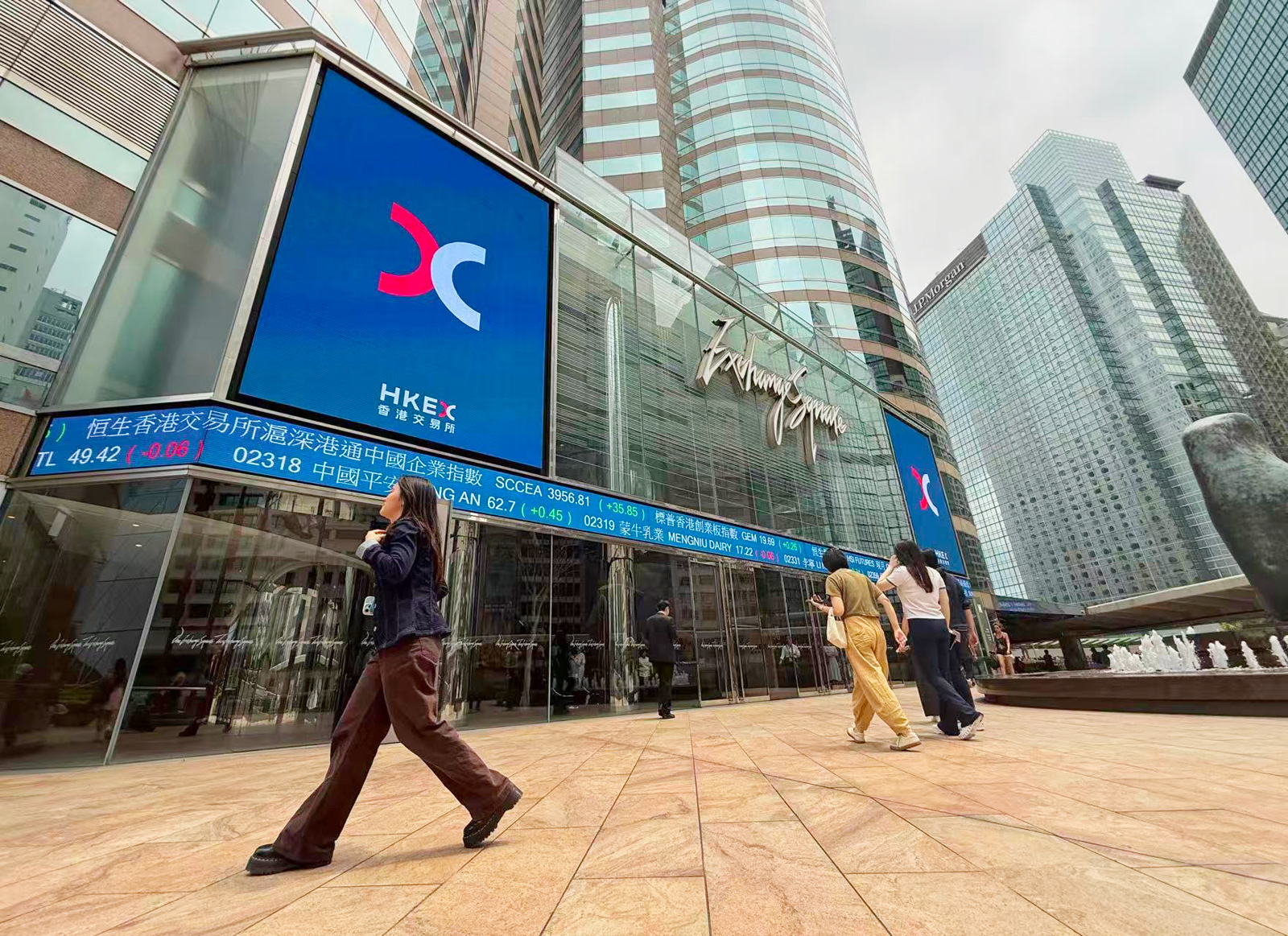
The world’s second-largest economy is now leveraging its massive reserves of cheap electricity, computing infrastructure and cost-effective models to process and “export” tokens — units of data used by AI systems. In Mio’s view, Hong Kong, expected to remain among the top three IPO markets worldwide this year, should have its “most realistic near-term role” anchored in a capital intermediary and financial-market infrastructure layer.
“If we look at what the SAR is already doing, Hong Kong’s strongest role is still funding and public-market access for the ecosystem,” she says. Such a thriving ecosystem could include model makers, AI infrastructure providers, and the broader “picks-and-shovels” chain ranging from high-density data-center design, advanced cooling, power management to optical interconnects and systems integration.
“‘Token economy’ is capex-heavy — data centers, networking, power — and needs repeatable access to capital across cycles, which Hong Kong can provide even when private capital is tight,” she says.
Mio points to the concrete signal from the “continued effort of the Hong Kong Exchanges and Clearing Ltd” — the operator of the Hong Kong stock exchange — to pull more specialist tech and biotech issuers into the world-renowned financial hub, through initiatives such as a dedicated Technology Enterprises Channel and confidential filing options.
Despite the talk of high-volume, low-margin look of China’s token export, Mio regards it more consistent with “a deliberate land-grab playbook than a structural issue” at this stage.
She depicts a three-phase trajectory. What begins as a play for volume, driven by rock-bottom pricing and open distribution to bake Chinese LLMs into the global developer stack, is now feeding into enterprise demand, where recurring revenues are generated through a unified application programming interface-based services and tiered premium offerings. Pricing is increasingly anchored in higher-value attributes such as security, compliance, latency, context length and agent reliability, where businesses are willing to pay more.
The endgame, Mio pointed out, is to charge for tangible outcomes instead of raw tokens. By leveraging vertical agents and applications, providers secure their position through proprietary data and specialized workflows.
READ MORE: AI large-model company Zhipu gains more than 13% in HK debut
Mio sees a broader investment story lie in a structural, systems-level AI acceleration the country is undergoing: Mass onboarding via consumer platforms, rapid iteration through open ecosystems, and a strong pivot toward agentic use cases with a focus on measurable return-on-investment.
“This matters for investors, because AI adoption — not just raw model capability — tends to determine who captures profit pools,” she says.
Contact the writer at sophialuo@chinadailyhk.com
