

Hong Kong’s economic transformation has taken a new twist with its goal to become a commercial space hub fast gaining momentum through artificial intelligence-powered satellite data services. As Jessica Chen reports, the growth of space-related enterprises in the Greater Bay Area gives Hong Kong the impetus to move forward in that direction.

Back in early 2021, as the world’s freest economy reeled under some of the strictest “zero-COVID” controls, Noor Fan flew into Hong Kong wearing an N95 mask.
The co-founder and president of STAR.VISION Aerospace Group — a Hangzhou-based satellite firm specializing in what it calls “deploying artificial intelligence in space” — had decided that Hong Kong, then quarantined, contested and “finished” in the eyes of doom-mongers, was the logical staging post for his company’s global drive.
Three years later, when former Morgan Stanley Asia chairman Stephen Roach published a controversial column in the Financial Times, entitled “It Pains Me to Say Hong Kong is Over”, Fan and his Hong Kong subsidiary were already reaping their first profit from the Hong Kong Special Administrative Region’s fledgling space economy.
By the time Roach admitted it had been “too early to declare Hong Kong over” last year, another space business newcomer had made his presence felt. Brian Zhou Boyang, a graduate of the Chinese Academy of Sciences, founded startup Space Zenith in the SAR even before he was granted permanent residency in the city. “I do not think residency was the issue,” he recalls. “Only business logic matters.”
READ MORE: Hong Kong-mainland platform to explore space intelligence
To Fan and Zhou, business logic runs through low-earth orbit. The former’s company focuses on building up data services drawn from satellites circling several hundred kilometers above the planet, mostly for customers in Africa and Southeast Asia, while Zhou’s outfit wagers on tailor-made analytics for what may become the next decade’s most data-rich industry.
“Since we set up the fully-owned subsidiary in Hong Kong, we have the advantage of this unique platform in promoting our services worldwide,” says Fan, indicating the SAR is where overseas data is managed, stored, processed and re-exported.
STAR.VISION is said to be the first enterprise to take up lunar exploration, tapping Hong Kong’s free flow of capital and open access for visitors, as national-grade space projects unfold in the city. Hong Kong universities are joining missions to the moon and in low-earth orbit. “A potential giant company will emerge in the future,” predicts Jackson Chung of Gobi Partners — a venture-capital firm that has been scouting Hong Kong’s space scene for the next breakout name.
Prudent insiders, however, remain cautious about the “space rush”, particularly the trend of establishing data centers in orbit. Anthony Neoh, former chairman of Hong Kong’s Securities and Futures Commission (SFC), told China Daily that the cost of space-based data centers is prohibitively high, making terrestrial data centers far more commercially viable at this stage.
Market vision
The SAR’s stock market is already a hive of activity, with Shanghai Top Numerical Control Technology Co, which makes five-axis machine tools used for building rockets and large aircraft, having started trading on the Hong Kong Exchanges and Clearing on Wednesday as the “first Chinese commercial aerospace stock” on the local bourse. Although the first space-flavored new listings are seen as a “belated milestone”, the industry has outpaced the SAR government’s efforts and is expected to move faster.
Even before the bourse caught up with the advent of a space industry, the political arena had begun to stir. The “convert-in-chief” is Regina Ip Lau Suk-yee, convenor of Hong Kong’s Executive Council and chairwoman of the New People’s Party, who has been rebranded by her colleagues as the “space lady”. She researched Luxembourg's stunning transformation and said she was impressed — a landlocked nation with merely 680,000 people having quietly made itself Europe’s leading commercial-space hub. What it has had, since the 2008 financial crisis, is a small state’s willingness to pick a niche and run with it.
“The small European state of Luxembourg has become a space powerhouse through regulatory innovation and financial expertise,” says Dominic Lee Tsz-king, a legislator with Ip’s New People’s Party. “Hong Kong could focus on space finance, insurance, legal services and technology development as high-value activities are perfectly in line with its strengths.”
Academics agree. “We have everything we need,” says Quentin Parker, director of the Laboratory for Space Research at the University of Hong Kong. “We are competitive with Luxembourg and the United Arab Emirates.” The need to diversify away from property and finance — a hot debate in Hong Kong for at least two decades — has acquired a new orbital twist.
Economic transformation
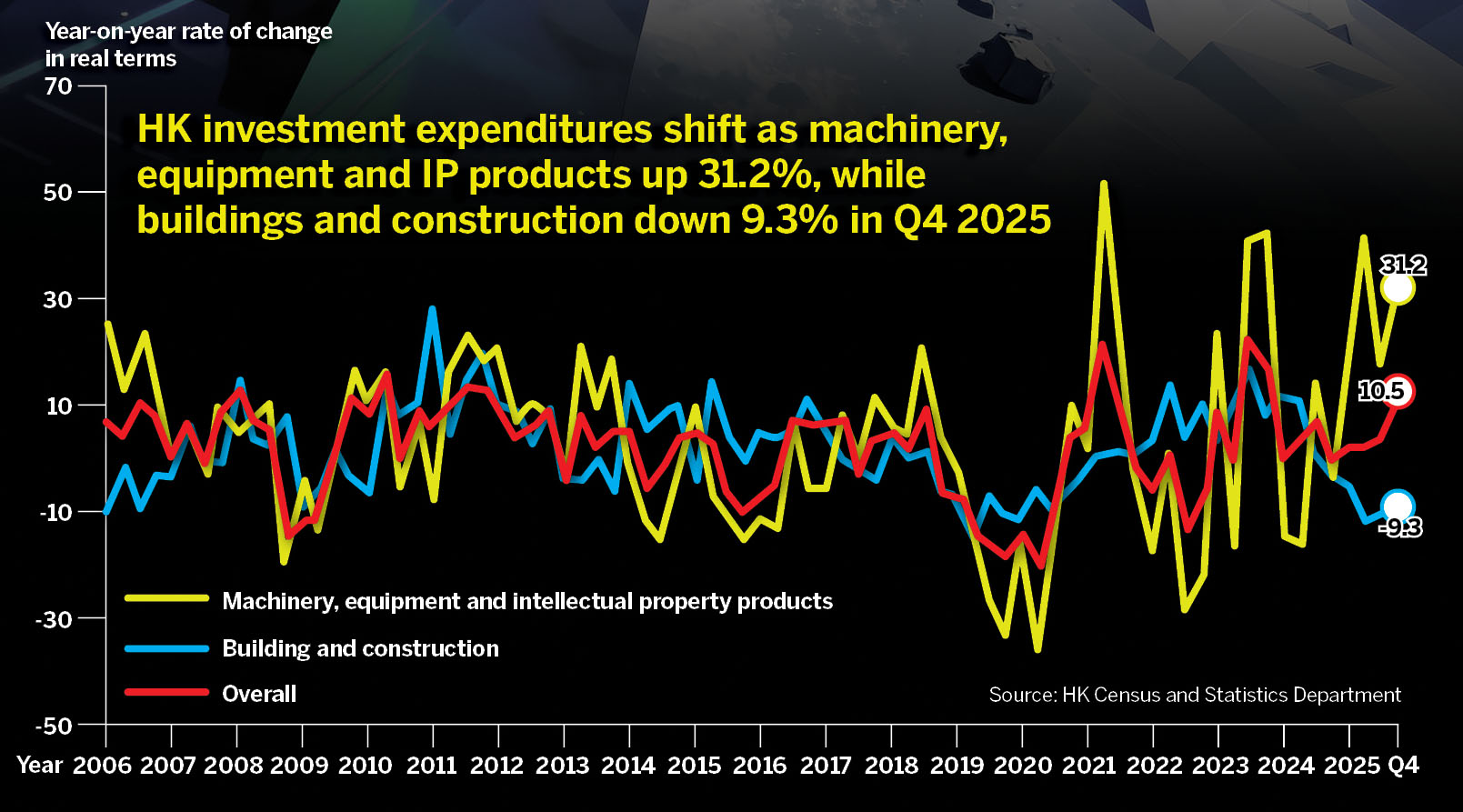
The hard numbers have begun to bend in the same direction. SAR government data for the fourth quarter of last year showed investments in machinery, equipment and intellectual-property products went up 31.2 percent year-on-year, compared with the construction sector, which saw a 9.3-percent decline. In the first quarter of 2026, the city’s gross domestic product expanded 5.9 percent year-on-year — its strongest growth in nearly five years.
The figures point to a structural shift economists have long expected but rarely seen so plainly — Hong Kong’s growth engine is migrating slowly from concrete to code. In an industry where data is the raw material, the city’s appetite for what Fan calls a “profit-generating data business model for the age of AI” looks less eccentric.
Until recently, Hong Kong’s space-economy pitch had lacked a prominent face. Now, it has one. Mahesh Harilela — convenor of the family council of the Harilela Group and a member of what is widely regarded as the city’s wealthiest Indian family — registered SpaceHK last year to push the agenda. “We are continuing to work with various government departments in trying to make Hong Kong a space hub,” he says.
While local Chinese media gleefully call the venture “Hong Kong’s version of SpaceX”, Harilela demurs. “SpaceHK will not launch anything. We just aim to develop an ecosystem centered on commercial aspects that embrace multiple industries in enhancing the nation’s 15th Five-Year Plan (2026-30).”
Meanwhile, as the Chinese mainland steps up its commercial-space infrastructure development, and Hong Kong’s low-altitude economy takes shape, entrepreneurs like Fan, Zhou and Harilela see a window. Harilela believes that jobs and initial public offerings in the space-related sector could deliver “an additional 3 to 5 percent contribution” to Hong Kong’s GDP.
Government’s role
A snapshot circulated in March this year by the Orion Astropreneur Space Academy (OASA) — a local space economy advocacy group — offers a solid baseline. Nearly one-fourth of the 212 space-related companies identified across the Guangdong-Hong Kong-Macao Greater Bay Area are based in Hong Kong, and the local share is heavily weighted toward professional services. The ecosystem resembles, in microcosm, Luxembourg’s space industry circa 2010: thin on hardware, thick on intermediation.
Whether intermediation alone is enough is a question from the scientific community. “Hong Kong will do the best job it can with its five outstanding universities,” says Brian Schmidt, a Nobel laureate astronomer who was at a recent space-science conference in the city. “But, the best way for Hong Kong to be a connector in space is to be a player. A player means having really good scientists who can contribute. You cannot just be a broker.”
He acknowledges Hong Kong’s rare structural advantage under the “one country, two systems” — a capacity to bridge research communities on either side of an increasingly fractured geopolitical line.
Two questions have dominated conversations between the space community and the government. The first is institutional. “We need a body with the authority and resources to serve as a single institutional point of contact for aerospace companies, investors and research institutions,” urges Ip. What is required is a dedicated coordination office to replace today’s patchwork of ministries and agencies.
ALSO READ: Mars mission to include Hong Kong, Macao, intl science payloads
David Dong Lu, deputy chief executive of the OASA, says it is vital to “narrow the policy gap” between government and industry. A former policy adviser at the China Aerospace Science and Technology Corp, Dong relocated his family to Hong Kong in 2022 under the Top Talent Pass Scheme. He tells China Daily the vibrant commercial space on the mainland will spill into Hong Kong both in the form of capital and migrating talent, making it urgent to “tame the fad and ride the trend”.
With commercial space sitting at the awkward intersection of telecommunications law, resource rights, environmental regulation and national security, it is a complexity that existing Hong Kong frameworks are not designed to address, particularly around AI-powered satellite-data services. The city’s common-law tradition and sophisticated arbitration infrastructure give it a head start.
What is missing, says Fan, is statute.
Luxembourg and Singapore have moved early to enact legislation in this respect. “Hong Kong has to take proactive measures to ride the trend,” he says.
Contact the writer at jessicachen@chinadailyhk.com
