

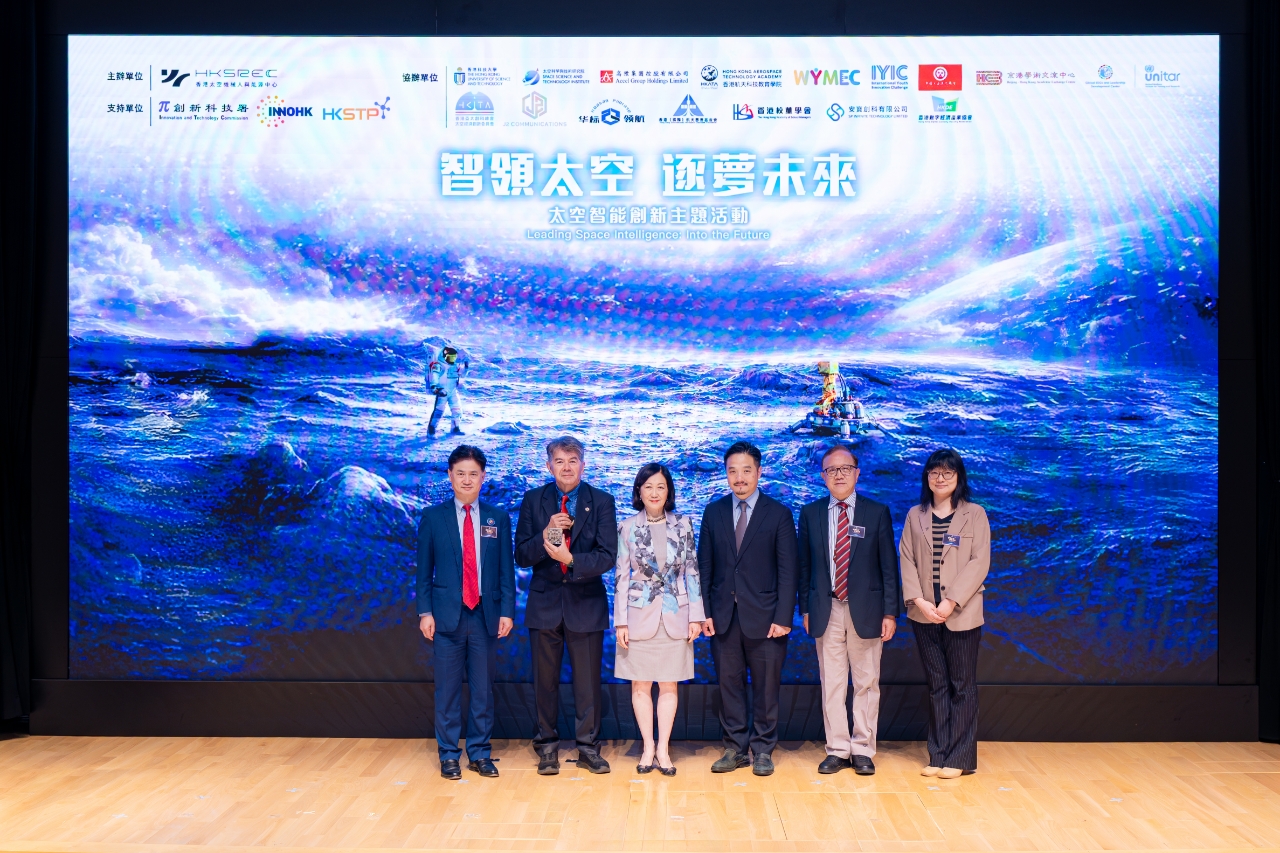
A new platform was established at Hong Kong’s Science Park on Wednesday to promote joint exploration of space intelligence between the Chinese mainland and Hong Kong. The two sides have long been committed to deepening exchanges in space technology research, cross-regional collaboration, and commercial aerospace applications.
The Beijing-Shanghai-Hong Kong Innovation Hub Initiative on Space Intelligence was launched by the Hong Kong Space Robotics and Energy Centre (HKSREC), led by the Hong Kong University of Science and Technology. Backed by top-tier mainland organizations, it marks a significant step toward transforming Hong Kong into a space powerhouse, and contributing to the nation’s aerospace development.
During the launch ceremony, Regina Ip Lau Suk-yee, convenor of the Hong Kong Special Administrative Region’s Executive Council, said Hong Kong should leverage its extensive experience in space research at its top universities, and serve as a hub for the nation’s aerospace companies, while developing new aerospace-related industries.
One notable example of the city’s strength is the HKSREC-developed operation robot for China’s Chang’e 8 mission, commissioned by the China National Space Administration in 2024. Scheduled for 2028-29 to explore the lunar South Pole, the mission exemplifies greater international cooperation, carrying payloads from 11 countries and regions, as well as one international organization.
Gao Yang, director of the HKSREC, said that the organization’s participation in the Chang’e 8 lunar mission focuses on embodied intelligence and operations in extreme environments. Its multi-functional lunar surface robot is equipped with a mobile charging station and capable of dexterous operations.
“We are grateful to the HKSAR government for supporting our research through the InnoHK platform, which has enabled Hong Kong research teams to contribute to national missions and collaborate closely with mainland and international experts,” Gao said.
ALSO READ: HK strengthens its developing aerospace industry
French scientist Bernard Foing, executive director of the International Lunar Exploration Working Group, said the Chang’e 8 mission is poised to become a key lunar scientific research project, and can lay a strong foundation for long-term human lunar exploration and economic growth.
Charles Ng Wang-wai, vice-president of the HKUST (Institutional Advancement), said that the nation’s 15th Five-Year Plan (2026-30) reaffirmed Hong Kong’s vital role in innovation and technology.
In addition to the Chang’e 8 mission, he highlighted various aerospace efforts by the university, including the launch of Hong Kong’s first higher education environmental remote sensing satellite in 2023. “At HKUST, we are not merely watching from the sidelines; we are actively forging that chapter ourselves,” he said.
During panel discussions afterward, experts highlighted space innovation collaboration between Hong Kong and the mainland, as well as commercial space opportunities and investments. The panels also stressed Hong Kong’s outstanding role as a superconnector and talent hub in this field.
READ MORE: Hong Kong ready to enter new era of aerospace innovation
Ivan Lee Kwok-bun, Hong Kong’s commissioner for innovation and technology, said Hong Kong will continue to invest in innovation and technology development, including aerospace technology, with the aim of transforming the city into an international I&T center, and contributing to the nation’s goal of becoming a global leader in science and technology.
The event also featured a special educational session aimed at sharing cutting-edge space discoveries with the public, especially young students.
Contact the writer at atlasshao@chinadailyhk.com
