

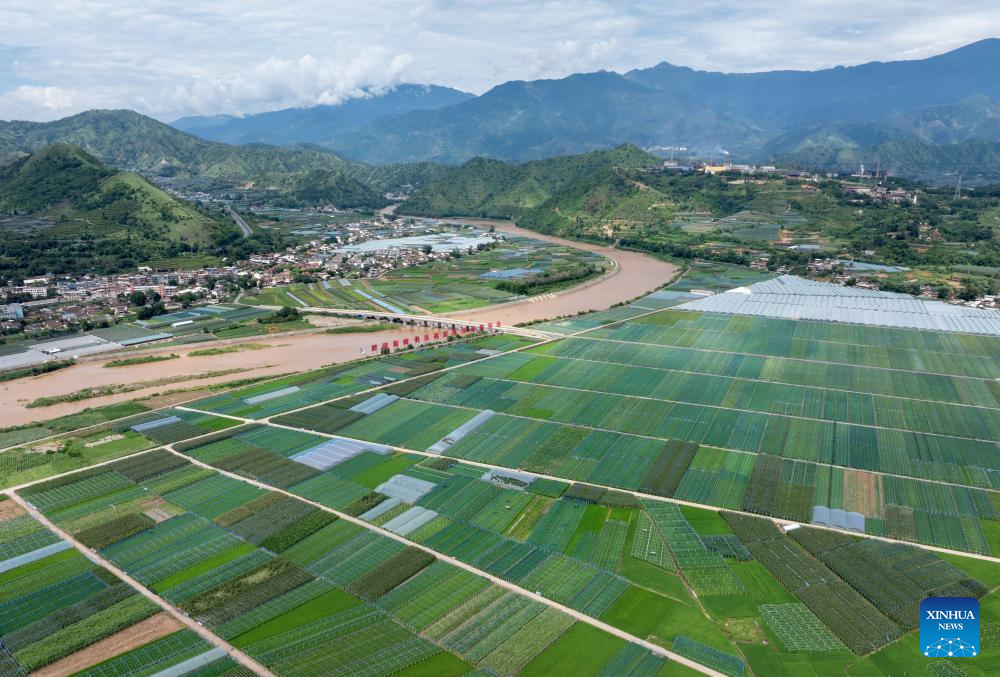
China's top judicial authorities issued a new legal document reaffirming their commitment to intensifying enforcement against the illegal occupation of farmland, as part of broader efforts to protect food security and support agricultural development.
On Monday, the Supreme People's Court and the Supreme People's Procuratorate released a 21-article judicial interpretation aimed at strengthening the protection of cultivated land and safeguarding farmers' legal rights.
The interpretation clarifies that government employees who abuse their power for personal gain — by unlawfully approving the expropriation or use of farmland while accepting bribes — should be convicted and punished for multiple crimes separately. Prosecutors are authorized to exercise their oversight role in protecting farmland by initiating public interest litigation, according to the interpretation, which takes effect on May 18.
Additionally, the legal document specifies that those who illegally occupy agricultural land and also cause environmental pollution or engage in illegal mining should face harsher penalties.
In recent years, Chinese judicial authorities have ramped up efforts to maintain the bottom line of land security. For instance, between 2020 and 2025, Chinese courts concluded nearly 240,000 administrative cases, around 400,000 civil cases, and 45,667 criminal cases related to cultivated land.
ALSO READ: Food security focus of agri law revision
While handling these cases efficiently, the Supreme People's Court has also formulated rules and publicized significant cases to combat damage to grasslands, forests, and black soil farmland, helping standardize judicial practices in these areas.
Yu Shuangbiao, an official from the Supreme People's Procuratorate, highlighted the importance of public interest litigation in the new interpretation. He noted that this measure helps implement the Ecological and Environmental Code — China's second law titled as a "code" — which was adopted in March, serving as the legal foundation for systematic environmental governance.
Yu praised the provision for allowing prosecutors to file public interest lawsuits when they discover irregularities involving cultivated land, adding that "this specific rule will help rigorously crack down on polluters and provide stronger oversight to ensure food safety".
The Supreme People's Procuratorate, together with the Ministry of Agriculture and Rural Affairs, has also launched a special initiative to support the development of high-standard farmland through public interest litigation. Furthermore, it has established a collaboration mechanism between procuratorial public interest litigation and land enforcement investigations with the Ministry of Natural Resources to strengthen coordinated governance of issues related to cultivated land protection, according to Yang Jianbo, another official from the SPP.
