

A new generation breathes life into centuries-old Nanyin melodies, sharing them with global audiences in a fresh, modern way.
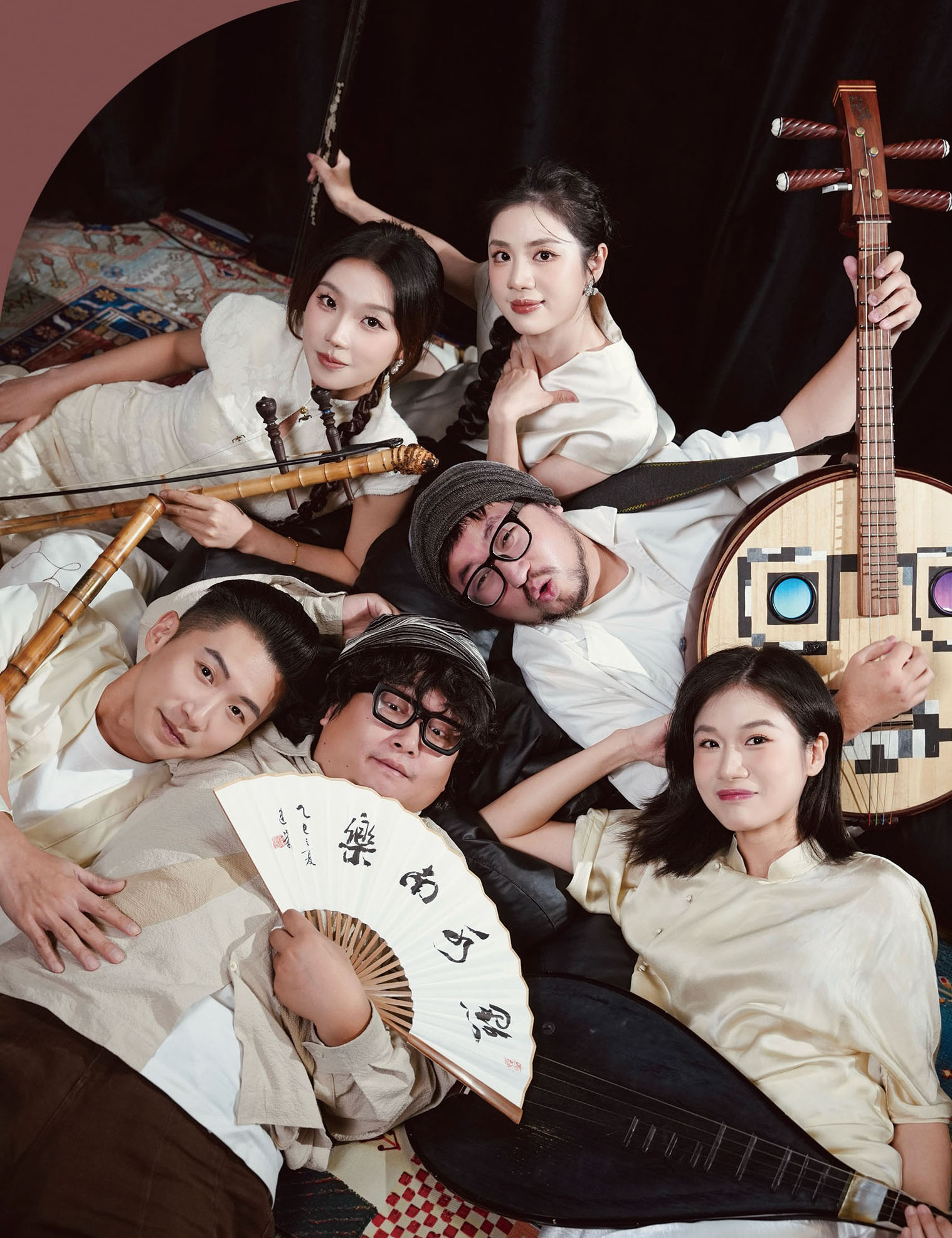
When Zheng Mingming was about 5, she loved sitting next to her grandmother, listening to her sing ancient songs in the Minnan dialect. Her grandmother, a "resident musician" at a Nanyin hall in Quanzhou, Fujian province, had hundreds of songs memorized.
Whether at family gatherings, festivals, and quiet afternoons at home, Nanyin music was the soundtrack to Zheng's everyday life.
Little did she know that this family tradition, passed down through five generations, would one day lead her to perform on a world-renowned stage.
On March 28 and 29, at Hong Kong City Hall, Zheng, a member of the modern Nanyin ensemble Tiam Drop, played the Nanyin pipa, a crooked-neck lute held horizontally, accompanied by five fellow musicians. More than 400 audience members from around the world listened intently and responded with thunderous applause.
The performance was part of the 54th Hong Kong Arts Festival, which featured about 1,200 outstanding international and local artists.
READ MORE: 54th Hong Kong Arts Festival opens
For the first time ever, Tiam Drop, a youth troupe founded in 2021, brought Nanyin to this prestigious Asian arts event.
Often referred to as a "living fossil" of Chinese music, Nanyin originated in Quanzhou and is one of the oldest known music genres in China, with a history of 800 to 1,000 years. Traditionally performed in the Minnan dialect, it features instruments like the pipa, dongxiao (a vertical bamboo flute), erxian (a two-stringed instrument), and sanxian (a three-stringed instrument).
In 2006, Nanyin was included in the first batch of China's national-level intangible cultural heritage list. In 2009, it was inscribed on UNESCO's Representative List of the Intangible Cultural Heritage of Humanity.
Growing up in Quanzhou, Zheng was deeply immersed in Nanyin. Every spring and autumn, local Nanyin musicians would hold ceremonies honoring Meng Chang, the god of music. During celebrations such as the Birthday of the Buddha, families would prepare dishes to share, while the community gathered to sing, play Nanyin, and enjoy a meal together.
"Nanyin is not just music; it's a way of life, filled with human warmth. It encompasses a complete universe — music, rituals, culture, and so much more. There's no end to it," Zheng said.
Many Nanyin lyrics are drawn from ancient tales, such as the Minnan love story of Chen San and Wu Niang. This story has inspired hundreds of songs passed down through generations, with each performer adding their own layers of emotion and detail.
"It's like reading a book, but even more enjoyable because you can sing and play it," Zheng explained.
"In Nanyin, time seems to fly," she added. "Each time you master a song or an instrument, you uncover new challenges — it's like leveling up in a game."
She noted that there are about 6,000 existing Nanyin songs, with some suites taking more than 40 minutes to perform.
The music 'chef'
Cai Kaidong, the founder and producer of Tiam Drop, was initially baffled by Nanyin's intricate musicality. A seasoned musician with experience performing with bands, arranging music, and producing albums for well-known groups, he realized he couldn't recall a single melody after listening to a Nanyin piece nearly 10 times.
This revelation made him question why so many people, even professionals like himself, found Nanyin so difficult to grasp.
"It's not that Nanyin isn't good," he explained. "It's just that our ears are so accustomed to the 'cooking style' of modern music."
He was referring to Nanyin's melody-centered texture, which differs from the harmonic progressions and strong rhythmic structures familiar to modern pop listeners.
"Nanyin is like raw meat from ancient times — pure and uncooked — while modern listeners are used to processed meat," he explained, using a culinary analogy. "What we need to do is provide 'chopsticks' in the form of arrangements to serve it to the audience."
However, Cai is determined not to turn Nanyin into something it's not. So, he has adopted the principle of "no changes, only arrangements" for Tiam Drop. The lyrics, melody, playing techniques, and tonality remain unchanged, but two subtle elements are introduced. First, bass harmony using the daruan, a long-lost Chinese plucked instrument. Second, a rhythmic framework with the cajon, whose neutral tone ensures that no foreign musical style is imposed.
"The daruan is a native instrument, yet not a single song featuring it has survived. This works in our favor, as it won't alter the core or style of Nanyin," Cai explained.
"The cajon is like plain boiled water. I don't want it to stand out; it shouldn't have any 'flavor'. I only use it to offer a subtle 'hint' at key moments — such as the start of a new section or a shift in emotion," he added.
These arrangements give Nanyin a clear structure — beginning, development, climax, and ending — making it more accessible to younger audiences.
At the Hong Kong Arts Festival, Tiam Drop even led an interactive session, teaching over 400 people to sing along. The experience was so moving that Cai removed his in-ear monitor and stood on stage, stunned.
ALSO READ: Tuning into the local
On March 30, Tiam Drop hosted "Echoes of a Millennium: Nanyin" sharing session at the Legislative Council of Hong Kong, where Legislative Council member Kenneth Fok Kai-kong tried the instruments and later praised the group on social media: "This unwavering commitment and passion for culture truly deserve our full support."
Cai remains grounded in his mission.
"Every generation has its own role to play, and what it does will be remembered," he said.
"Our generation just needs to approach traditional Chinese music with sincerity, responsibility, and respect."
Contact the writers at guiqian@i21st.cn
