

Karst landscapes a magnet for the world's climbing community
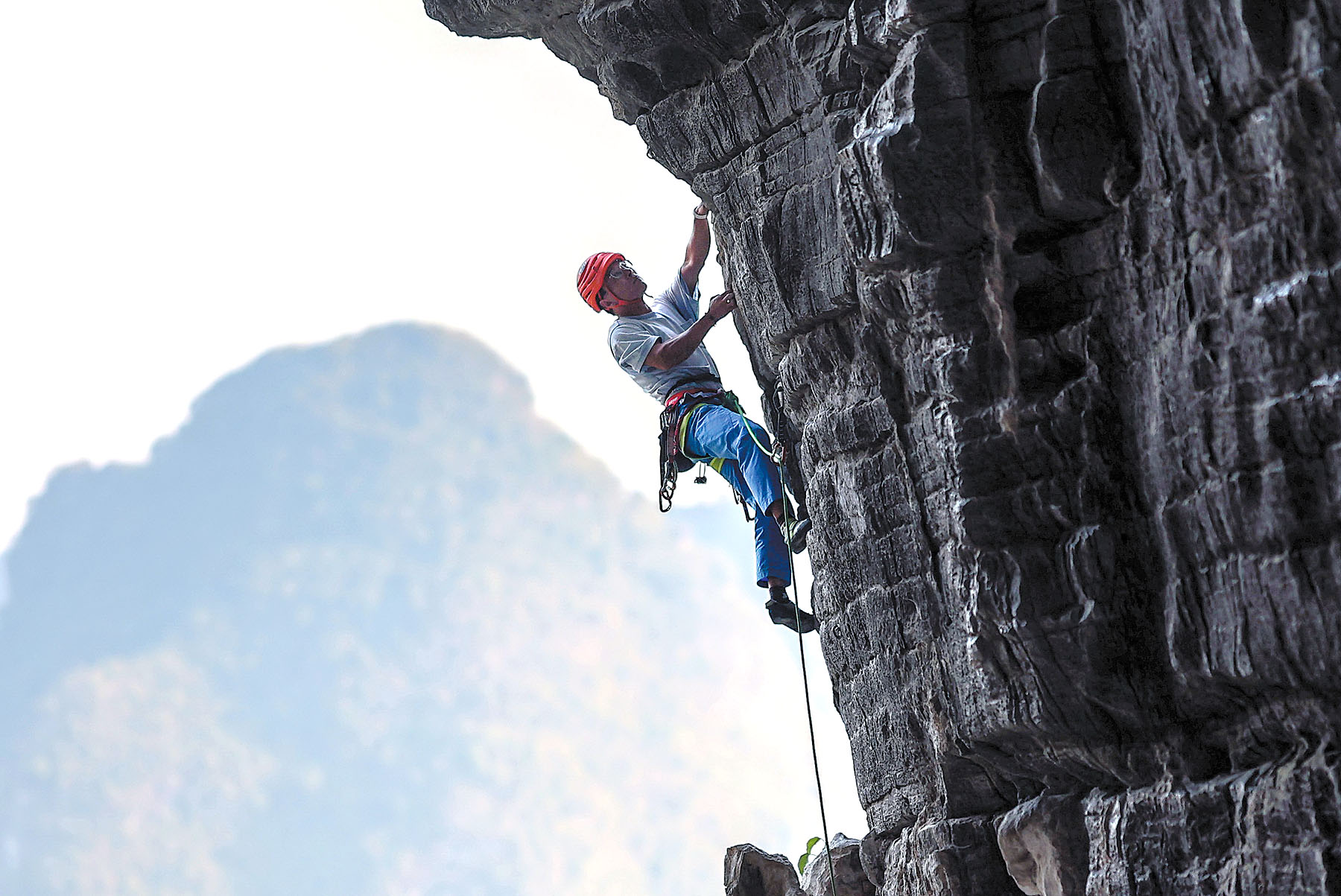
The arch of Shegeng Cave rose before He Chuan, a 47-year-old climber from Beijing, like a stone cathedral dropped into the karst peaks of the Guangxi Zhuang autonomous region. A winding path snaked through its vast opening and, 70 meters above, the limestone ceiling hung — raw, ridged, pockmarked with cavities and streaked with subtle mineral lines. For a moment, he simply stood still.
Then he saw natural handholds scattered across the wall, like a challenge laid down by Mother Nature. His pulse quickened. "I have found a place that could rewrite Chinese climbing history," he later recalled. And he was right.
Starting in May 2024, Chinese and international route setters descended on the cave in the Leye-Fengshan UNESCO Global Geopark, working in three intensive rounds to carve 110 routes into the living rock. Based on the Yosemite Decimal System, a grading system used for rating the difficulty of rock climbing, the routes range in difficulty from a welcoming 5.8 to a savage 5.15b.
The hardest line is named She Diao (The Eagle Shooters), a 30-meter route up the inner left wall of the north entrance. It follows a steep, overhanging parabola that demands elite-level fingertip strength.
After completing the route, French climber Seb Bouin noted that the crux moves demand fingertip-pulling power at an extremely high level of difficulty. Yet when he paused and looked up through the cave's opening, he could see green mountains and drifting clouds. He said the climbing process is complex, but "enjoying the scenery while climbing" makes it utterly exhilarating.
Graded as China's hardest route to date, She Diao has vaulted Shegeng Cave in this remote corner of Guangxi into the world's top climbing destinations.
On May 15 last year, the cave officially opened as a pilgrimage site for hardcore enthusiasts chasing the planet's most extreme vertical challenges.
But Guangxi's rocks don't belong only to the elite. Further south, a different rhythm hums in the fabled karst landscape of Yangshuo county. Here, the stone is for everyone.
For generations, Yangshuo has been where the Lijiang River winds through arched peaks. Now, a growing community is swapping river cruises for chalk bags.
"For most Chinese and international tourists, Yangshuo is the true international climbing destination," said Liu Yongbang, vice-president of the Yangshuo Climbing Association. "It boasts routes for beginners and intermediate and advanced climbers, along with a unique climbing lifestyle."
That lifestyle is a world away from the urban grind. Climbers from across the globe rent modest guesthouses or quiet rural rooms, hop on scooters each morning, and spend hours on the natural limestone faces. Once there, they practice moves, control the tightness of rope for partners, and swap route beta — the specific sequence of moves, holds and techniques used to complete a particular climbing route. During evenings, climbers share meals and swap stories, living a slow, voluntary simplicity that binds a global community far from the 9-to-5.
Liu is one of them. Born in Hengyang, Hunan province, he chose to settle in Yangshuo for its endless natural rock and the electric promise of its climbing future.
"Yangshuo, a small county in Guangxi, has gathered climbers from all over the world," he said. "Now every Chinese climber who wants to learn outdoor climbing comes here. We have over 600 climbing practitioners, nearly 2,000 routes and 74 crags, and new routes are still being developed. Many tourists discover Yangshuo through climbing. They experience their first ascent here as visitors, then become climbers, and some eventually settle down as residents."
Foreign climbers can access most crags after registering with the local association. For beginners, Yangshuo's 37 certified clubs, all of which hold high-risk operation permits, offer safe, reliable gateways into the vertical world.
Then there is 12-year-old Zhou Zhou.
ALSO READ: Super idol rewrites the script
When she first arrived in Yangshuo in 2024 from Changsha, Hunan, she was afraid of bugs, the sun and the dark. Under Liu's instruction, she began to climb. A year later, her mother saw how much she had changed.
"She has become brave and independent," her mother said. "It seems that the rock remakes her."
From the soaring arch of Shegeng Cave to the sun-warmed crags of Yangshuo, Guangxi's limestone is no longer just scenery. It is a canvas for human daring, a global crossroads, and for those who linger, a way of life.
Tips for visitors
Shegeng Cave: A 3-hour drive from Nanning or accessible from Baise in the Guangxi Zhuang autonomous region. The best climbing conditions are from October to April. Experienced climbers should come equipped with a full rack of quickdraws, used to attach ropes to bolts or anchors, a 70-meter rope and plenty of chalk.
Yangshuo: Easily reached via Guilin's high-speed rail station or airport, followed by a bus or taxi ride. The main climbing season runs from September to May. Beginners should book through one of Yangshuo's 37 licensed clubs, which provide gear rental, certified guides and safety briefings. Register with the Yangshuo Climbing Association for access to most sites, and always climb with a partner.
Contact the writers at xingwen@chinadaily.com.cn
