

Expat livestreamers help customers better understand China and Chinese products

The afternoon sun slants through the tinted glass walls of a livestreaming base in Chengmai county, Hainan province, casting a golden light on the busy venue.
At 2 pm, the place comes alive. Behind one soundproof door, a young woman from Morocco adjusts a ring light; behind another, a Ghanaian man flashes a wide smile at his camera. In less than a minute, they will begin speaking to thousands of shoppers thousands of miles away — in places like New York, Casablanca, Lagos and Jakarta.
This is not a scene from well-known Chinese e-commerce cities such as Shenzhen, Guangdong province, or Hangzhou, Zhejiang province. This is Hainan, the southern island province known for coconut trees, beach resorts and rocket launches.
READ MORE: Pioneering zone to be launched in Hunan to propel Sino-African trade
But after the island-wide special customs operations came into effect in December at Hainan Free Trade Port, a different kind of tide is rolling in — not of tourists, but of foreign faces speaking into phones, selling "Made in China" to the world.
"What makes me come to Hainan? It's growing. It's a good opportunity. I feel like I'm going to grow together with this island," said Imane, a 25-year-old from Morocco, taking a quick break from her setup.
Her eyes scan a shelf of products: a professional DJ mixer, a foldable electric scooter and Labubu figurines from Pop Mart. "Especially the policies, especially the shipments — you know the ports, the delivery is fast plus it doesn't cost that much money."
Imane is one of a growing number of foreign livestreamers who have made Hainan their home base. Since arriving in October, she has gone from a newcomer to a seasoned host, broadcasting to audiences who once questioned the quality of Chinese goods. Now she speaks not just as a seller, but as a cultural bridge.
During a recent livestreaming session, she held up a sleek electric bike.
"This bike is popular, it's famous, and even trending — especially in the US," she said. Her tone was neither rehearsed nor forced. She speaks with the ease of someone who has lived in China for years — Hangzhou; Guangzhou, Guangdong; Shenyang, Liaoning province; and now Hainan. That journey gave her a layered understanding of a country that many overseas consumers still see in flat, outdated terms.
"Before, it was so difficult because people didn't trust Chinese products," she said. "But when we start explaining — the story of how it comes, we talk about the quality, how it's going to help your daily life — then they start understanding."
She held up a box of coconut tea, a Hainan specialty. "I drink Chinese tea every day — green tea, very refreshing. But when I moved to Hainan, I really like this: coconut tea. In Morocco, we also have tea, it's famous. So I tell my audience: 'This is like your tea, but with a tropical touch'. The biggest challenge is not the language," she reflected.
"It's the trust. But once you show them the story behind the product — how it's made, who makes it and what problem it solves — they become your loyal customers."
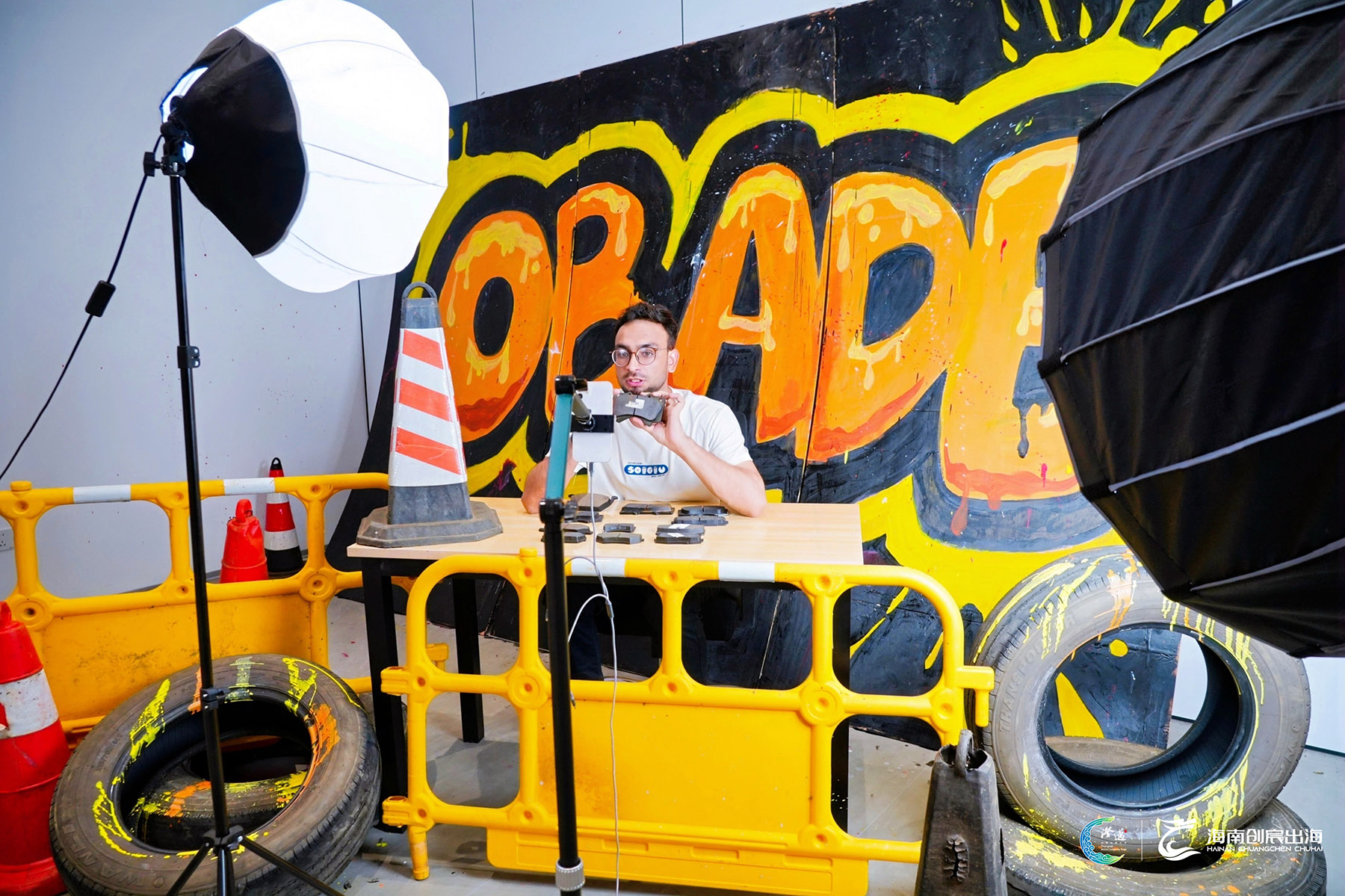
That trust-building is exactly why Hainan's cross-border e-commerce players are doubling down on foreign hosts. Xu Jie, co-founder of Hainan Chuangchen Overseas Enterprise Services, runs a livestreaming base in Chengmai that now employs hosts from nine countries — Pakistan, Egypt, Morocco, Ghana, Congo and beyond.
"In the Chinese mainland, it's very difficult to get work visas for foreign livestreamers. Thanks to Hainan's policy, we can legally hire foreign hosts. We also have dedicated cross-border livestreaming lines that ensure real-time transmission with very low latency. Overseas consumers see a local face, hear a local accent and receive a local cultural reference. That's an unbeatable advantage," Xu said.
Behind the smiling faces on camera is a carefully engineered policy environment. Xu said: "Without Hainan's special policies, we couldn't have built this international team."
Hainan Free Trade Port has rolled out a suite of measures that directly benefit cross-border e-commerce. For foreign talent, the process has been streamlined. Hainan now offers a joint work permit and residence permit application that takes just three working days — a reduction of more than seventy percent compared to traditional procedures. Work permits, once issued for three or six months, are now routinely valid for a year.
"That means our foreign hosts can legally live and work in Hainan for the long term. That stability is essential for building a team and growing a business," Xu said.
Even more attractive are the cost advantages brought by the customs policies. Xu calculated that with individual income tax capped at 15 percent for high-end talent — and corporate income tax at 15 percent for encouraged industries — his total operating costs are fifteen to twenty percent lower than in the Chinese mainland.
For a company that employs dozens of international staff and ships thousands of parcels daily, that is a game-changing edge.
Why has Chengmai become the epicenter of this activity? The county, located in northwestern Hainan, sits inside the half-hour economic circle of the provincial capital Haikou. It is close enough to benefit from Haikou's infrastructure, but affordable enough to host large-scale operations.
Huang Wanshu, deputy director of the Bureau of Commerce in Chengmai, said the strategy comes with right timing, right location and right people.
The location includes Macun Port — a national first-class open port connecting to Southeast Asia and the countries and regions involved in the Belt and Road Initiative. Logistics giants such as JD.com, Prologis, Mapletree and Americold have set up facilities there, cutting transportation and customs costs by at least 10 percent.

As for people, Chengmai has adopted a "talent first" philosophy, streamlining bureaucratic hurdles and providing value-added services. "We chose the '100 meters deep, one meter wide' approach — focusing on a niche section of cross-border e-commerce, and digging deep," Huang said.
But Chengmai's ambitions rest on more than low costs and good ports. The county also boasts Hainan's first and largest digital economy cluster — Hainan Ecological Software Park.
"More than 17,000 enterprises have registered there, with combined annual revenue exceeding 200 billion yuan ($29.3 billion). Tech giants including Baidu, Tencent and Meituan have a presence."
The park was also approved as one of China's first digital service export bases, and its game-centric global public services platform has launched 158 Chinese games overseas, with more than 12 million registered users outside China.
"That digital infrastructure provides invaluable technical and data-compliance support for cross-border e-commerce," Huang said.
Financial services are equally robust. Chengmai has built a fund matrix of "mother funds plus sub-funds plus special funds". The entire county now hosts 55 registered private fund managers, managing 1,748 funds with total assets exceeding 220 billion yuan — more than half of the entire island's total.
The story of Chengmai is not isolated. Across Hainan, a bigger picture is emerging. In Haikou's industrial parks, livestreaming rooms facing Southeast Asia are running at full capacity. More than a thousand foreign livestreamers now operate in that park alone.
In Sanya, cross-border e-commerce charter flights are also busy traveling around the world.
Zhang Chunsheng, president of the Hainan Cross-border E-commerce Association, puts the transformation into a historical context.
"For a long time, when people in Hainan said 'cross-border e-commerce', they meant imports," he recalled. "Without a strong manufacturing base like Guangzhou or Hangzhou, Hainan naturally focused on bringing goods in — that's how we got the label 'the island of imported goods'."
That began to change two years ago, when the so-called "9610" e-commerce retail export model took off. About two years ago, Hainan's cross-border e-commerce export value reached roughly 2 billion yuan, mostly via "transshipment aggregation" — mainly goods made in the Pearl River or Yangtze River deltas being shipped to Hainan for customs clearance, then sent directly to overseas consumers using Hainan's extensive Southeast Asia shipping routes.
Special customs operations have brought two major benefits, Zhang said. First, the entire island has become a comprehensive pilot zone for exports — a scale and degree of autonomy unmatched anywhere else in China.
Second, a massive tourist dividend has evolved. "Hainan receives about 90 million tourists a year. That could rise to 400 million within two to three years," Zhang predicted. Those 400 million visitors will generate new offline-online hybrid models — O2O, self-pickup and fast delivery — aimed at foreign travelers, creating a completely new growth frontier.
ALSO READ: Secondhand luxury goods sellers tap overseas markets
"Some people say Hainan has no industry cluster," Zhang said. "But neither did Hong Kong nor Singapore. Hainan's goal is to become a free trade port with its own manufacturing support. The current zero-tariff policy covering 6,600 tariff lines benefits enterprises, but the real intent is to encourage the import of production-oriented raw materials to attract substantive processing and manufacturing to the island, and to gradually cultivate a local industrial base. That road is longer, but once built, its value will be much higher."
As dusk falls over Chengmai, Imane wraps up her final broadcast of the day."I'm not just selling a lamp or a speaker," she said, unplugging her microphone. "I'm showing them that Chinese innovation is real, that it can make their life better. And I'm from Morocco — they see me, they trust me and they start to trust China."
Hainan, once a tropical vacation getaway, is now a frontier of a different kind — an island where a young woman from Casablanca and a young man from Accra are helping the world see a new China, one livestreaming session at a time.
Contact the writers at masi@chinadaily.com.cn
