

FM’s visit to Cambodia, Thailand and Myanmar underlines focus on region
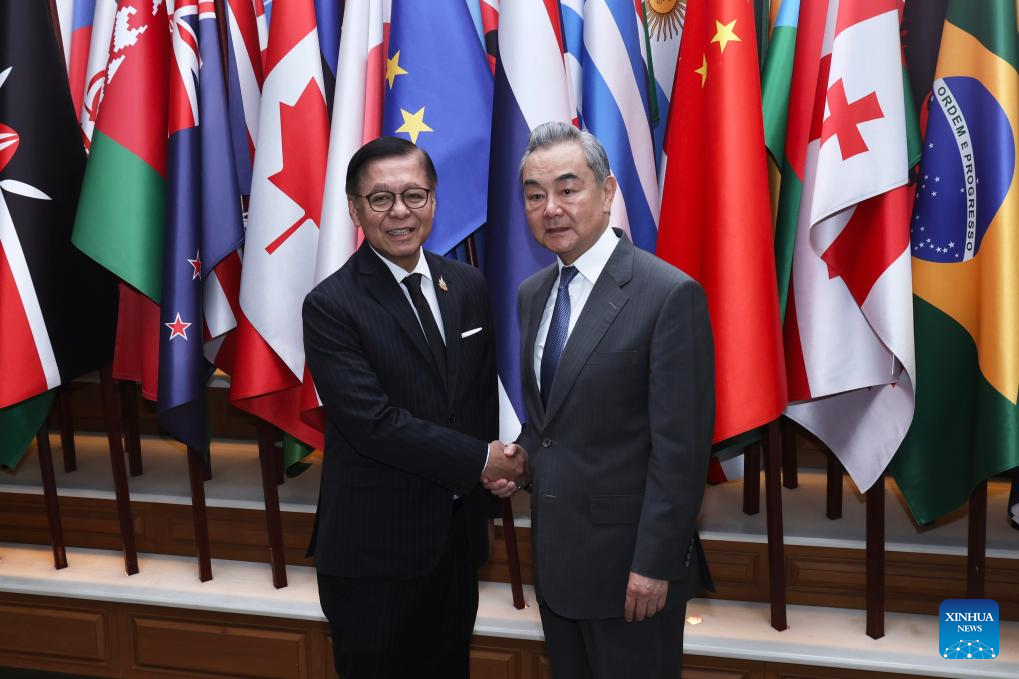
Foreign Minister Wang Yi wrapped up a five-day visit to Cambodia, Thailand, and Myanmar on April 26, a tour analysts said underscored Beijing’s efforts to deepen political trust, expand practical cooperation, and promote regional stability amid rising external uncertainties.
Myanmar was the final stop of Wang’s tour. He was the first senior foreign official to visit Myanmar after its new government was elected, underscoring the importance Beijing attaches to relations with the country as it enters a new stage of national development, observers said.
Meeting with Myanmar President Min Aung Hlaing in Nay Pyi Taw, the capital of Myanmar, on April 25, Wang said China’s Myanmar policy has been consistent. Min Aung Hlaing told Wang that Myanmar would never allow any act that harms China’s interests to take place on Myanmar’s territory.
During talks with Myanmar’s Union Minister for Foreign Affairs Tin Maung Swe, Wang called for stronger cooperation in areas including energy, trade, and investment, as well as closer security coordination to safeguard border stability and combat online gambling and telecom fraud.
Du Lan, deputy director of the Department for Asia-Pacific Studies at the China Institute of International Studies, said the visit reflected China’s constructive role in Myanmar’s peace process and regional stability. She said the consensus reached on post-earthquake reconstruction and the China-Myanmar Economic Corridor also showed the breadth of bilateral cooperation.
The Myanmar visit was part of a wider regional itinerary in which security, development, and sub-regional cooperation emerged as common themes.
On April 24, Wang’s stop in Thailand came at the start of the new Thai government’s term and sought to build on the momentum of the 50th anniversary of China-Thailand ties, as the two sides aim to translate their long-standing friendship into more substantive cooperation.
At a meeting with Thai Prime Minister Anutin Charnvirakul in Bangkok, the capital of Thailand, Wang said China supports the government’s efforts to accelerate economic development.
Wang also held talks with Sihasak Phuangketkeow, Thailand’s deputy prime minister and foreign minister. He said that China has always regarded Thailand as a priority in its neighborhood diplomacy, and expressed hope for improved Thailand-Cambodia relations, adding that China is willing to continue providing a platform to help the two sides to rebuild mutual trust.
According to Thai media, Sihasak said after the meeting that Thailand and China would draw up a five-year action plan for bilateral ties, with future cooperation expected to focus on stronger economic links, shared development, digital innovation, and the green transition.
Wang began his tour in Cambodia, where he attended the first China-Cambodia “2+2” strategic dialogue mechanism between foreign and defense ministers in Phnom Penh on April 22. The two sides reached a six-point consensus, and Wang also met Cambodian leaders during his two-day visit.
Zhou Fangyin, a professor at Sun Yat-sen University’s School of International Studies, said recent progress in security-related ministerial mechanisms between China and the Association of Southeast Asian Nations members, including dialogues with Indonesia, Vietnam, and Cambodia, signals a new level of strategic trust.
A recent survey by the ASEAN Studies Centre at Singapore’s ISEAS-Yusof Ishak Institute showed that 52 percent of respondents in ASEAN region support aligning with China, suggesting a notable change in regional strategic preferences.
Zhou said the findings highlight the growing importance of the consistency and predictability of China’s neighborhood diplomacy.
Du from CIIS said that Wang’s visits reflected both deeper bilateral engagement and stronger regional coordination, as China seeks to respond to uncertainty with stability, promote security through development, and advance peace through cooperation.
Contact the writers at zhaojia@chinadaily.com.cn
