

Guidance, expert connections provided to patients in outlying communities
Qian Zhifang sat at the kitchen table in her home in rural Hubei province, scrolling through her phone. The 65-year-old factory worker had just checked her blood pressure using a smartwatch her daughter had bought her. Within seconds, a message appeared on the screen, saying that her reading was slightly elevated.
Instead of traveling hours to the nearest city hospital in Wuhan, Zhang opened an app and typed a question, and the response came almost instantly from an artificial intelligence doctor.
"It reminded me to monitor my salt intake and suggested when to see a 'real' doctor," Zhang said. "For someone like me, it feels like having a family doctor at home."
She is part of a growing wave of digital healthcare users. What began as a set of experimental tools is evolving into a system operating at scale, one that simultaneously guides patients in daily health decisions and supports doctors in clinical care.
READ MORE: AI has finger on pulse of healthcare advances
At the center of this transformation is Ant Health's AQ, launched in mid-2025. The platform has grown rapidly, particularly in smaller cities and rural areas, where access to specialists remains limited. The company reports surging adoption, with combined daily consultations exceeding 10 million and monthly active users tripling that number.
Its popularity reflects a structural challenge long facing China's medical system. While the country has world-class hospitals in major cities like Beijing and Shanghai, patients from smaller towns and rural areas often travel long distances for specialist care. Many crowd into large urban hospitals for conditions that might be handled elsewhere.
AQ aims to relieve some of that pressure by combining AI-generated health guidance with access to real doctors.
"People often need guidance before they ever see a doctor, and support after they leave the hospital," said Shen Yunfang, head of communications at Ant Health. "Our goal is to help users understand their health situation earlier, while making sure they still seek professional medical care when needed."
Behind the app is a large network of medical data and partnerships. According to Ant Health, the system draws on clinical guidelines, peer-reviewed medical journals, and collaborations with more than 5,000 hospitals and 300,000 physicians. Despite the impressive numbers, the company stresses that the platform is designed to assist doctors, not replace them.
More than 55 percent of AQ users live in third-tier cities or smaller communities, according to the company. "In those regions, people may not have easy access to top hospitals," Shen said.
As these users may depend on the app more than people living in urban areas, Shen assured that they have complete control over the uploading and utilization of their data, including test results, prescriptions, or photos for AI-assisted interpretation through the platform's question-and-answer function. Privacy protections automatically blur sensitive information, and data is encrypted end to end, she said.
"We strictly follow the nation's legal requirements and regulations, and ensure that only the user can access their health data," Shen said."Trust is critical when dealing with medical information."
One of the app's most unusual features is a library of "AI doctor avatars". These digital assistants are modeled on the knowledge and clinical experience of more than 1,000 physicians.
Patients can ask routine questions to these virtual doctors, while complex cases are redirected to human specialists.
"The avatars allow doctors to focus their time on difficult cases," Shen said. "At the same time, they allow patients in remote areas to interact with medical experts they might otherwise never reach."
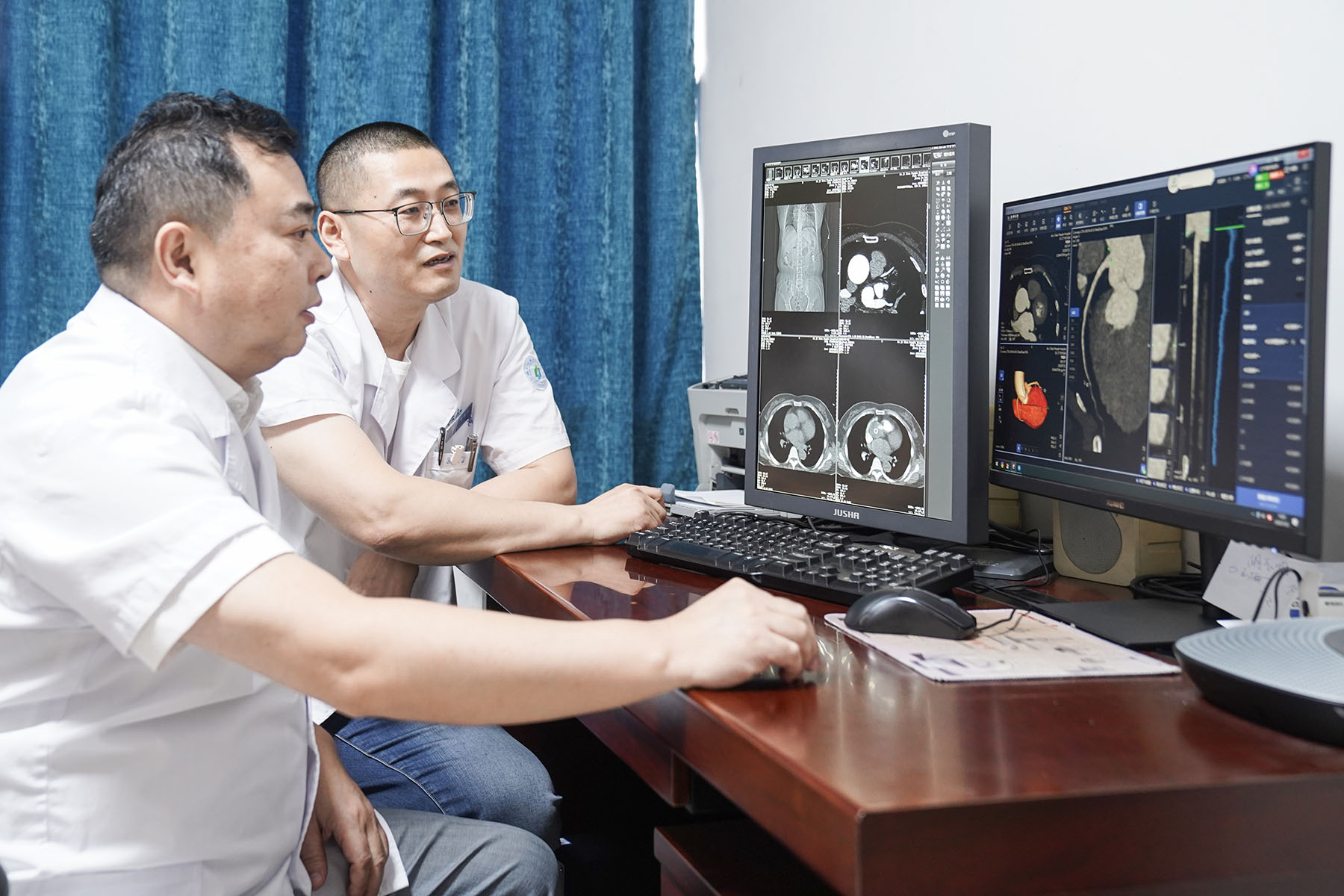
Beyond commercial platforms, researchers are pushing the boundaries of what AI in medicine might become.
At Tsinghua University, scientists have developed an experimental system known as "Agent Hospital", where AI doctors are trained to diagnose and treat simulated patients in a fully virtual environment. The system allows multiple AI agents to collaborate, mimicking the workflows of real hospitals.
"The idea is to let AI systems learn medicine the way young doctors do, through repeated exposure to cases, decision-making, and feedback," said Liu Yang, executive dean of the Institute for AI Industry Research at Tsinghua University and the project's lead scientist.
"In a virtual setting, they can accumulate experience at a scale and speed that would be impossible in the real world," Liu said.
The project offers a glimpse of a more automated future, in which elements of medical care could be scaled far beyond the limits of human staffing.
"We are not trying to replace hospitals," Liu added. "But we are exploring how parts of medical reasoning and routine care could be standardized and extended through AI."
Yet as the technology advances, so do the questions surrounding it.
The rapid expansion of AI healthcare tools has sparked debate over accuracy, accountability, and the evolving role of physicians.
While platforms emphasize that AI is designed to assist rather than replace doctors, some experts warn that overreliance on automated systems could introduce new risks, particularly in complex or ambiguous cases.
"Medicine is full of uncertainty," said Mo Kai, a Beijing-based health policy expert. "When cases fall outside standard patterns, human judgment becomes critical, and that's where current AI systems still struggle."
There are also concerns about accessibility. While digital tools can extend care to underserved populations, they may be less effective for elderly users or those unfamiliar with smartphones.
"Technology can expand access," Liu said, "but ensuring that it remains usable and trustworthy for all populations is just as important as improving its intelligence."
Some physicians say such tools are already changing how they work.
Zhang Ling, a cardiologist at China-Japan Friendship Hospital, uses Ant A-Fu's desktop platform to manage online consultations and review patient histories.
"The AI assistant organizes patient information before I even begin the consultation," Zhang said. "It identifies potential warning signs and highlights urgent cases."
That kind of triage can be valuable in China's busiest hospitals, where doctors often see dozens of patients each day.
"It doesn't replace clinical judgment," Zhang added. "But it can make the system much more efficient."
Still, adoption has not been without resistance, particularly from within hospitals. Some administrators and clinicians remain cautious about integrating large AI models into clinical workflows, citing concerns over reliability and professional risk.
"Medicine is not just pattern recognition, but involves judgment, responsibility, and uncertainty," said a hospital administrator who asked not to be named.
"If an AI system produces an incorrect recommendation, even rarely, the consequences in a clinical setting can be serious. That's where many institutions remain hesitant."
Concerns over data governance present an additional barrier. While technology companies stress that patient information is protected, some hospitals are reluctant to share internal data with external platforms, fearing loss of control or unintended exposure.
"From the hospital's perspective, data is one of its most sensitive assets," the administrator said.
"Even if companies claim the data won't be used beyond specific applications, it sometimes sounds not trustworthy enough. Trust takes time to build."
ALSO READ: TCM on verge of expansion, AI main driver
Developers say such concerns are understandable, but, in many cases, misplaced. According to Shen, the Ant Health communication head, most platforms operate under strict data isolation protocols, with patient information encrypted and stored within controlled environments.
Data used for AI-assisted services is typically not fed back into foundational model training, and these safeguards are often written into formal agreements with partner institutions.
"We don't use hospital data to train base models, and that is clearly specified in our contracts," Shen said. "There are also strict rules governing data storage, access permissions, and system architecture."
With AI medicine remaining a developing field, experts have said that algorithms must cope with more diverse medical conditions and the digital barriers faced by users. Ensuring accuracy and maintaining public trust will remain critical challenges.
Ant Health says it is already working on new features, including chronic-disease management tools. A senior-friendly interface with dialect support for elderly users launched in February.
For patients like Qian in Hubei, the technology is already reshaping everyday healthcare. She now checks her blood pressure regularly and consults the app whenever she has questions. If necessary, it can connect her directly to a physician online. "It makes me feel less alone dealing with my health," she said.
Contact the writers at weiwangyu@chinadaily.com.cn
