

An ongoing show at Tai Kwun draws attention to the people behind China’s vast industrial labor force and supply chains, while also celebrating the country’s role as a global connector and leading exporter of human capital. Chitralekha Basu reports.
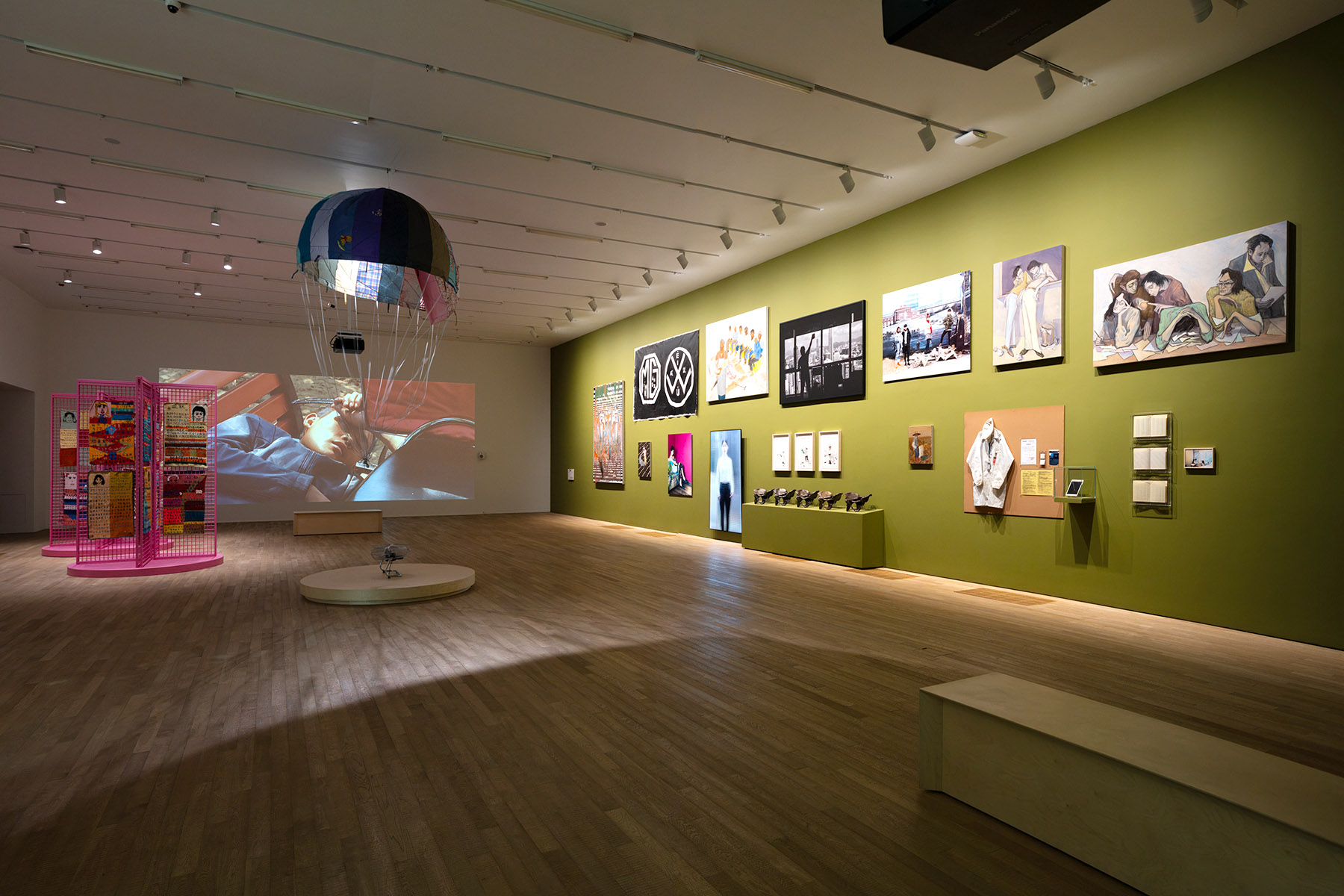
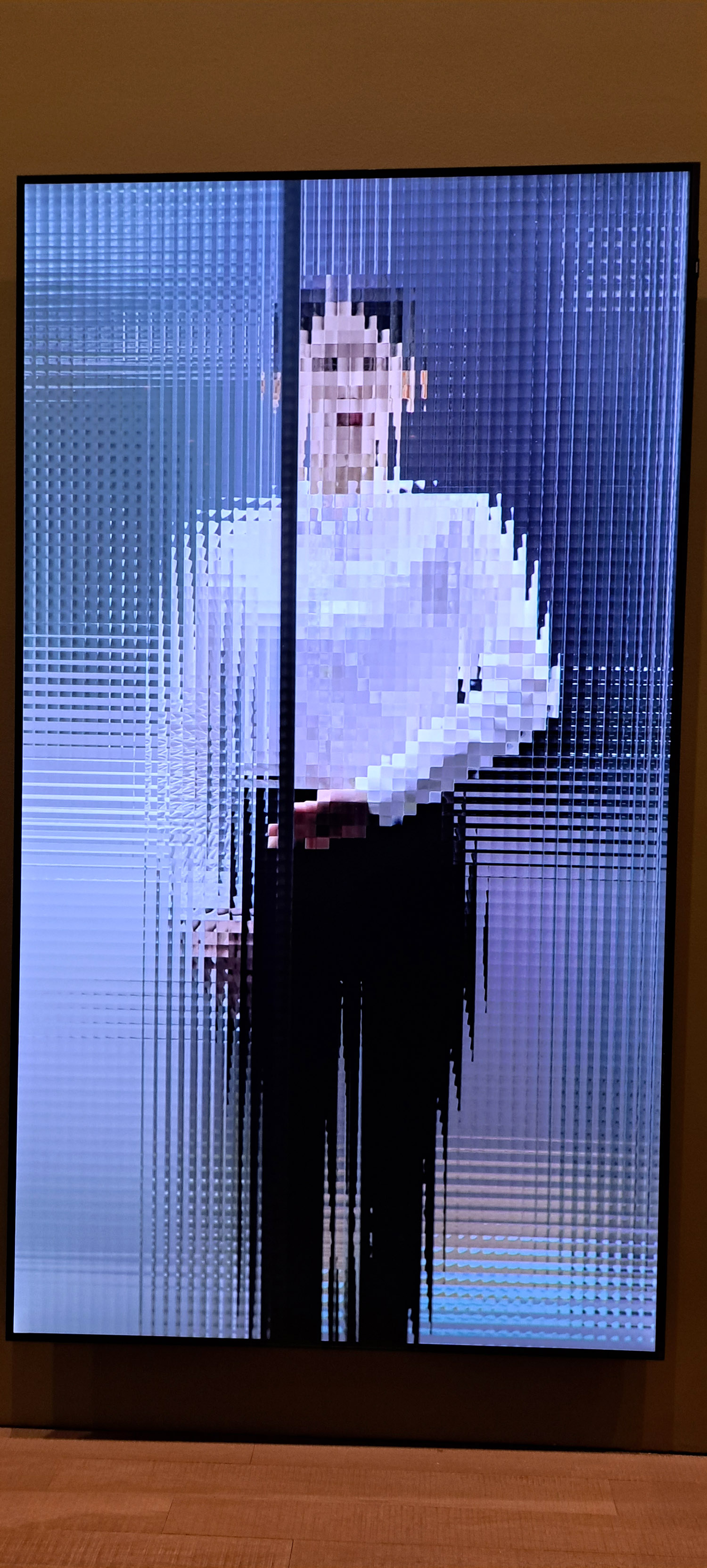
Around two dozen artworks feature in a salon-wall-style display as part of the Stay Connected: Supplying the Globe exhibition at JC Contemporary in Tai Kwun. These are mostly traditional media works, with the exception of Joyce Ho’s video installation, Behind the Scene (2022), in which a woman dressed in the standard hospitality-sector garb of white shirt and black trousers, continuously slides the glass partition separating her from the viewer. Her face morphs into different shapes behind the mosaic glass screen, but remains unreadable — for she is a cog in the wheel of an enormous service-industry collective.
Ying Kwok, who co-curated the show with Pi Li, says that one of its goals is to emphasize the fact that the inconspicuous, and undistinguished, people behind every system and every supply chain are real and human. “We wanted to pay more attention to and show more care toward their desires, feelings, emotions and what they want from life. We are trying to understand the many complicated and human sides of this topic.”
ALSO READ: Setting the stage
Other salon-wall highlights include a set of memorabilia comprising uniform, identity card and labor contract from Li Liao’s time spent as a factory hand at Foxconn’s production unit in Shenzhen as part of a performance art project (Consumption, 2012), and the iPad he bought with his wages at the end of it. There is also Xyza Cruz Bacani’s large black-and-white photo, Domestic Worker Cleaning Hong Kong (2015) — an ode to the anonymous tribe of domestic helpers who make sure that their employers get to enjoy the gorgeous Hong Kong skyline through meticulously scrubbed window panes.
The wall represents a tonal shift from Stay Connected: Navigating the Cloud, which preceded the current exhibition. While Navigating the Cloud was focused on what artists make of the way new and evolving technologies are changing the world as we know it and respond to those changes — often aided by said new technologies — Supplying the Globe seems more interested in the personal journeys of the people whose visibility as makers — whether they work in a manufacturing shed or an artist’s studio — are increasingly getting obliterated in our tech-driven environments.
“Salon walls are supposed to display portraits of powerful people, but in our exhibition, we use it to showcase portraits of different kinds of labor,” says Kwok. “These are portraits of laborers, workers and farmers; these are more of a portrait of their inner worlds, and the artists have actually worked at manual jobs.”
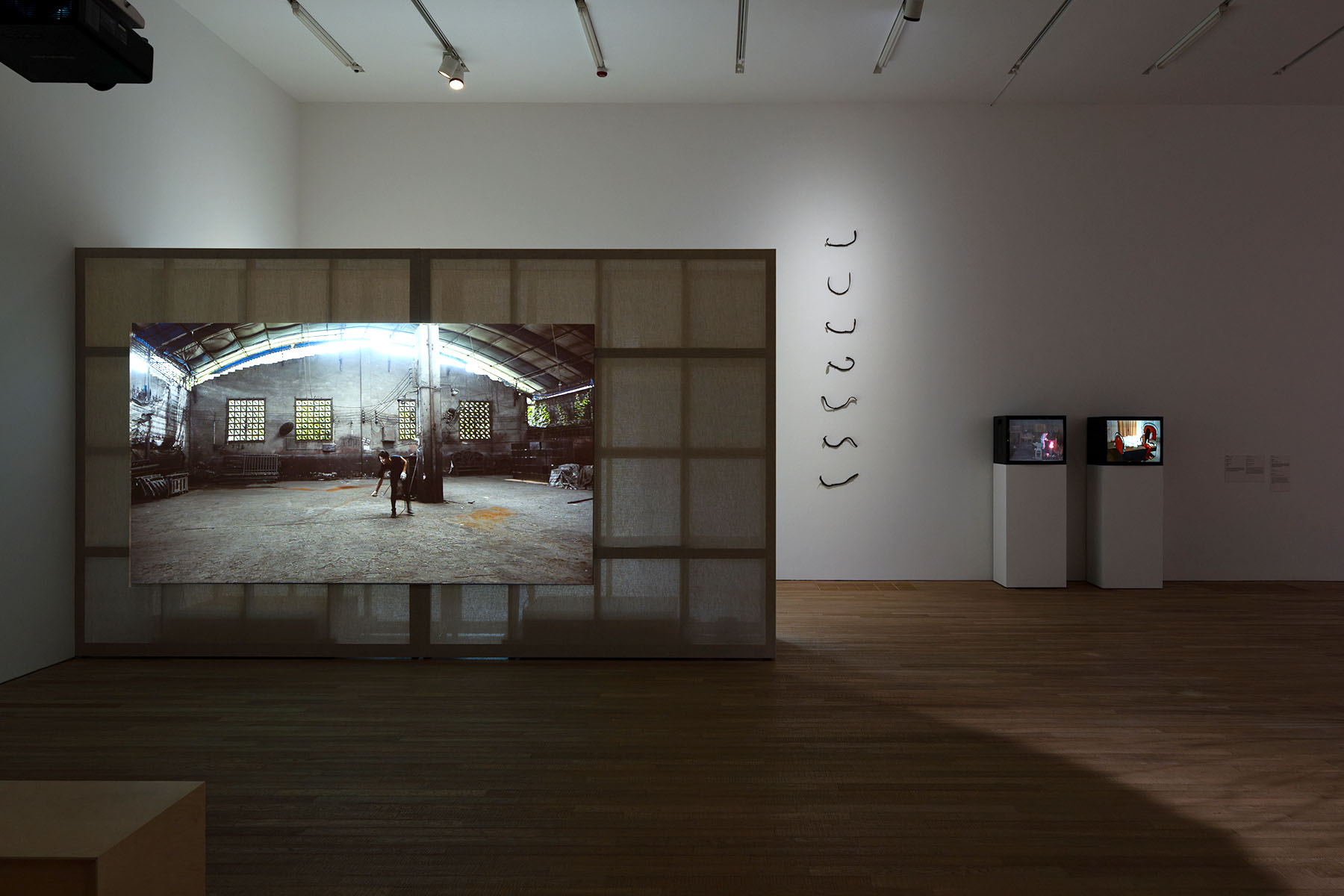
Cruz Bacani was a domestic helper in Hong Kong before she famously won the Magnum Foundation Human Rights scholarship to New York University. Hu Yinping, who is part of the Hu Xiaofang collective for women engaged in textile-based work in rural China, invited its members to tell their stories in the form of hand-crocheted tapestries, which are displayed like an upright, open book. The piece is called CV (2023-25). Tong Wenmin put herself through the wringer for her Factory Project series (2016). Three video installations provide a documentation of her attempts to perform tasks commonly associated with male laborers working in a metal foundry. We see Tong, a slightly built young woman, struggles trying to manipulate a metal strip, several times in length compared to her own height.
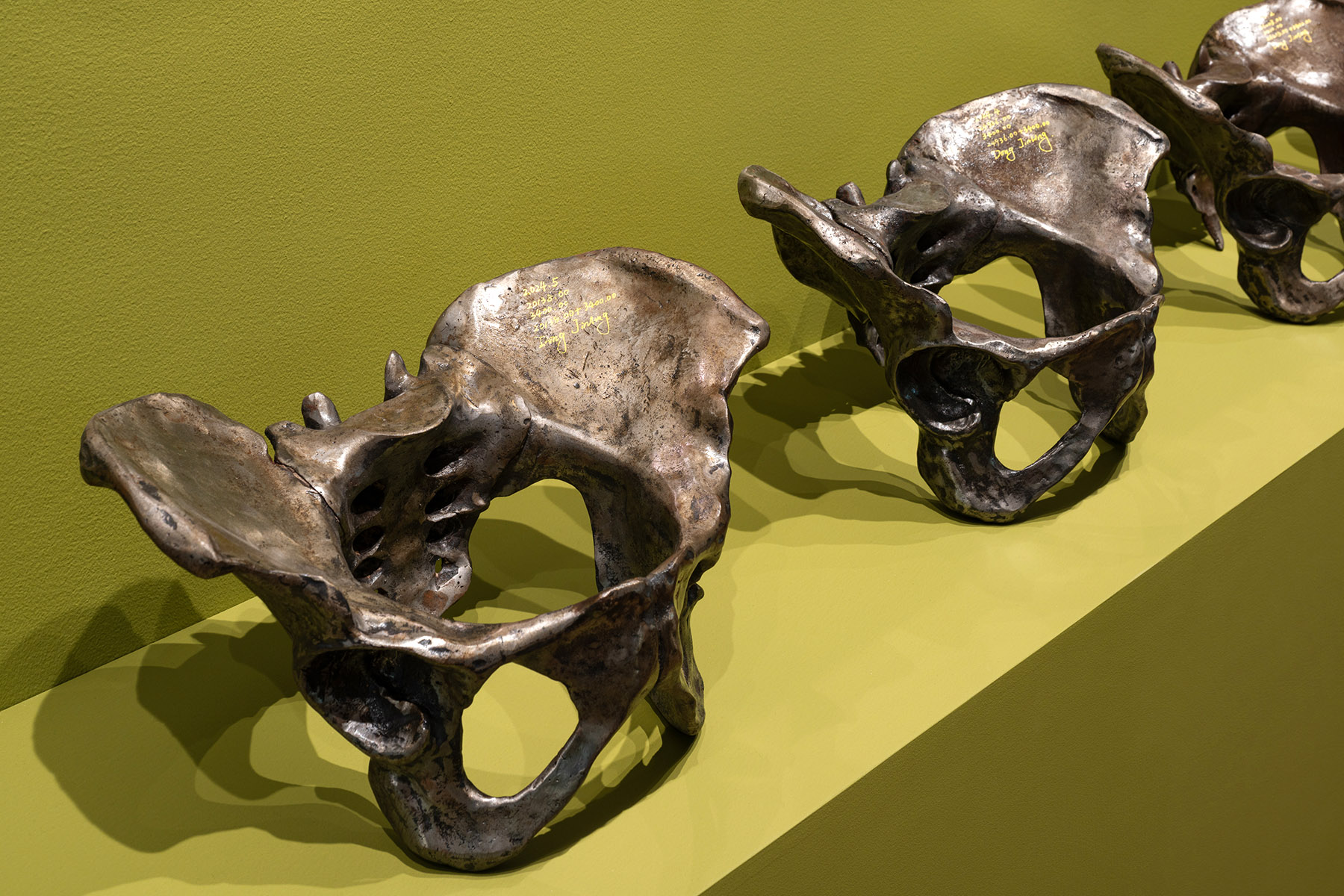
In Dong Jinling’s Workers (2023-24), women laborers are represented in the form of pelvic structures, sculpted in metal. The artist worked as part of different factory settings and supply chains, before commissioning factory workers to fabricate the sculptures. The value of the metal used for each piece in the series is directly proportional to the money its maker earned in terms of wages the week the sculpture was made. The production date, the maker’s salary, fabrication costs and market price of the product are stamped on the metal.
The value of work
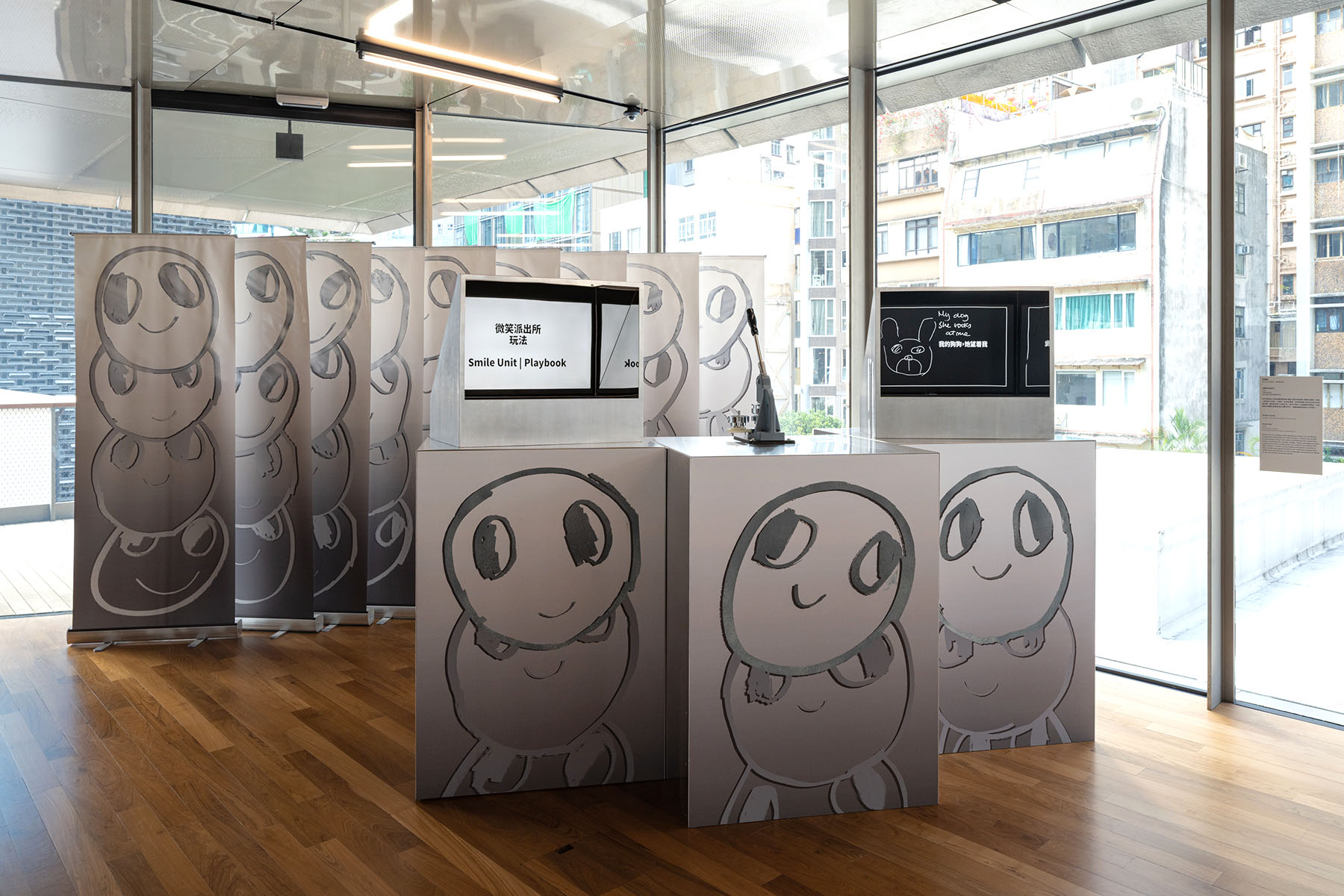
Elsewhere in the exhibition, Ocean Leung’s Smile Unit (2026), an interactive installation specially commissioned for the exhibition, invites participants to share a story, or even a silly joke, that had brought a smile to their lips, and get a smiley badge in return. Each smiley image is a unique deviation from the Harvey Ball-designed perfect, and symmetrical, symbol that has, since its inception in 1963, become universal shorthand for happiness.
Leung says that “the effort and contemplation” that go into thinking up a story in order “to trigger a smile in another person” is what matters the most, as it brings about “a genuine exchange”, or, in other words, a fair transaction. He adds that it is “the seriousness in seeking smiles from participants” that he finds most satisfying.
If the works by Dong and Leung raise questions about the value of labor, Li Ran’s oil-on-canvas painting, Commissioned Thriller Writers (2023), extends the idea to include practitioners of creative and intellectual labor within its scope. Kwok says that Li’s cartoonish portrayal of visibly dejected writers forced to take on thriller-writing gigs refers to the plight of people making a living from creative work “at the time of the COVID-19 pandemic, when a lot of exhibitions were called off, and artists, as well as freelance writers, had to deal with a lot of anxiety”.
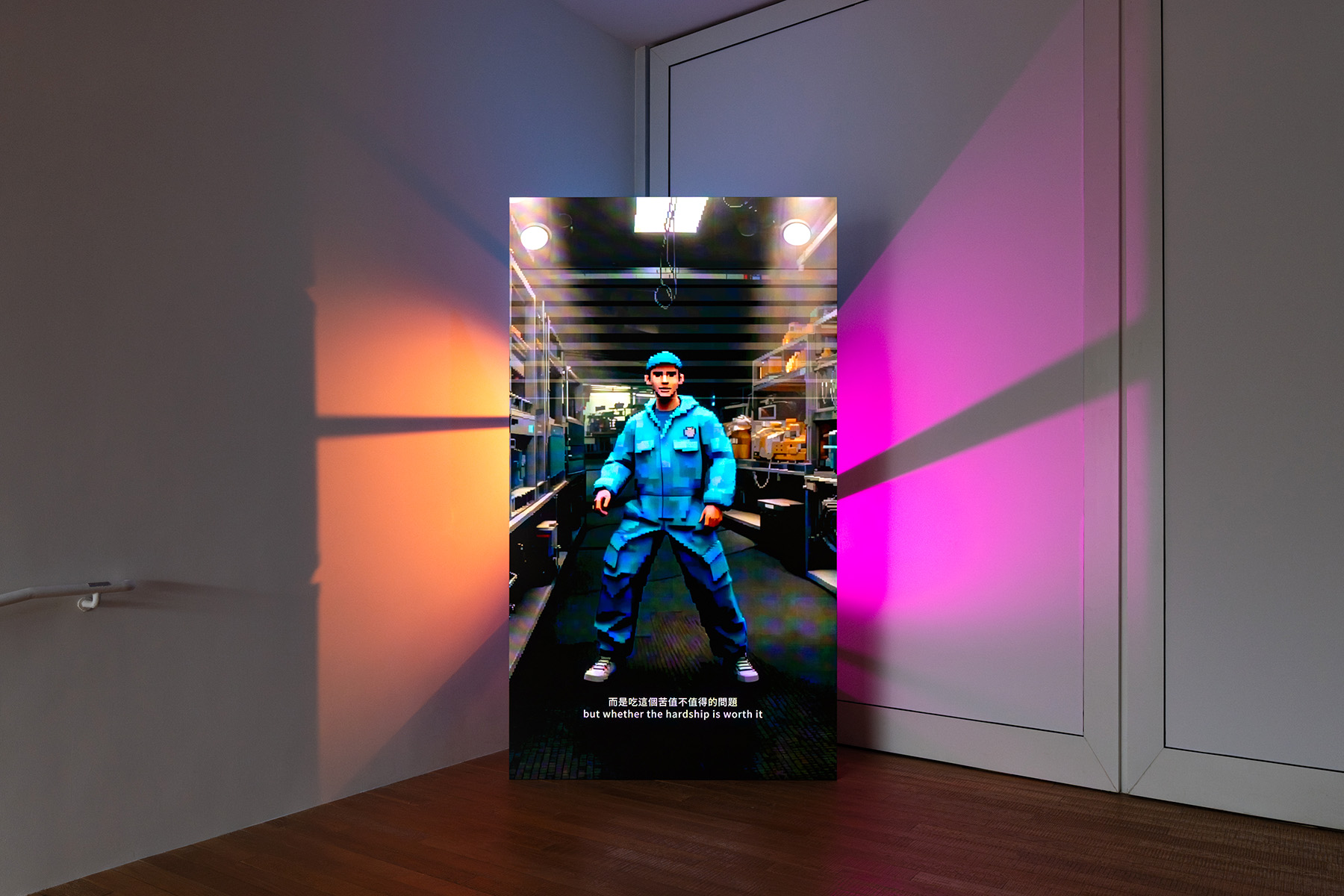
Li Yifan’s video Why Not Dance 2 (2025), however, tells a different story. The documentary features a young factory worker who has taken advantage of the rising labor costs in southern China to change jobs 40 times in two years, thus earning himself the nickname “King of 10,000 Resignations”, and since rebranded himself as a social-media influencer. Li’s other piece, Why Not Dance 1 (2025), is an artificial-intelligence-aided rap video narrating the life story of another factory worker who similarly hops between jobs, sectors, and cities, offering a lighthearted satire on his own state of perpetual migration.
Flow of people and things
Migration of labor is one of the key themes of Supplying the Globe, especially seeing that the trend forms the basis of China’s transition from a mass producer of assembly-line consumer goods to a worldwide exporter of original products and the brains behind them.
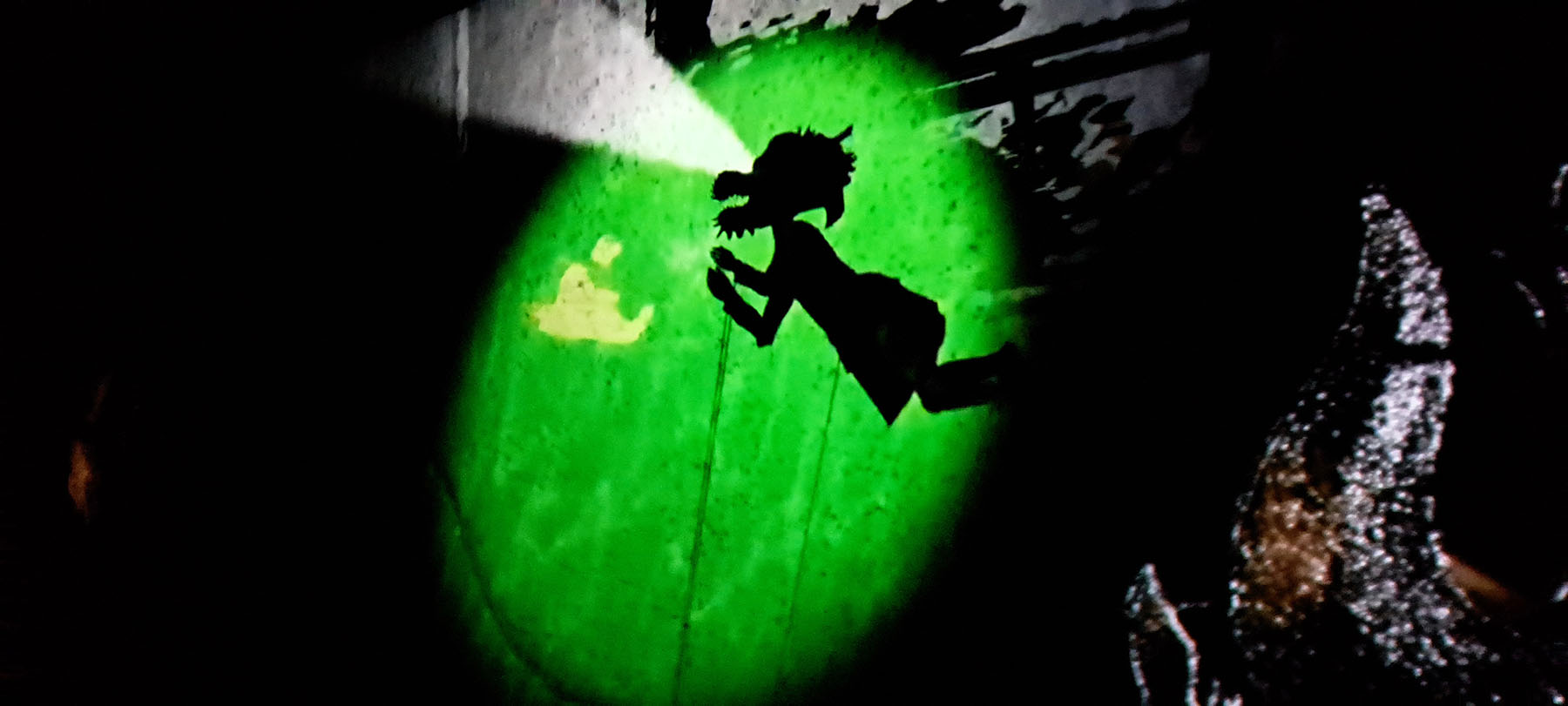
In Tales of the Altersea (2023), Lam Lap-see draws on the journey of her own ancestors from Hong Kong to Stockholm in the ’70s to set up a Chinese restaurant. It is a walk-in immersive 360-degree video installation. Using shadow puppets, Lam tells the story of two sisters who set off on an underwater adventure. Along the way, they come across a dragon boat-shaped restaurant and Lo Ting, a mythological fish-human hybrid figure from whom Hong Kong people supposedly originated.
Projected on fabric, two videos — Song of the Exile and Cool Breezes Gently Sweep Through (2024-26) — by Law Yuk-mui continue the migration story since the ’50s, connecting the Java Sea, the Strait of Malacca, the Seven Islands Sea, the Pacific Ocean, the South China Sea, and Hong Kong’s Victoria Harbour.
Musquiqui Chihying’s three-channel video installation The Link (2024) connects the history of the Chinese laborers recruited to work on the sugar plantations in Mauritius in the early 19th century with that of the submarine cable networks built by Chinese corporations in the eastern African island more recently, in 2019. The artist invited the progeny of the early Hakka settlers in Mauritius to sing Mauritian style for a music video, revisiting historical connections between the two cultures.
ALSO READ: Things fall apart
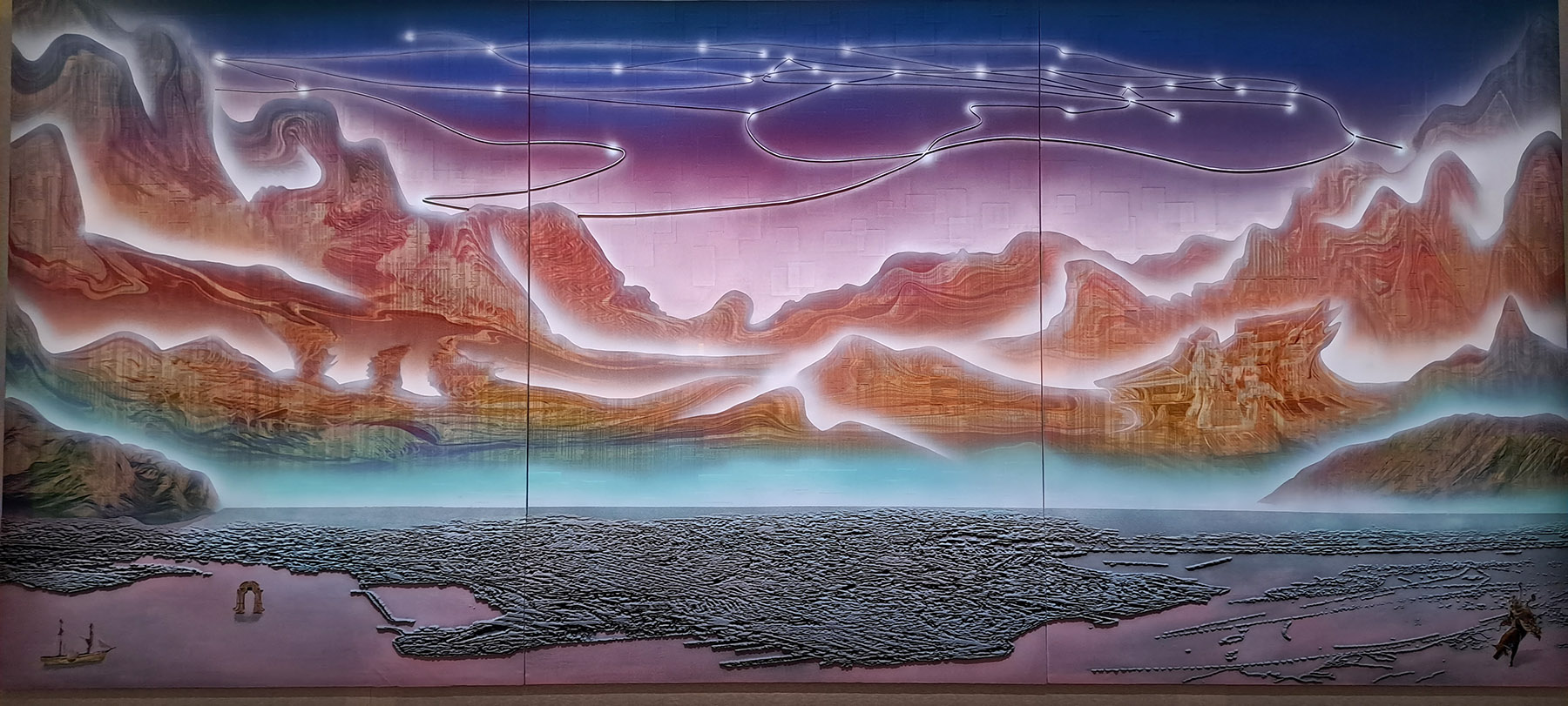
Ho Rui-an’s looping video animation, Ultimate Coin Test China High-speed Rail (2018), shows a two-euro coin perfectly balanced on the ledge of a window in a moving train, a playful comment on China’s role in the worldwide flow of goods and capital. Kwok points out that the piece is meant to be in dialogue with Gordon Cheung’s New Territories (2025), a multimedia collage that makes use of archival inkjet print, PLA filament, sand on linen, and the artist’s signature material — recycled Financial Times pages. It is a vast, surreal landscape with minuscule images of the British gunboat Nemesis approaching the archway to the Old Summer Palace in Beijing in one bottom corner, and a galaxy of interconnected constellations representing the trade routes constituting China’s Belt and Road Initiative taking up the top section. In between this huge swath of history lies the sprawling Kowloon Peninsula and the hills of Shenzhen, layered with newspaper pages displaying stock-market data.
If you go
Stay Connected: Supplying the Globe
Dates: Through May 31
Venue: JC Contemporary, Tai Kwun, 10 Hollywood Road, Central
Contact the writer at basu@chinadailyhk.com
