

A younger generation of writers is redefining the genre, exploring technology, history, and humanity and getting global attention, Yang Yang reports.
Chinese science fiction readers have long been curious about what would follow the success of Liu Cixin's The Three-Body Trilogy. According to Song Mingwei, a noted science fiction scholar and chair of the Department of East Asian Languages and Cultures at Wellesley College in the US, the answer is now clear.
In a video for the "Emerging Chinese Science Fiction Writers: An International Outlook", an event co-organized by the China Writers Association and China Science Writers Association, Song explained that a new wave of Chinese sci-fi is unfolding.
"Following the first wave created by (writers) Liu Cixin, Han Song, Wang Jinkang, among others, which illuminated 'sinotopia' for the world, the second wave of Chinese science fiction is currently being made in a free, nonbinary literary universe created by an entire generation of younger writers," Song said.
READ MORE: Chinese sci-fi eyes long-term growth after decade of fast expansion
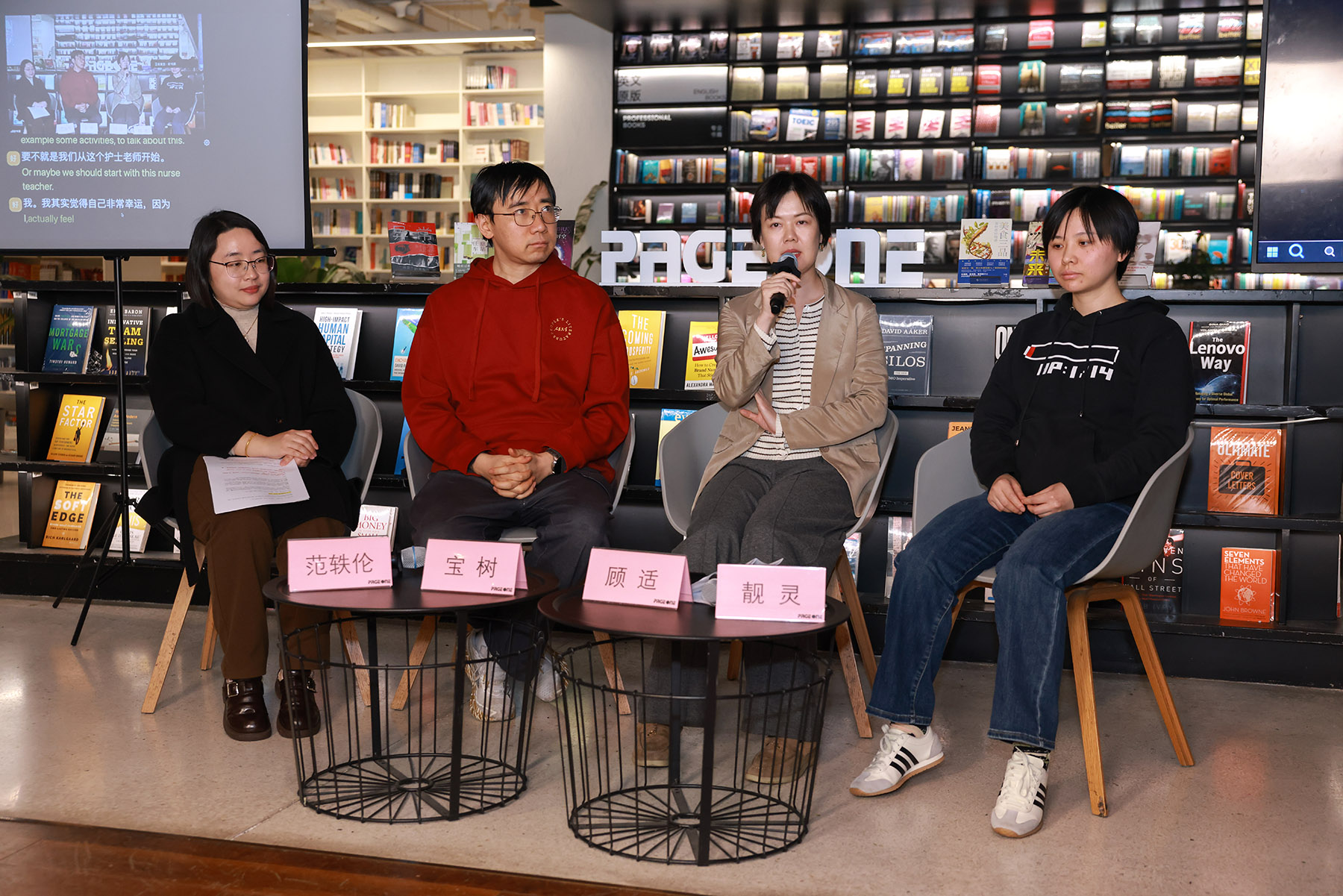
The March 26 event featured seven writers — Chen Qiufan, Liang Qingsan, Baoshu, Gu Shi, Wang Weilian, Liang Ling, and Shen Dacheng — and attracted some 120 sci-fi publishers, writers, translators, scholars, and readers from more than 20 countries, either in person at PageOne Bookstore in Beijing's Qianmen or online.
Song believes this second wave of Chinese sci-fi writing is born from curiosity and uncertainty about the unknown, and conscious dreaming about alternative futures.
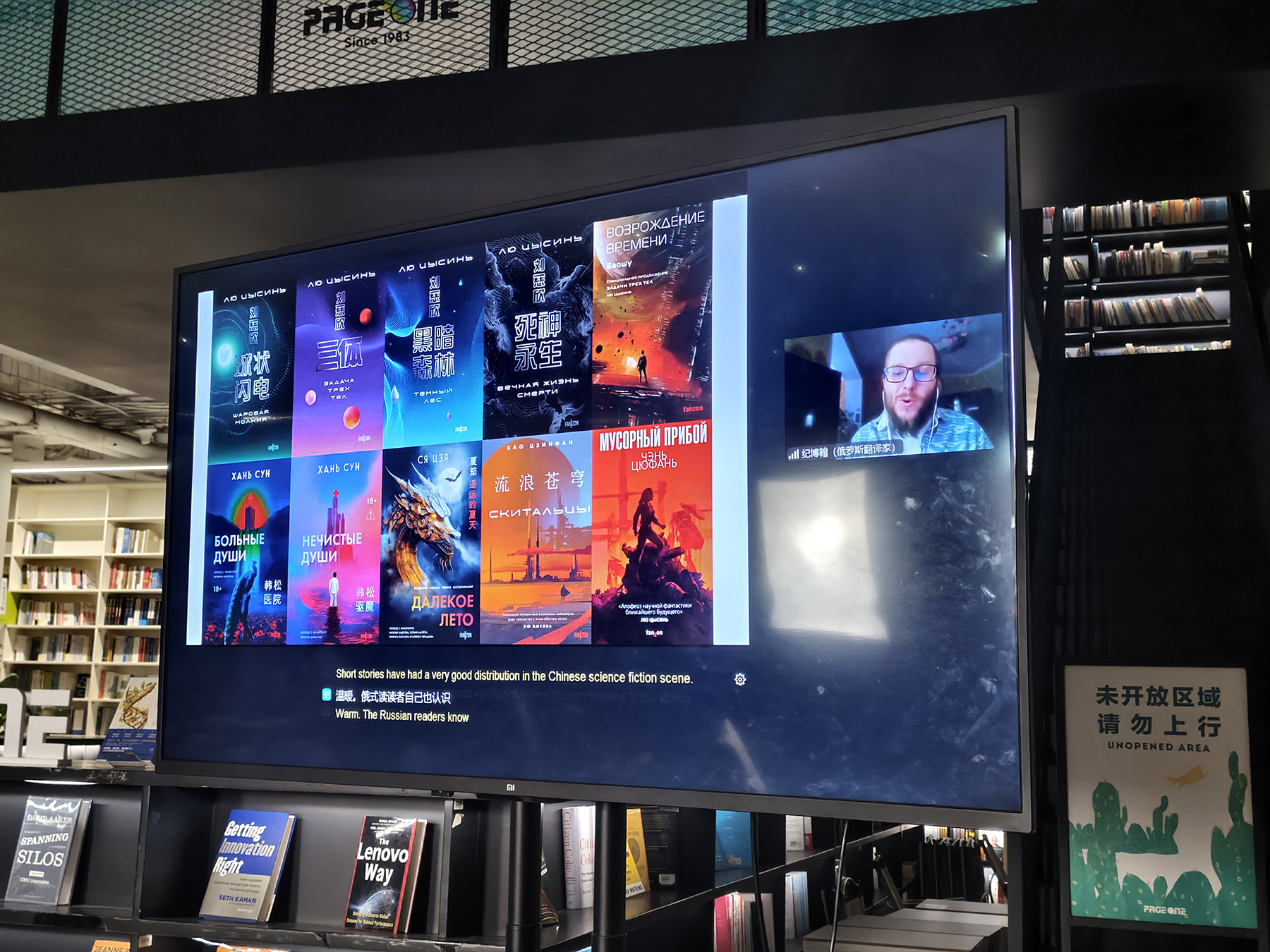
Liu Cixin, also speaking via video, said that humanity stands at a unique point in time where the future is already here, yet history remains ever-present. "As machines grow smarter, people seem more bewildered. The imagination and contemplation of civilization, technology, and human nature have become everyday topics of discussion. Young Chinese science fiction writers are enriching these discussions with their captivating works, providing diverse perspectives rooted in Eastern civilization," Liu said.
Echoing this sentiment at the bookstore, Liang Ling shared her passion for blending reality with imagination in her writing, using science fiction as a means to transcend reality and cross boundaries. Her novella Su Zhi Tian (Speed Candy), found in her latest book Anywhere Station, is written like a documentary and delves into a near-future scenario in the food delivery industry.
In the story, a delivery company introduces a product called "speed candy". When consumed by delivery workers, this sweet doubles their speed, allowing them to complete more deliveries and earn higher incomes. However, the candy has serious hidden side effects, including health issues, accelerated aging, and impacts on the workers' children. Despite these consequences, the delivery company repeatedly conceals the truth.
"Through this work, I want to question our times: as we relentlessly chase a society that values being higher, faster, and more efficient, do health, life, and dignity still hold a place in our priorities?" Liang Ling said at the event.
Following Liang Ling's insights, Gu Shi's multi-award-winning story Ze Cheng (City of Choice) tackles the question, "When humanity faces climate change, should we confront it together, or should we give power to those who are more likely to survive the subsequent disasters?"
The plot features the legendary Chinese figure Da Yu, who is reimagined as an AI navigation system that helps people escape flooding. However, the protagonist, a city safety planner, discovers that the AI prioritizes speed when guiding her child but slows down when she's alone, effectively abandoning the elderly and the sick.
With an open ending, the story "could be a scenario from our era that science fiction can explore, opening up a topic for discussion", she added.
Baoshu, in his comments, said he uses science fiction to reflect on the relationship between history and the present.
In his book series Our Science Fiction Era, the first volume of which has been translated into English and Japanese, he explores themes from the 1960s onward, touching on familiar historical and contemporary issues like the Cold War, the rise of science fiction, and market transformation.
"I want to use a science fiction approach to combine familiar everyday life with our own history, our parents' history, and possibly other elements. The story will be expansive. For instance, I'll use the concept of parallel universes to explore events from the Cold War," he said at the bookstore.
"The topic itself is quite intriguing," he added.
By "science fiction era", Baoshu explained that he uses the idea that "we're currently living in a time that feels very much like science fiction".
However, it is also a way to reflect on history, "drawing inspiration from the sci-fi boom of the early 1920s and our hopes for a bright future after the founding of the nation", he said.
"Many events have unfolded since then, and this history is closely connected to our present. Bringing all these elements together is my ambition," he added.
Liang Qingsan, speaking online, discussed his novel Kaishi De Jieshu Zhi Qiang (The Gun of the End of the Beginning), which aims to prompt the reader to reflect on war.
Set against the backdrop of Northeast China during the Russo-Japanese War from 1904-1905, the work blends elements of history, science fiction, and espionage to tell the story of the protagonist, Zhang Ju, as he seeks a mysterious firearm capable of ending the war and even human civilization.
"In today's world, it's even more crucial for us to reflect on and contemplate the nature of war," Liang Qingsan said. "No matter which side claims victory, humanity as a whole ends up losing. So, who is the real enemy in a war? This is a question I pose in my novel — who is your true enemy? Who are you really trying to defeat?"
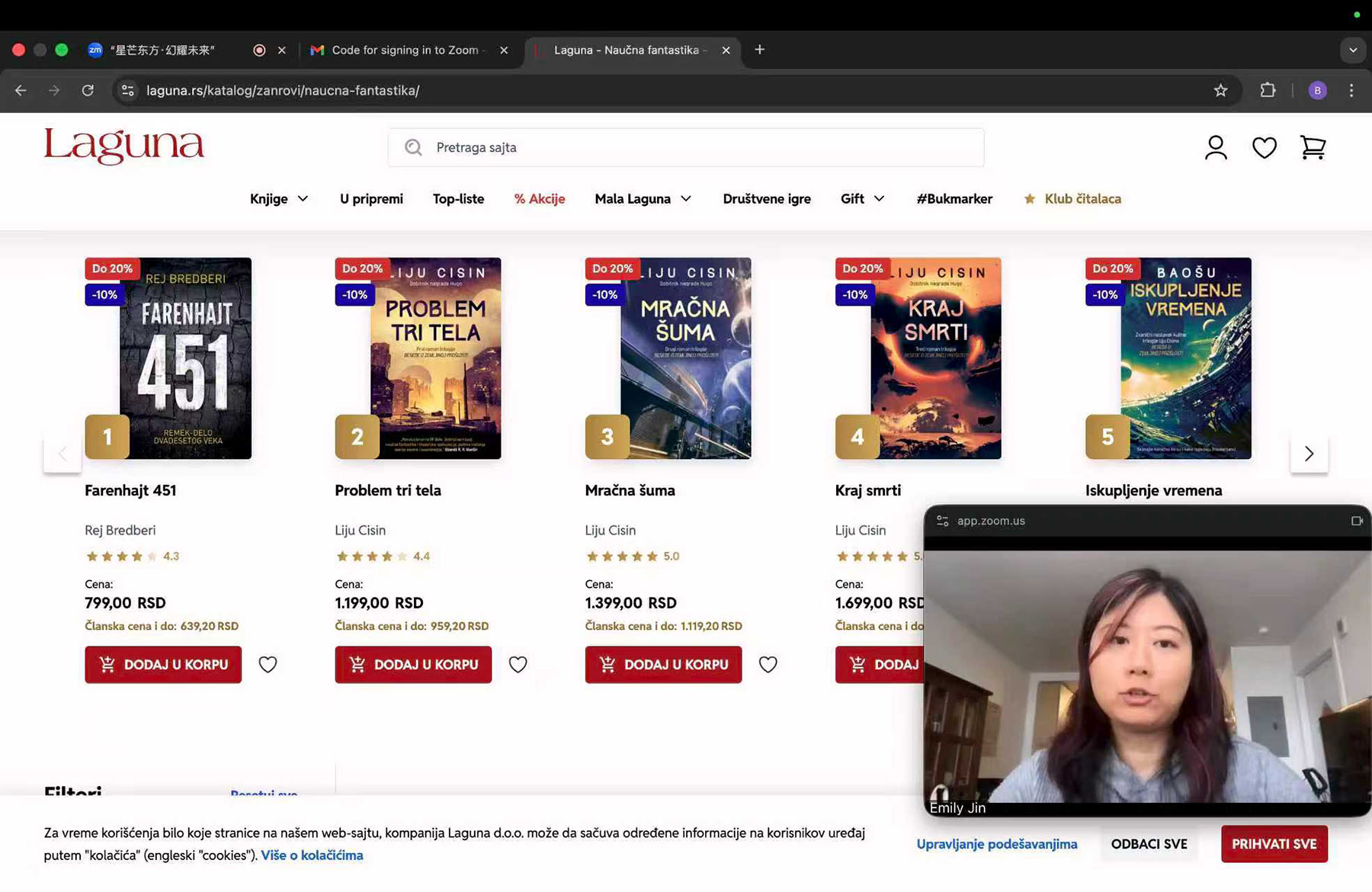
Chinese authors speak with such earnest passion about the genre's philosophy and practice that science fiction seems intrinsically more relevant to contemporary China than to the West, said Nicolas Cheetham, managing director of the British publishing house Head of Zeus. Head of Zeus has published works by several Chinese sci-fi authors, including Liu Cixin, Chen Qiufan, Baoshu, and Hao Jingfang.
Cheetham shared insights into the success of Liu Cixin's The Three-Body Trilogy in the United Kingdom, despite unpromising factors.
After 2009, due to the overwhelming popularity of fantasy series like Game of Thrones, science fiction print sales dropped by 50 percent.
Moreover, due to its much higher cost, only a small fraction of translated fiction reaches English readers, with even fewer works from Chinese authors, and even less in the science fiction genre. For most of the past century, the flow of science fiction has been predominantly from the West to China. Despite China's global market dominance in other sectors since the 1990s, this specific trade imbalance in science fiction remains largely unchanged, Cheetham said.
However, Western science fiction's golden years have shown that technologically induced economic booms are beneficial to the science fiction imagination and science fiction sales, he said.
ALSO READ: Trilogy signals arrival of golden age for Chinese sci-fi
"When the technological and economic changes that took generations in the West occurred almost within a single generation in China, you might well expect a Chinese science fiction bubble, a vibrant modern science fiction scene that reflects a vibrant and modern China."
He noted that science fiction is inherently export-ready, because it is a literature of possibilities, embracing the new and different, and challenging readers with alien concepts.
Moreover, unlike other popular Chinese genres like historical fiction, science fiction's reliance on universal scientific concepts makes it more accessible internationally. Other genres often rely on heavy cultural references that can be difficult to translate without extensive explanation, he added.
"Liu Cixin himself really puts this particularly well when he says that science fiction is the most global, most universal storytelling vessel, with the capability to be understood by all cultures," he said.
Contact the writer at yangyangs@chinadaily.com.cn
