

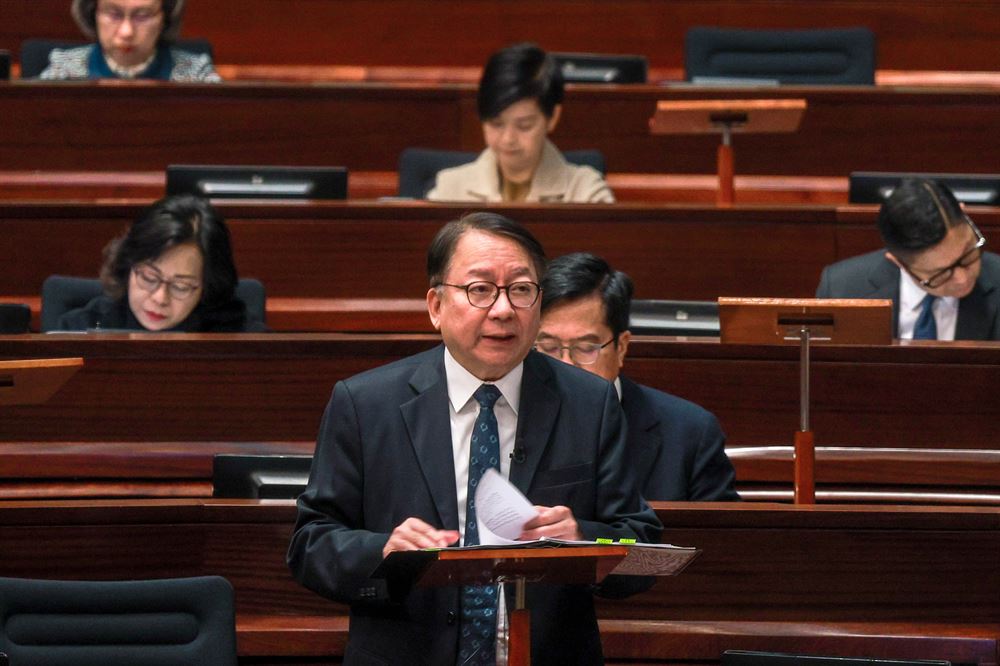
Hong Kong, in the process of drafting its first-ever five-year plan, will actively respond to the call of the nation’s 15th Five-Year Plan (2026-30) to strengthen its national security safeguards, ensuring a top-level design that balances security and development, Chief Secretary for Administration Eric Chan Kwok-ki said.
Chan made the remarks during a group interview ahead of the 11th National Security Education Day, which falls on Wednesday.
The theme of this year’s National Security Education Day is “Proactively Align with the 15th Five-Year Plan, Follow a Holistic Approach to Development and Security”.
Chan described Hong Kong’s own five-year plan as a “macro-level, strategic and forward-looking blueprint” with a goal of completion within the year. He said the plan aims to chart a clear, practical path for Hong Kong’s development, better leverage the city’s strengths to serve national needs, and translate the vast opportunities from national development into “tangible benefits that Hong Kong residents can see and feel”.
READ MORE: HK police's role in ‘impregnable defense’ of national security hailed
To ensure smooth progress, Chief Executive John Lee Ka-chiu will take the lead, with the Constitutional and Mainland Affairs Bureau assuming primary responsibility, and all other bureaus involved.
Chan expressed hope that through collective efforts and wisdom, the plan will serve as a guiding framework for “pioneering new horizons and achieving a new leap forward” for Hong Kong.
However, Chan reaffirmed that security is the prerequisite for development, and development is the guarantee of security. While mapping out social, economic and livelihood development for Hong Kong’s future, authorities will also incorporate considerations of national security and long-term stability from the outset, he said.
Hong Kong will enhance mechanisms for safeguarding national security in accordance with the guidance of the white paper “Hong Kong: Safeguarding China’s National Security Under the Framework of One Country, Two Systems”, issued by the State Council Information Office in February, said Chan. The city will focus on enhancing executive-legislative interactions, governance team training, and patriotic education.

Balancing branches
He said an executive-led political system does not mean the executive branch has the final say, but that the executive, legislature and judiciary each perform their respective functions while cooperating to form a joint governance force. This system helps to “steer the city in the right direction, balance different views, and maintain stability”, Chan said.
In December, before the oath-taking ceremony of newly elected legislators, the government invited them to the government headquarters in Admiralty for exchanges. During the oath-taking ceremony, the chief executive delivered an unprecedented speech to articulate the importance of interaction, cooperation and checks and balances between the executive and legislative branches — examples of the positive engagement seen in recent years.
More notably, Chan said, the Legislative Council is fully cooperating with the SAR government to proactively align with the nation’s 15th Five-Year Plan. In response to a proposal from the chief executive, the legislature has established a dedicated subcommittee to work with the government on consultation and research. According to Chan, these joint efforts will span finance and trade, innovation and industrial upgrading, land and housing, Northern Metropolis development, livelihoods and more.
“This is a groundbreaking step,” he said.
Boosting governance team
Chan also highlighted efforts to strengthen the governance team. To implement the principle of “patriots administering Hong Kong”, he said the officials must have strong national security awareness, a global vision, competence and a passion for public service.
To this end, the SAR government has strengthened institutional safeguards, requiring civil servants to sign declarations or take oaths to affirm their responsibilities. It has also rolled out a range of training measures, including Chinese mainland study tours, professional lectures, and dedicated talent programs.
ALSO READ: Amendments to HK's national security law lauded
Patriotic education remains a key measure for safeguarding national security. Chan said that the Working Group on Patriotic Education, established in 2024, has organized a diverse array of activities, including those based on the 15th National Games — co-hosted by Guangdong, Hong Kong and Macao — and celebrations marking the 60th anniversary of connecting crucial Dongjiang water supplies to Hong Kong.
The working group also promotes curriculum reform and organizes exchange tours for teachers and students to the mainland, ensuring a steady and sustained approach to patriotic education.
As 2027 marks the 30th anniversary of Hong Kong’s return to the motherland, Chan said the authorities will seize this opportunity to promote a patriotic spirit and strengthen young people’s sense of national identity and belonging.
“Security brings stability, and stability enables development. Hong Kong fears no threats and will resolutely uphold its national security duty,” Chan said.
Contact the writers at gangwen@chinadailyhk.com
