

Experts call for boosting economic ties and advancing synergies across continent and beyond
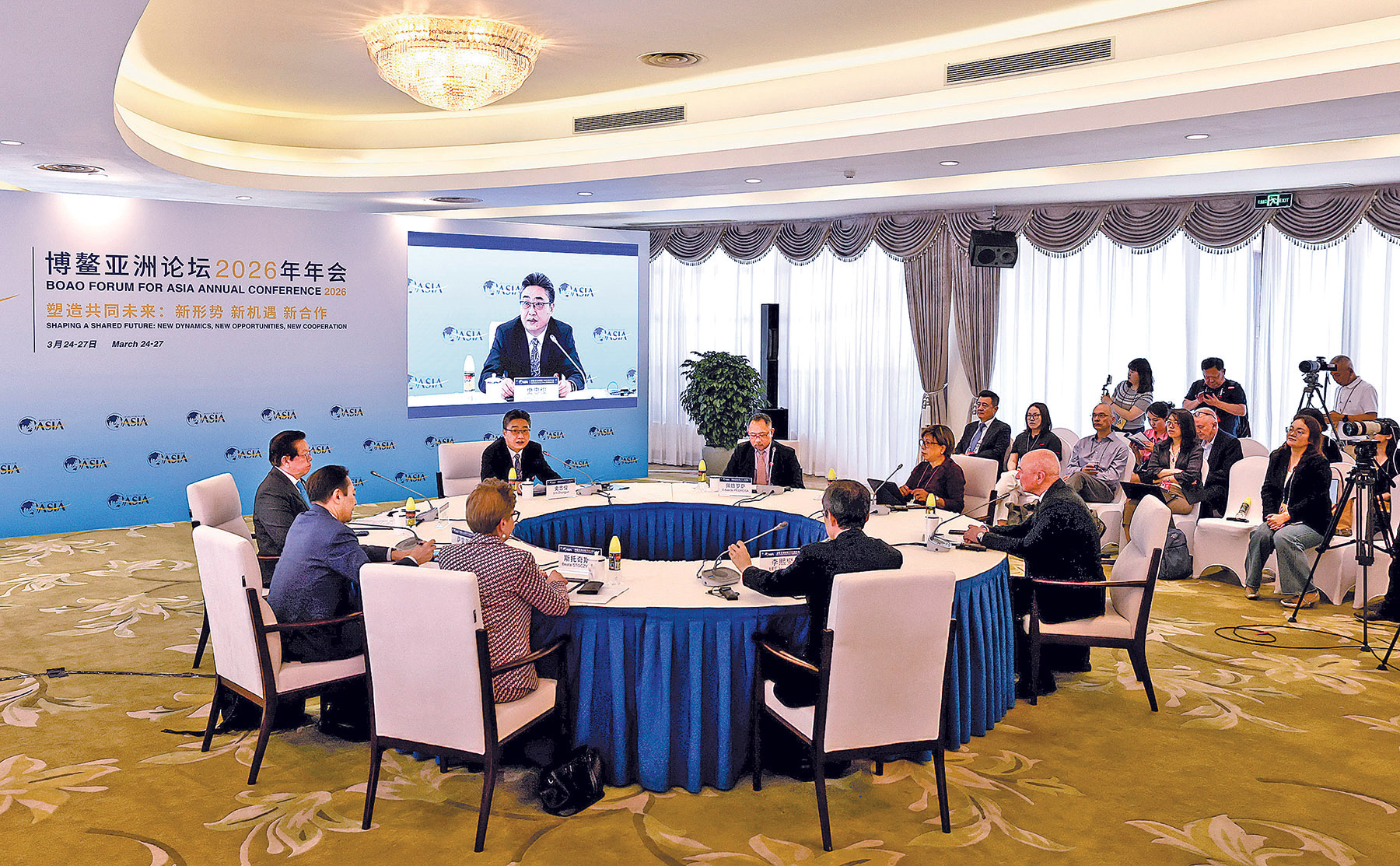
Leading regional organizations in Asia discussed ways to enhance cooperation at the Boao Forum for Asia Annual Conference 2026, with experts calling for increased synergy among different regions for shared development.
“Across Asia and the wider Asia-Pacific, we do not suffer from a lack of forms; we suffer from a lack of interoperability,” said Mohd Faiz Abdullah, executive chairman of the Institute of Strategic and International Studies Malaysia, at a panel session on March 24.
Noting that duplication and inconsistency in work streams and fragmentation carries economic consequences, Abdullah said it is important to use existing agreements as transition engines to develop norms and pilot projects to save time and produce practical results for the public.
Referring to the panel topic “Strengthening Cooperation among Regional Organizations to Forge Synergy in Policy Coordination”, Eduardo Pedrosa, executive director of the Asia-Pacific Economic Cooperation (APEC) Secretariat, said APEC has become a collective forum for regional leaders to address the full range of critical issues both regionally and globally.
He said it is necessary to educate the public and opinion leaders about the region and support free trade to truly address issues such as inequality and fragmentation.
“It is not about forcing people to follow … it is just making sure that we can all work together,” he added.
Taking the Regional Comprehensive Economic Partnership (RCEP) as an example, Rebecca Fatima Sta Maria, former executive director of the APEC Secretariat and director of the Institute for Democracy and Economic Affairs in Malaysia, said the free trade pact demonstrates that when regional priorities are embedded into national strategies, they can deliver real results.
“Four years after it entered into force, the RCEP’s importance to Asia’s economic security has only grown,” she said, noting that the policy certainty shown by regional governments can help attract investments and sustained growth.
Despite the ongoing challenges, Asia remains one of the principal engines of the global economy, with countries pursuing development-oriented cooperation and deepening integration, said Kairat Sarybay, secretary general of the Conference on Interaction and Confidence Building Measures in Asia, an intergovernmental forum headquartered in Astana, Kazakhstan.
“Asia’s future will not only depend on economic dynamics but also on the strength of its operating institutions,” said Sarybay.
Beata Stoczynska, executive director of Singapore-based Asia-Europe Foundation, said there are opportunities for Europe and Asia.
She said both sides can connect regional strengths, such as creating policy dialogues between organizations and enhancing economic and infrastructure connectivity.
Speaking on ASEAN Plus Three cooperation, Lee Hee-sup, secretary-general of the Trilateral Cooperation Secretariat in South Korea, said the organization hopes to further promote the interdependence and synergy between the three countries of China, Japan and South Korea, and ASEAN.
For example, Lee said the organization is working to accelerate regional integration and prepare for the future by expanding cooperation in the digital economy, artificial intelligence and new energy.
“The world is searching for anchors of trust in a sea of uncertainty,” said Charymuhammet Shallyyev, director of the Central Asia Regional Economic Cooperation Institute, an intergovernmental organization dedicated to promoting economic cooperation in Central Asia and along the Silk Road.
Moderating the session, Shi Zhongjun, secretary general of the ASEAN-China Centre, said the region must strengthen multilateral mechanisms, uphold Asian values, strengthen policy coordination and economic integration, and achieve common development.
Contact the writers at kelly@chinadailyapac.com
