

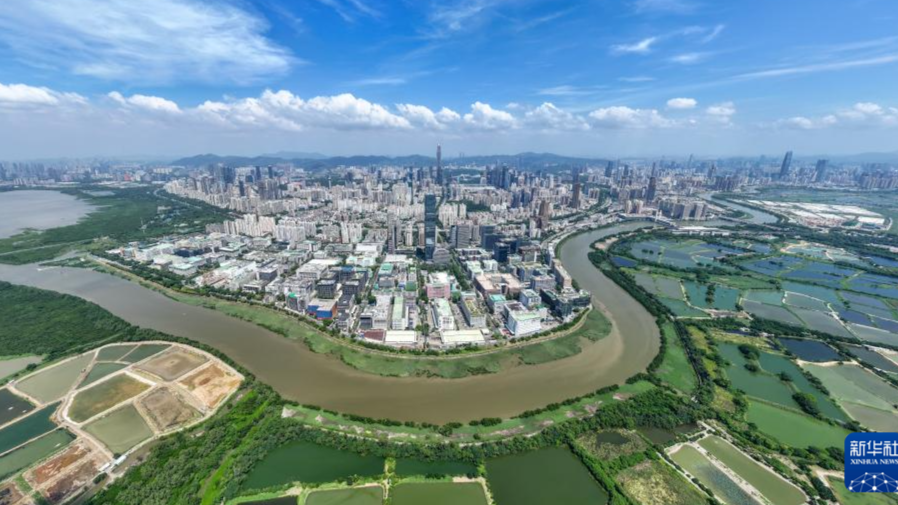
A long-awaited pilot program that allows biological samples from the Chinese mainland to be transferred to and handled in the Hong Kong Park of the Hetao Shenzhen-Hong Kong Science and Technology Innovation Cooperation Zone is set to be introduced this year, a senior Hong Kong Special Administrative Region government official has revealed.
The unprecedented cross-border corridor for specimens would significantly boost the work of life and health technology researchers in the Hong Kong Park, which has already gained momentum in its first three months of operation, said Permanent Secretary for Innovation, Technology and Industry Kevin Choi.
In an exclusive interview with China Daily, Choi, who also chairs the Hong Kong Park’s operator — Hong Kong-Shenzhen Innovation and Technology Park Ltd — said although the cross-border transit of biological samples has long been agreed in principle by Hong Kong and mainland authorities, workable policies must be carefully calibrated against the industry’s actual demands.
“We need companies to tell us what kinds of samples they need,” said Choi. “These could be blood, DNA and cells. Samples are not limited to human origins, but may also be derived from animals or plants.”
Straddling opposite banks of the Shenzhen River, the 0.87-square-kilometer Hong Kong Park and the 3.02- square-kilometer Shenzhen Park jointly constitute the Hetao Shenzhen- Hong Kong Science and Technology Innovation Cooperation Zone.
ALSO READ: Shenzhen sees major efficiency boost in e-commerce export clearance
As a national-level innovation platform, the zone’s “one zone, twin parks” synergy differentiates it from conventional tech hubs and serves as a magnet for enterprises. Its ecosystem allows the seamless cross-border flow of data, capital, talent, and essential materials like biological samples.
Choi said biological specimens are crucial for life science research. For instance, Hong Kong-based researchers could leverage a massive pool of mainland samples — drawing from a demographic of 1.4 billion people — while mainland innovators could gain access to overseas data and research insights, he said. “In my view, Hetao is the only place in China that can truly capitalize on institutional strengths to deliver this work,” he added.
Having matured over several years of operation, Hetao’s Shenzhen Park has successfully housed nearly 500 high-tech firms.
Since commencing operations on Dec 22, the Hong Kong Park — with two wet laboratory buildings and one talent accommodation facility in service — has onboarded over 70 businesses of varying scales from Hong Kong, the mainland and overseas, according to Choi.
“About 40 percent of them specialize in life and health technology,” he said. “I am confident that concrete demands (for imported samples) will emerge very soon.”
Choi said the authorities will soon invite enterprises to outline their biological sample requirements. From those submissions, two companies — one established business and one startup — will be picked to spearhead the pilot program for taking on mainland samples.
As application scenarios diversify, Choi expressed confidence that the two parks will forge further agreements to refine and optimize procedures for cross-border specimen mobility.
Strict biosecurity protocols will govern the initiative. Imported samples must be exclusively utilized and stored within the Hong Kong Park’s boundary.
“We have set aside areas in the park to store the samples,” Choi said. Legislation to regulate the use of mainland biological samples in the Hong Kong Park will be tabled in the Legislative Council later this year, Choi said.
“We are in close dialogue with the enterprises to fully grasp their needs, and we don’t want them to wait for too long,” he added.
Beyond biological material, the mobility of talent remains equally pivotal to the zone’s success. Choi said this has proven a major draw for overseas firms, which currently make up around 15 percent of the Hong Kong Park’s tenants.
“Foreign tenants have told us they are excited to see that Shenzhen is just across the river,” Choi said. “They are keen to explore Shenzhen’s development and exchange ideas with mainland innovators.”
At present, despite a distance between them of only a few hundred meters, the two parks remain physically severed. Those looking to travel between them must detour to nearby border checkpoints.
Choi said the authorities will erect a dedicated footbridge on the west side of the Hong Kong Park, spanning the river to the Shenzhen Park.
On the bridge, which is expected to be completed by 2027, there will be a dedicated checkpoint open exclusively to “whitelisted” travelers — mainly researchers and businesspeople from both parks, Choi said, adding that biometric facial recognition technology will be deployed to enable swift passage.
“We hope the whitelist can cover most enterprises in both parks,” Choi said, adding that those who enter the Hong Kong Park via the bridge could theoretically also travel to other areas of Hong Kong.
He said details, including quotas and other restrictions to safeguard the channel from abuse, are still under discussion.
ALSO READ: GBA urged to boost financial integration
The Hetao zone, and Hong Kong’s Northern Metropolis — a mega township and innovation hub that houses the Hong Kong Park, are both featured in the nation’s 15th Five-Year Plan (2026-30) as key drivers of the city’s competitiveness.
Choi said he is encouraged by the nation’s positioning of Hong Kong as an international innovation center. He vowed to actively participate in formulating the city’s first five-year plan, ensuring Hong Kong’s innovation and technology development aligns closely with the country’s overall growth.
Specific goals include building high-standard innovation facilities, modernizing Hong Kong’s industrial system, and responding to the nation’s
“Artificial Intelligence Plus” action to propel Hong Kong’s AI development. He rated the Hong Kong Park’s debut “10 out of 10”, citing an over 80-percent occupancy rate and its attractiveness to overseas firms at this early stage.
The Hong Kong Park, he said, will complement the planned San Tin Technopole and the Sandy Ridge data center to cultivate an innovation ecosystem with a full industry chain across the Northern Metropolis — one that spans research, pilot testing and commercialization.
“These projects will provide Hong Kong with more high-quality employment opportunities and substantial economic dividends,” the secretary said.
Meanwhile, the remaining five buildings of the Hong Kong Park’s initial phase will be fully operational by the end of this year — a few months ahead of the original schedule.For the subsequent second and third phases, the government intends to fast-track development through strategic partnerships with the private sector.
“We believe the Hetao area will become a powerful connector — linking Hong Kong, Shenzhen and even the entire Guangdong-Hong Kong- Macao Greater Bay Area’s robust supply chain,” he added.
