

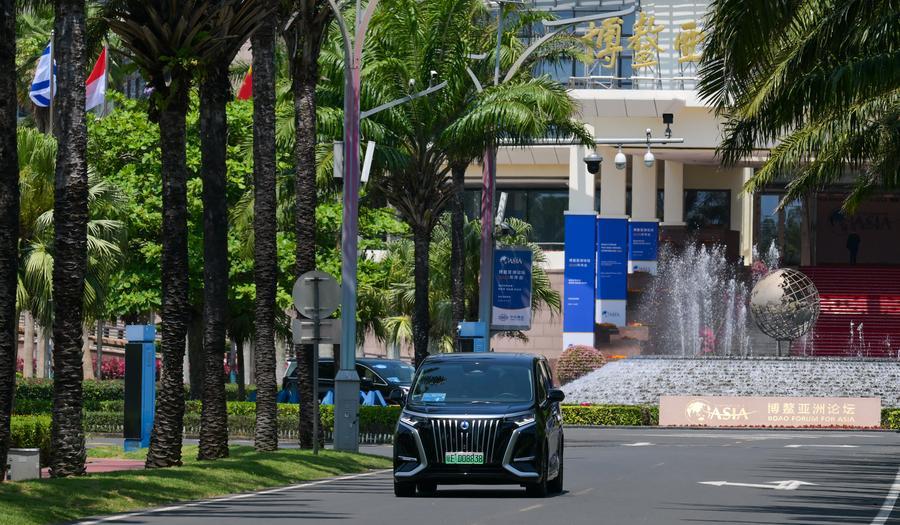
The Boao Zero-Carbon Demonstration Zone in Qionghai, Hainan province, has reached a stage of routine, full-scale zero-carbon operation, a milestone built on significant progress in energy conservation and carbon reduction, according to the local authorities.
By the end of 2025, carbon dioxide emissions from buildings and municipal infrastructure in the zone had fallen from about 11,350 metric tons in 2019 to only about 14.6 tons, a reduction of 99.9 percent, according to the Hainan Provincial Department of Housing and Urban-Rural Development.
The zone generates 29 million kilowatt-hours of green electricity annually, meeting its own demand of about 19.4 million kWh and feeding the remaining 9.6 million kWh into the grid, accumulating 4,965 tons of carbon credits, the department disclosed on the sidelines of the annual Boao Forum for Asia, which kicked off on Tuesday and will run through Friday.
READ MORE: China ‘primary’ global growth driver
The main source of green electricity for the zone is an agrivoltaic base that combines solar power generation with organic farming, producing 25 million kWh of green electricity per year, said Cai Qi, an employee with Guoneng (Hainan)New Energy Development.
Spanning about 22 hectares, the base consists of 23 agricultural greenhouses. "More than 30 varieties of fruits and vegetables are grown here, all organic," he said. While reducing carbon emissions by around 20,000 tons, it supplies more than 600 tons of organic produce annually, including strawberries, finger limes and cherry tomatoes.
Launched in 2022 as a joint initiative between the Ministry of Housing and Urban-Rural Development and the Hainan provincial government, the Boao Zero-Carbon Demonstration Zone encompasses 18 renovation projects across eight categories, including green buildings, renewable energy use and green transportation. The zone was originally named the Boao Near-Zero Carbon Demonstration Zone and was renamed in March 2025.
Rather than large-scale demolition and reconstruction, the renovations took a more targeted approach, according to the project's lead technical coordinator, the China Academy of Urban Planning and Design.
Meng Ning, a senior engineer at the academy's Beijing branch who participated in the project, pointed to the zone's news center as an example. While rooftop photovoltaics, photovoltaic louvered facades and photovoltaic floor tiles were installed to generate power, roof insulation and airtight doors were adopted to help reduce energy demand, he said.
ALSO READ: China: Low-carbon goals gaining prominence
He said a smart power system that integrates solar panels with battery storage, and direct current technology was also installed to balance electricity supply and demand. Solar panels produce direct current, yet most power grids and building appliances operate on alternating current. That mismatch requires energy-wasting conversions. Direct current technology avoids this by keeping electricity in DC form from generation to use. Battery storage helps smooth out the intermittent nature of solar power, ensuring a steady supply of electricity.
Zeng Youwen, chief engineer of the academy's Hainan branch, underscored the broader significance of the Boao demonstration zone. Its achievements have been certified by several authoritative institutions, including the German Energy Agency, and a comprehensive "Boao standard" has taken shape, covering the full process of zero-carbon design, construction, acceptance, operation, maintenance and evaluation.
"This offers valuable experience for zero-carbon retrofitting projects elsewhere," he said.
Contact the writers at houliqiang@chinadaily.com.cn
