

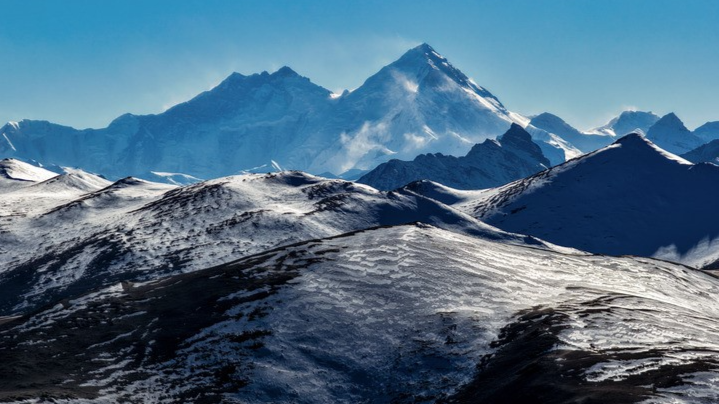
BEIJING - A new study by Chinese scientists reveals that the Qinghai-Tibet Plateau did not experience a steady, continuous rise, but underwent two distinct cycles of dramatic uplift and fall.
Published recently in the journal Geology, the research was led by scientists from the Guangzhou Institute of Geochemistry under the Chinese Academy of Sciences. By linking deep-underground activities to changes on the plateau's surface, the findings offer new insights into how massive mountain plateaus form.
The team focused on two intermountain basins within the Gangdise Mountains in the southern part of the plateau, known as the "roof of the world." The sedimentary layers in these basins function like geological "diaries," preserving detailed records of landform changes over tens of millions of years.
READ MORE: Qinghai-Tibet Plateau research offers insight into effects of climate change
Using uranium-lead isotope dating technology and mineral analyses of the basin sediments, the team discovered that the two basins, formed tens of millions of years apart, share striking similarities in their hydrological systems. Their water systems both shifted from open to closed and then back to open.
The scientists explained that before a rapid uplift, the basins were relatively open, receiving input from complex, external river systems. As the terrain rose swiftly to form towering mountain barriers, they cut off rivers and isolated the basins. Later, when the land sank again, the rivers reconnected.
Based on this pattern, the study infers that the Gangdise Mountains underwent two periods of rapid uplift: the first between approximately 54 million and 51 million years ago, and the second between 15 million and 8 million years ago. Each uplift pushed the land up by about one kilometer. Critically, each uplift was followed by a period of subsidence.
The study also finds that both uplifts were accompanied by thinning of the Earth's crust, suggesting that they were driven by similar deep processes.
According to the scientists, the first uplift was likely triggered by the break-off of the sinking Neo-Tethys oceanic plate. The second was caused by the delamination of a portion of the underthrust Indian continental plate. In both cases, the loss of part of the heavy, sinking plate allowed the land above to rebound upward, like removing a heavy weight. However, after the initial rebound, the continent's continued push pulled the surface back down, leading to subsidence.
READ MORE: China releases latest findings from second Qinghai-Tibet Plateau scientific expedition
"The growth of the Qinghai-Tibet Plateau wasn't a simple story of 'getting taller,'" said Xue Erkun, a postdoctoral researcher at the Guangzhou institute. "It was the result of multiple, alternating phases of uplift and subsidence. Furthermore, similar surface changes were driven by similar deep-seated movement mechanisms."
