

Immersive exhibition reveals how classical poetry shaped Chinese painting through exchange, report Xu Lin and Wu Yong in Shenyang.
As a queue winds patiently through the museum's hall, a question ripples through the crowd: "Which one is Lady Guoguo?"
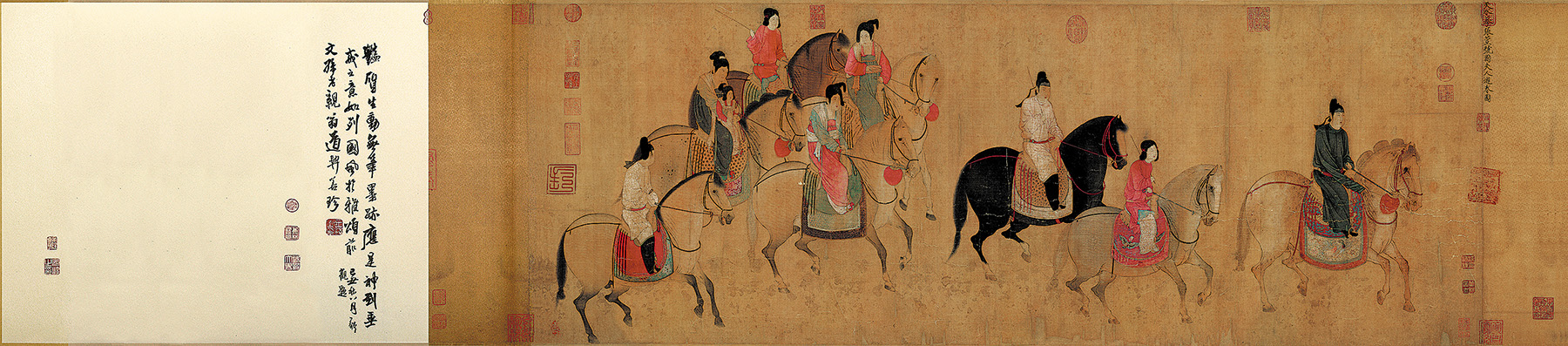
This debate is sparked by a rare display of a Song Dynasty (960-1279) replica of Lady Guoguo's Spring Outing, offering a vivid glimpse into the dazzling world of the powerful family of the Tang Dynasty (618-907).
The original work, by Tang court painter Zhang Xuan, is lost to time, making this meticulous copy a priceless portal to the dynasty's glorious peak and aesthetics.
Lady Guoguo was an elder sister of Yang Yuhuan, the most beloved consort of Emperor Xuanzong of the Tang Dynasty.
READ MORE: The enigma of ink
This silk scroll painting depicts a grand procession of nine figures and eight horses. Accompanied by attendants, noblewomen are dressed in opulent attire, with characteristically round Tang-era faces and elaborate hairstyles. They ride tall, robust and well-groomed horses adorned with distinctive ornaments.
The treasured painting belongs to the Liaoning Provincial Museum, in Shenyang, Liaoning province, where it was last exhibited from October 2019 to early January 2020.
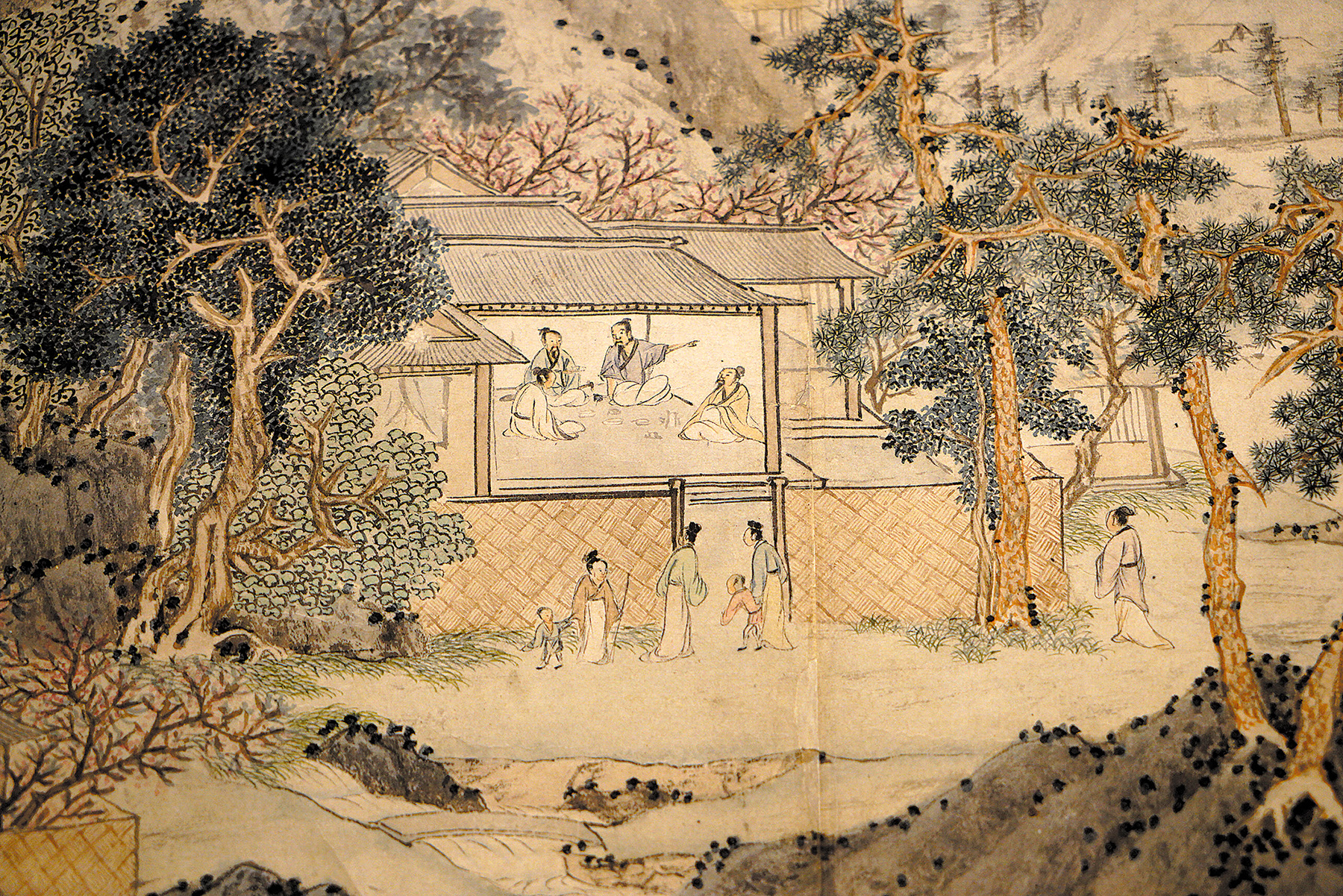
It's now among the 115 pieces/sets (210 individual pieces) of paintings and calligraphy on display in the ongoing exhibition, China in Poetry and Painting: The Poetic Realm of Chinese Painting.
Hosted by the Liaoning Provincial Museum, the exhibition until March 29, is organized in partnership with 10 museums across the country including the National Museum of China and the Shanghai Museum.
"The exhibition guides the audience to interpret the paintings through the lens of poetry. Our lifelong engagement with classical verse makes these works more approachable than displays arranged strictly by chronology or biography," says Dong Baohou, deputy head of the provincial museum.
"The key is to identify the pivotal line of a poem and the focal point of a painting. When you discover the connection between them, you will comprehend the artist's creative intent and fundamental vision."
In his poem Satire on Fair Ladies, the great Tang poet Du Fu depicted Lady Guoguo and her sisters on a lavish spring outing, exposing the Yang clan's indulgent extravagance and overwhelming power in the imperial court.
Yet, the identity of Lady Guoguo in this painting remains unresolved.
Some argue that the foremost figure is Lady Guoguo, a woman dressed in men's attire riding on a refined horse, which aligns with Tang Dynasty trends among noblewomen.
Another points to one of the two central riders, closer to the viewer. A third suggests the woman holding a child at the rear.
"None of these three theories is fully conclusive due to a lack of historical corroboration," Dong says.
"The principal figure is often centrally placed. Also, you can judge a figure's status by their fine attire and superior horses. However, these clues point to different people …This very ambiguity, debated for centuries, is a key source of the artwork's enduring appeal."
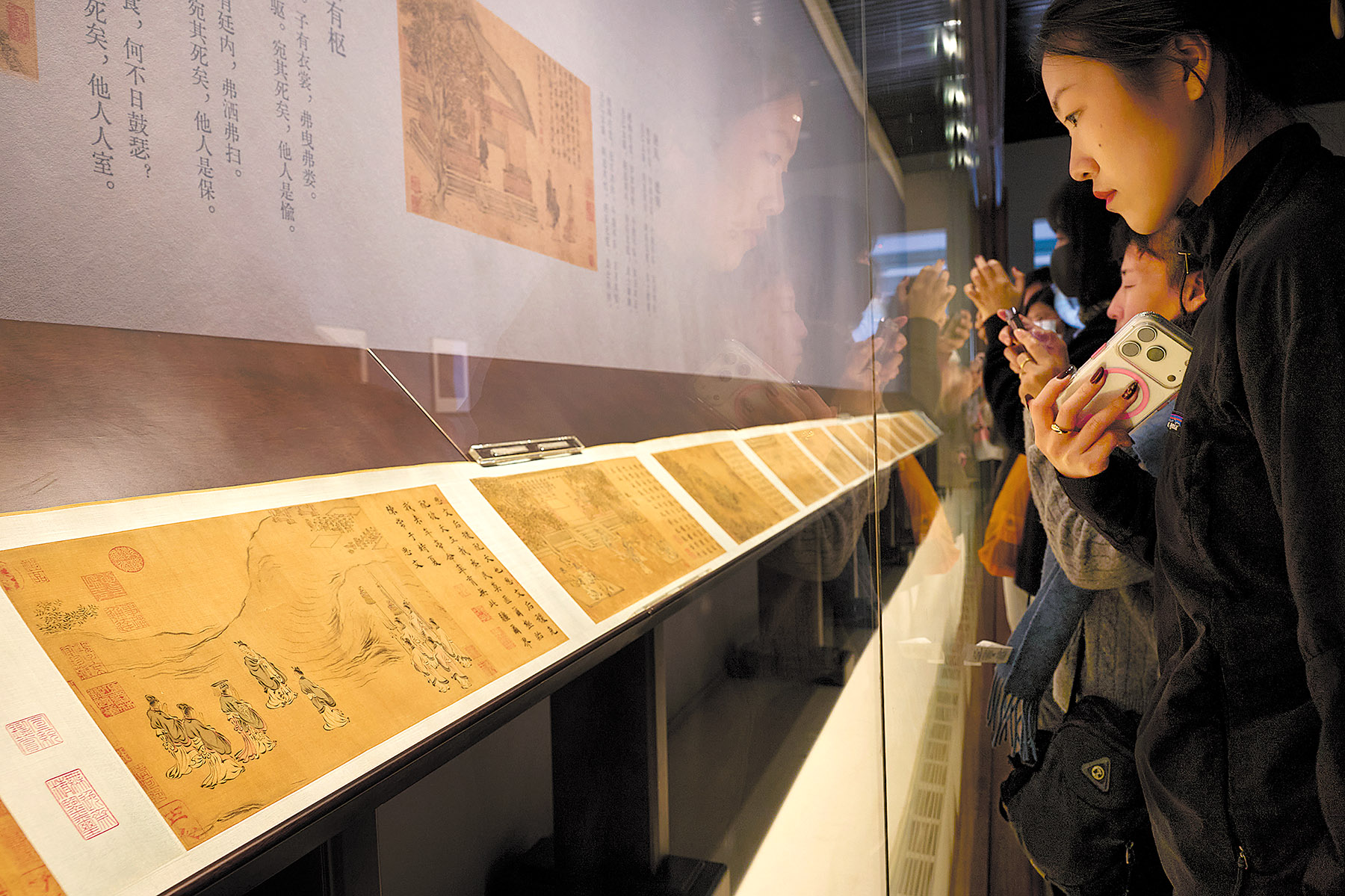
Thanks to advanced digitalization of cultural relics, visitors can carefully observe the details of the painting on large interactive screens, from vivid colors to intricate textile patterns.
To safeguard fragile masterpieces, select works in the exhibition will be displayed on a rotating schedule. For example, Lady Guoguo's Spring Outing will be on view until March 1.
"Balancing access and preservation is essential. Our museum typically observes a three-year conservation resting period for important paintings and calligraphy pieces. As there is no fixed industry standard, conservation depends on each work's condition,"Dong says.
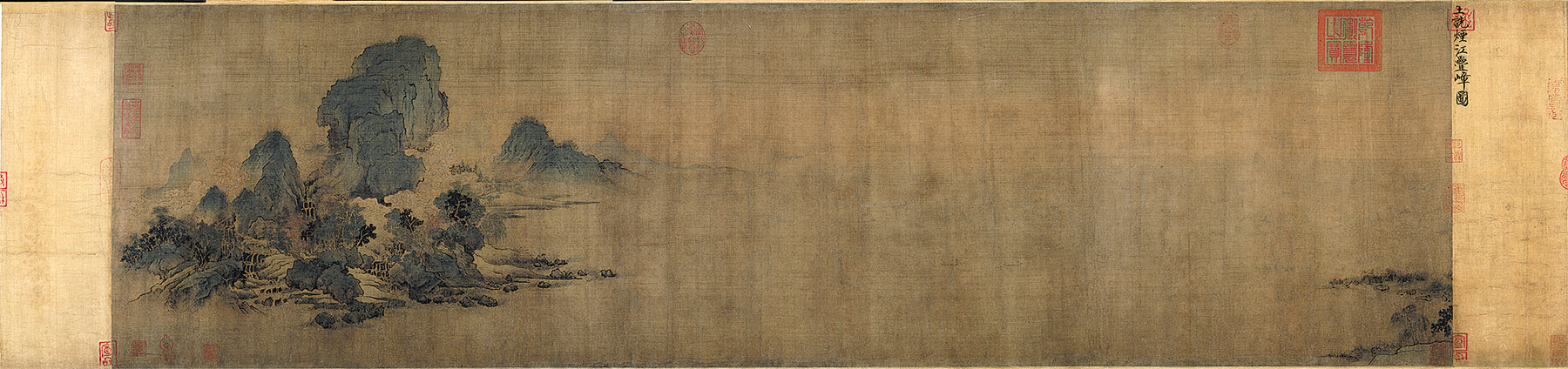
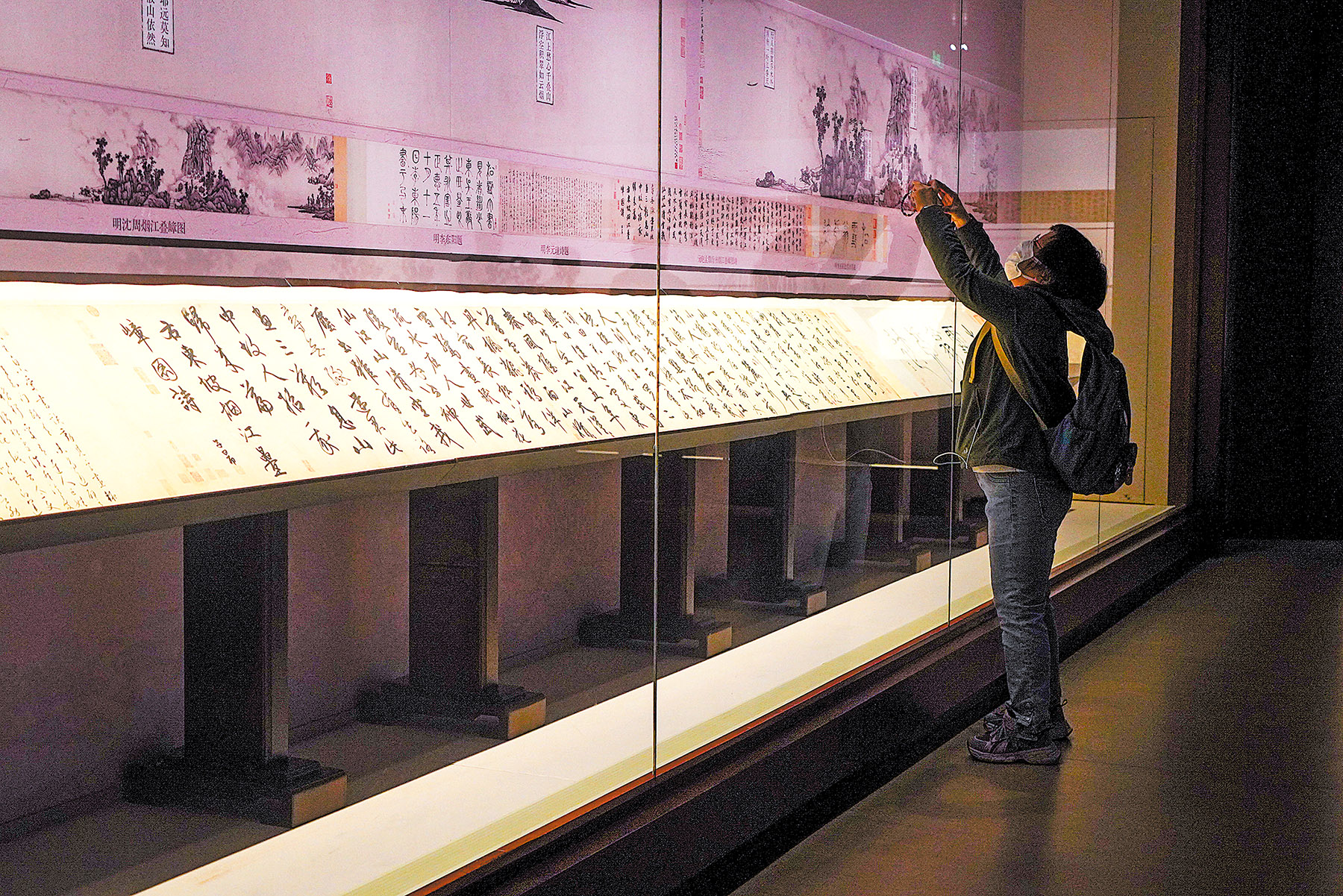
Also on view is Song Dynasty scholar Wang Shen's Misty River and Layered Peaks, from the Shanghai Museum collection.
Its left side is dominated by dense, jagged peaks draped in mist and teeming with vegetation, streams and waterfalls. This gives way to an expansive void on the right, depicting a vast, tranquil lake where a closer look reveals two small boats with figures.
When Song literary giant Su Shi saw this painting, he responded with a poem on the same theme. Wang replied with a poem and another painting. Their mutual exchange initiated an artistic dialogue that evolved into a classic theme.
For centuries, later scholars continued the exchange, paying tribute to the tradition by creating paintings inspired by the poem or producing calligraphic works of the poem itself.
Yuan Dynasty (1271-1368) calligrapher Zhao Mengfu transcribed the poem in running script, while Ming Dynasty (1368-1644) scholars Shen Zhou and Wen Zhengming later painted their own interpretations.
These three separate works were ultimately mounted into a single, continuous scroll, now part of the Liaoning Provincial Museum collection and presented in the exhibition."Creations centered on the theme 'Misty River and Layered Peaks' are the pinnacle of poetry-painting integration in literati art," Dong says.
"Literati paintings were created by scholars, not professional painters. Scholars composed poetry and inscribed the poems in calligraphy on the paintings. This practice was not merely combined but fused into a single, unified expression of their inner world."
It was a common practice for ancient Chinese scholars to paint with inspiration from poetry and use it as a central theme.
The exhibition also gathers exquisite artworks inspired by the Confucian classic Shijing (The Book of Songs) and poems by famous Tang poets Li Bai, Du Fu and Wang Wei.
One section focuses on plum blossoms, symbols of the scholars' moral integrity. "In the Song Dynasty, scholar-artists elevated plum blossom imagery to new heights," Dong says.
Tao Yuanming, a great poet and essayist in the Eastern Jin Dynasty (317-420), famously described Peach Blossom Spring in an essay and a poem as a secluded utopia accidentally discovered by a fisherman.
"We bring together paintings inspired by the very literary theme, demonstrating how different artists visually interpret the same text. It reveals the intimate and creative dialogue between literature and painting and helps people better understand the text," Dong says.
A prime example is the long scroll painting of Peach Blossom Spring by Ming scholar Wen Zhengming.
"To fully understand it, one must read it alongside the original text. Each unfolding scene serves as a visual annotation, matching the classic line by line," Dong says.
To appreciate traditional Chinese painting, Dong suggests the audience ponder three key questions.
"What is depicted? Look beneath the surface to uncover symbolic meanings. For example, Nanshan Mountain means longevity in Chinese culture," he says.
"How is it painted? Think about the composition, brushwork techniques and use of blank space. How well is it done? Form your own opinion about the artwork."
He says through repeated viewing, discussion and reflection, the viewer's understanding deepens with fresh insights.
ALSO READ: Tiny sheets of paper carry profound history
The exhibition has become a cultural draw during Shenyang's winter travel season, attracting visitors from across the country.
Supported by the local government, the museum is collaborating with hotels, scenic spots and a ski resort to provide visitor discounts, encouraging longer stays and boosting local tourism.
"It's a romantic exhibition, weaving together different themes on the integration of poetry and paintings," says Liao Xiaohan, 32, from Chongqing, who recently visited the city for the exhibition.
"Viewing these precious works brings profound tranquility; it feels like conversing with the artists across hundreds of years," she says, adding that she is an enthusiast of Chinese painting and is learning the art by replicating masterpieces.
Contact the writers at xulin@chinadaily.com.cn
