

The long-awaited free trade agreement between India and the European Union, unveiled last week, faces multiple challenges in implementation, analysts say, citing complex legal procedures and India's need for adequate preparation to benefit from the deal.
Indian and EU leaders said the agreement was announced at a time when both sides seek to strengthen their relationship in the face of United States tariffs, with India looking for alternative export markets.
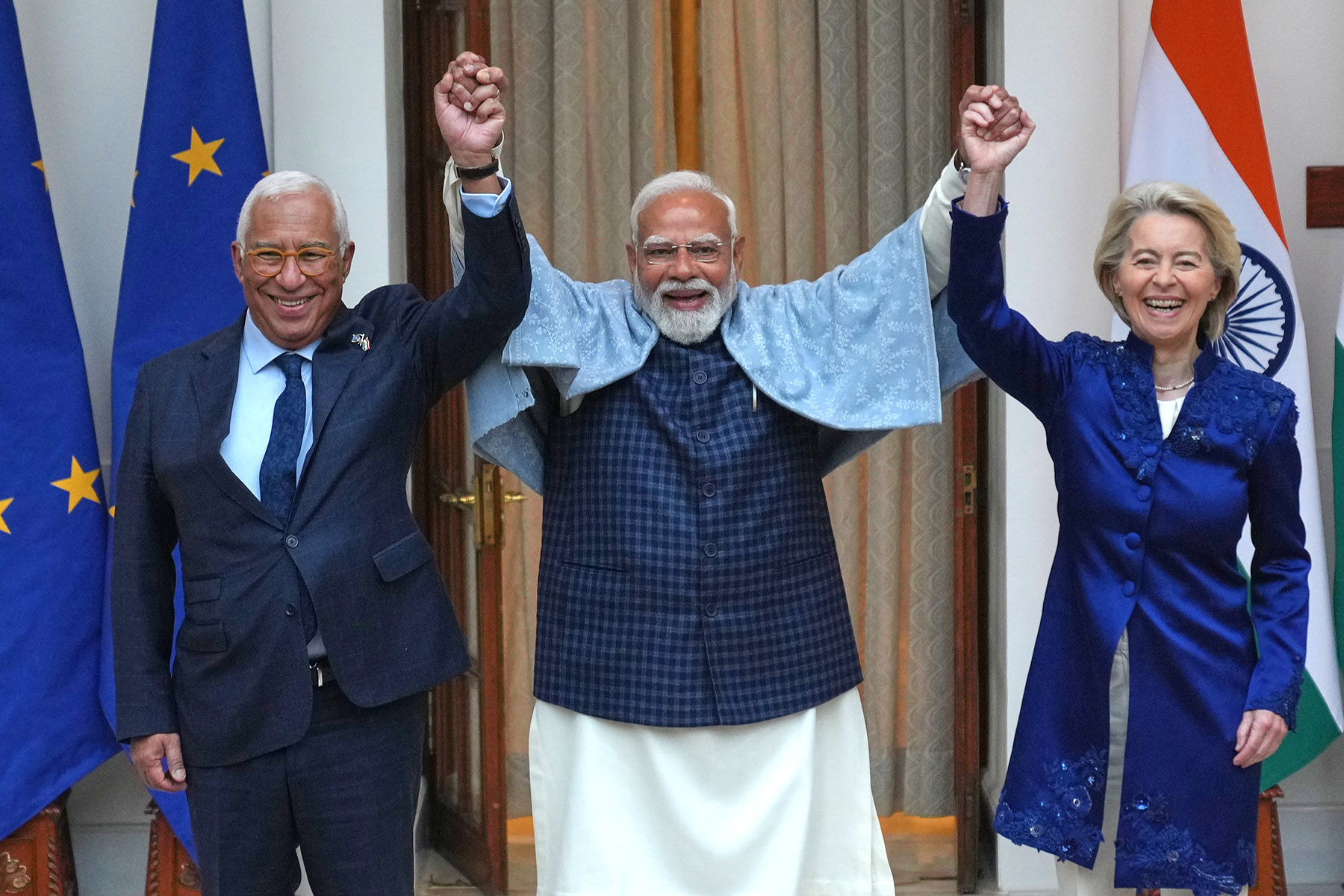
European Commission President Ursula von der Leyen and European Council President Antonio Costa joined Indian Prime Minister Narendra Modi in New Delhi on Jan 26 as honorary guests for India's 77th Republic Day.
READ MORE: India, EU clinch 'mother of all deals' after two decades of trade talks
"We have concluded the mother of all deals," von der Leyen said in a post on social media.
The agreement, struck the next day after nearly 20 years of negotiations, would eliminate or reduce tariffs on more than 90 percent of goods traded between them.
Under the pact, India will lower duties on European automobiles and agricultural products, and the EU will do the same for Indian textiles, leather goods, marine products, gems and jewelry. Many of these sectors have been hit hard by a 50 percent US tariff imposed over India's purchases of subsidized Russian oil.
India's Commerce and Industry Minister Piyush Goyal said he expects the agreement to come into force later this year. Observers, however, said the deal needs to be formalized legally before being ratified by EU member states and the European Parliament.
Madhavi Arora, chief economist at Emkay Global Financial Services in India, said the agreement needs to be ratified by the European Parliament after formal approval, a process that could take considerable time and potentially delay implementation by up to a year.
It involves a multistage legal protocol, moving from concluded negotiations to domestic ratification and enforcement, with full implementation more likely this year or next, she said.
Dibyendu Maiti, a professor at the Delhi School of Economics in New Delhi, said the process requires legal scrubbing, translation into all official EU languages, ratification by the European Parliament and European Council, and approval by India's Parliament.
Considering the partners' history of legal functions, Maiti said it could take years for the deal to reach a final shape. Meanwhile, how India and the EU would react to US pressure would also affect the agreement's actual implementation, he said.
Biswajit Dhar, a former professor at the Centre for Economic Studies and Planning at Jawaharlal Nehru University in New Delhi, said India would need to make adequate preparations to fully benefit from the agreement.
Strict standards
Indian businesses could face considerable challenges to increase their presence in the EU market — one of the most regulated in the world — if the bloc sticks to a plethora of regulations, such as strict emissions rules and labor standards, Dhar said.
Companies, he added, would need adequate preparations to ensure that high compliance costs under the EU's Carbon Border Adjustment Mechanism do not erode their competitiveness.
Several sensitive regulatory and standards barriers remain unresolved, such as CBAM-related adjustments and the EU's carbon tax. If left unaddressed, such measures could steadily offset the tariff gains for India, said Arora of Emkay Global Financial Services.
ALSO READ: India, EU agree to wrap up free trade pact this year
Ajay Srivastava, founder of the think tank Global Trade Research Initiative in New Delhi, cautioned that the timing of the deal matters. Indian exporters have already been hit by weak demand in the United States, while gains from Europe will materialize only after the agreement is implemented.
The near-term mismatch remains a concern, Srivastava said."The gains from the EU will be at least one year away."
Still, the free trade agreement could significantly boost exports of textiles, leather goods and marine products by putting Indian companies on an equal footing with competitors such as Bangladesh and Vietnam in the European market, according to the Global Trade Research Initiative.
India's total merchandise trade with the EU stood at $136.54 billion in 2024-25, according to data from the commerce ministry.
The writer is a freelance journalist for China Daily.
