

Shipping surge boosts consumption; tech bolsters express delivery sector
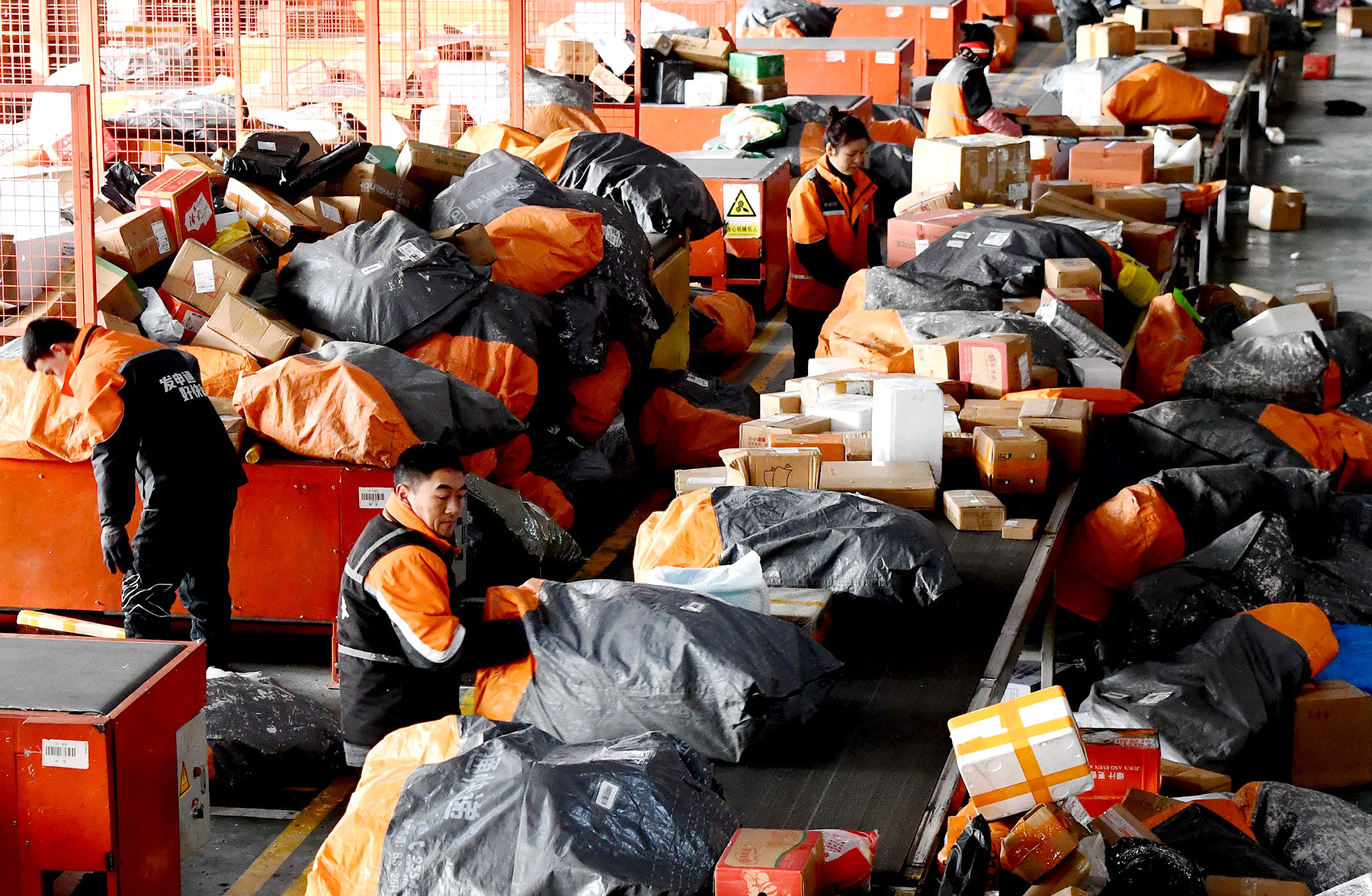
As Spring Festival, also known as Chinese New Year, approaches, the roads, rail lines and conveyor belts of China's delivery network are filling with an annual tide of packages — boxes of snacks, flowers, cakes and gifts moving across thousands of kilometers, from megacities to villages, from coastal workplaces to inland homes.
This year, the Spring Festival holiday falls on Feb 17, ushering in a weeklong public holiday from Feb 15 to 23 — a period marked by family reunions, travel and a surge in consumption. For many families, courier services have simplified holiday preparations.
Shao Fang, who works in Hainan province and is originally from Zhumadian in Central China's Henan province, recently sent several boxes of nuts, snacks and cakes back home. On previous occasions, Shao would return to her hometown early to prepare for the holiday. But this year, she ordered everything online.
READ MORE: China launches campaign to spur consumption ahead of Spring Festival
"There's no need to go back early to prepare anymore," she said. "I just sent everything ahead, and when I get home, I can focus on being with my family."
Across China, similar parcels are moving in massive volumes. In warehouses, conveyor belts run continuously. In residential compounds, delivery workers stack and sort piles of boxes by building and floor, preparing routes that will carry packages to millions of households before the holiday.
At an e-commerce warehouse in the city of Luoyang, Henan, productivity has doubled. Workers pack a variety of boxes as orders flow in from across the country.
"Sales during the Spring Festival shopping season are about twice the normal levels," said Ma Jun, a manager at the warehouse."As we approach the holiday, volumes keep rising. Toward the end of January, they reached three to four times the usual levels."
On ordinary days, the warehouse processes about 30,000 orders daily. During the peak holiday period, that number rises to 60,000 and is expected to exceed 100,000 in the days preceding the festival, with more than 80 percent of the orders handled by J&T Express.
While packaged food items account for much of the volume, other categories have become increasingly prominent, including fresh flowers and regional specialty products. In Luoyang, the Tuqiao community has become a hub for peonies, a traditional Spring Festival decoration.
Wei Linqiang, 52, a local farmer and livestream seller, once sold his flowers mainly through offline exhibitions, reaching nearby cities like Zhengzhou and Wuhan, Hubei province. Transportation was his biggest obstacle; the flowers were fragile, and long-distance shipping often resulted in damaged buds and wilted leaves.
That has changed. Today, Wei ships peonies nationwide through livestream sales and e-commerce platforms. His greenhouse operation has expanded from three sheds to eight. Annual output now reaches about 6,000 pots, with online orders accounting for roughly 40 percent of sales. Customers come from more than 20 provincial regions, and some overseas buyers place orders through forwarding services.
The growing scale of Spring Festival deliveries reflects bigger changes in China's logistics and consumption patterns, said Liu Jiang, director of strategic planning research at the State Post Bureau of China.
"In recent years, the scale economies of China's postal and express delivery sector have continued to strengthen," Liu said. "The Spring Festival shipping surge not only directly boosts retail, warehousing and transportation, but has also become an important force in expanding domestic consumption."
Managing the surge has required increasingly sophisticated coordination. In 2025, China processed nearly 199 billion parcels, a 13.6 percent increase from 2024, generating 1.5 trillion yuan ($216 billion) in revenue. At its peak, more than 777 million packages moved through the network.
At a J&T Express outlet in Luoyang, daily delivery volumes during the 2026 Spring Festival shopping season have risen about 30 percent year over year, according to Li Shaopeng, the site manager. The station has added extra shifts and increased vehicle frequency. Deliveries that once ran twice a day now run three times daily.
The outlet introduced two autonomous delivery vehicles this year to ease pressure on frontline couriers. Driverless carts transport parcels between sorting centers and pickup points, handling more than 3,000 packages a day along fixed routes.
At the national level, the delivery surge is part of a managed seasonal cycle. The bureau has designated the upcoming Spring Festival holiday travel period — from Feb 2 to March 13 — as a key service window, requiring companies to forecast volumes and maintain basic coverage. The plan also emphasizes worker protections, including rest periods, overtime pay and holiday compensation.
ALSO READ: Spring Festival celebrations to amplify consumption
"Couriers also deserve their own moments of reunion," said Liu Ying, a spokeswoman for the bureau."Companies are required to strike a balance between meeting basic delivery needs and respecting workers' expectations to spend the holiday with their families."
When the holiday ends and people return to work, delivery volumes are expected to rebound quickly, prompting companies to prepare staffing in advance.
For the delivery system, Spring Festival now functions as both a stress test and a platform to showcase its capabilities. For families, it has reshaped the rhythm of the holiday itself. As millions of packages move across highways and rail lines, the looming Spring Festival holiday is no longer measured only in train ticket sales — but in tracking numbers and the steady knock of courier workers at the door.
Contact the writers at luowangshu@chinadaily.com.cn
