

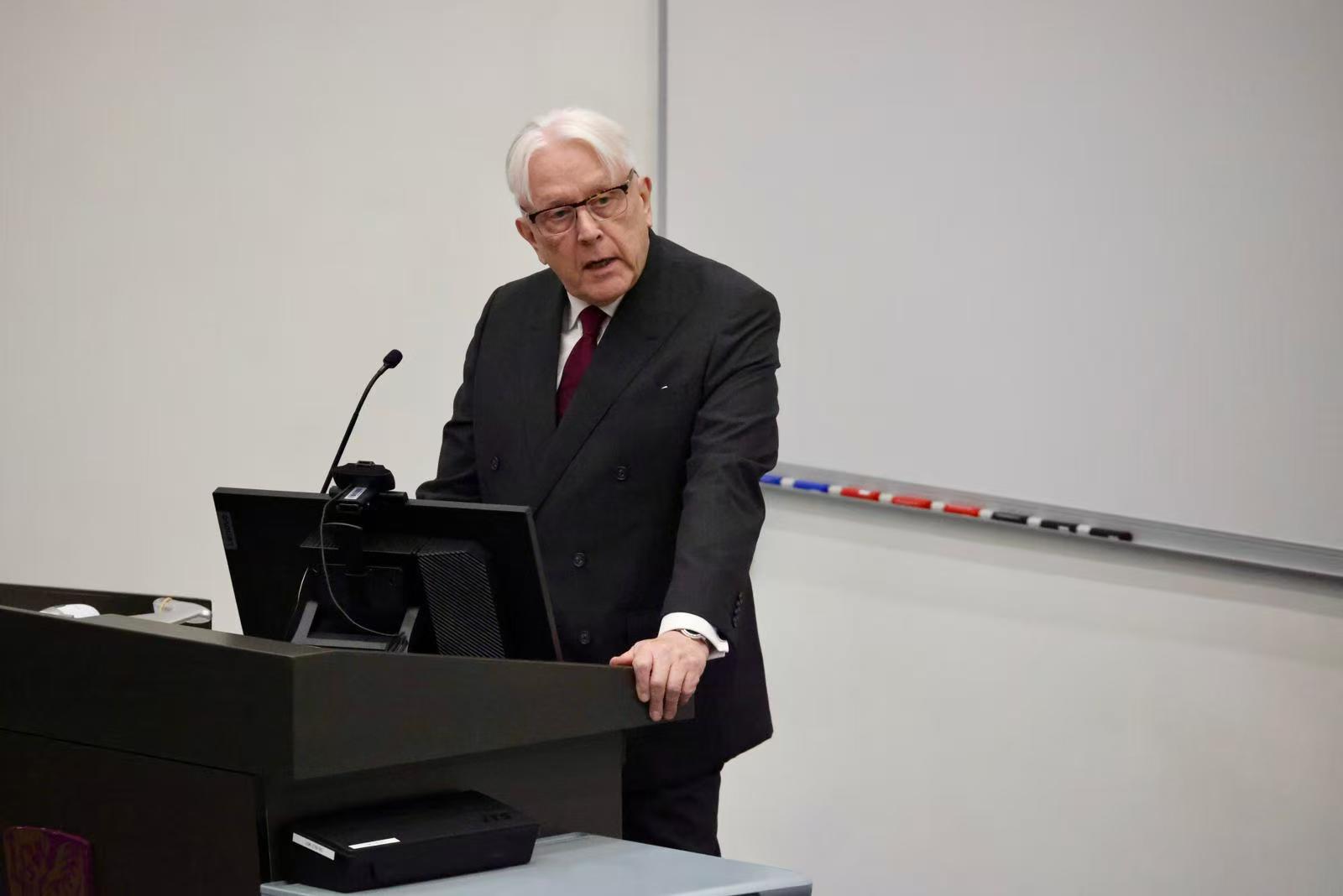
Grenville Cross – the first public prosecutor of the Hong Kong Special Administrative Region – has said the recently concluded national security trial of former media mogul Jimmy Lai Chee-ying has “vividly demonstrated” that fundamental human rights in the SAR are “better protected” under the jurisdiction’s robust rule of law.
“The Basic Law reassures everybody who believe the fundamental rights to which people were accustomed to before reunification should continue thereafter, as has been proven in Lai’s case,” said Cross, who started prosecuting in Hong Kong in 1978.
Speaking at the inauguration ceremony of Invictus -- the 18th Executive Committee of the Undergraduate Law Society of The Chinese University of Hong Kong -- on Friday, he said he believes Lai’s trial has exemplified the protection of human rights in the common law jurisdiction.
Lai was able to exercise the right to counsel, challenge prosecution evidence and testify in his own defense during the trial. He was represented by barrister senior counsel Robert Pang Yiu-hung and King’s Counsel Marc Corlett.
“He enjoyed the presumption of innocence, chose a high-powered team of six barristers to defend him, challenged the evidence the prosecution relied on, and gave evidence in his own defense. He was only convicted after the Court of First Instance had carefully evaluated the evidence and concluded he was guilty beyond reasonable doubt,” Cross told the university’s Law School students.
Lai said last Friday he would not appeal against his conviction under the HKSAR’s National Security Law on two charges of conspiracy to collude external forces and one charge of conspiracy to publish seditious materials.
ALSO READ: China rebukes reports indicating Jimmy Lai should be released
Cross, who’s also a professor of law affiliated with a number of universities, said it was “most likely” that Lai’s lawyers had advised him he “has no arguable grounds of appeal”. “Lai could certainly have exercised this right had he wished to appeal and he had nothing to lose by doing so.”
“Our independent judiciary operates under the Basic Law that ensures the presumption of innocence and the right to a fair trial,” Cross said, adding that these rights mirror the safeguards under the International Covenant on Civil and Political Rights.
Hong Kong’s National Security Law and the 2024 Safeguarding National Security Ordinance are “human‑rights heavy”, compared with similar laws overseas, he said. “Both explicitly require respect for human rights, contrasting them with the United Kingdom’s National Security Act (2023) which, he said, “has little or nothing to say about human rights protections”.
Citing the nation’s latest white paper on Hong Kong, issued in February this year, Cross said the central authorities have reaffirmed a “balanced approach” to security and pledged that law‑abiding residents have nothing to fear. “Respecting human rights,” the white paper stated, is “a salient feature” of Hong Kong’s national security efforts.
Reflecting on his legal career that spanned nearly half a century, Cross said Hong Kong’s legal profession has become “far more human‑rights friendly”, with prosecutors, defense lawyers and judges increasingly guided by rights principles.
“Human rights imperatives now steer decision‑making at every stage of the justice process. Whatever your responsibilities may be, always ask if there are human rights dimensions, and give them due respect,” he told his audience of aspiring lawyers.
