

The latest high-end accelerator facility will help the nation lead in nuclear science and potentially extend the periodic table with additional discoveries. Li Bingcun reports from Shenzhen.
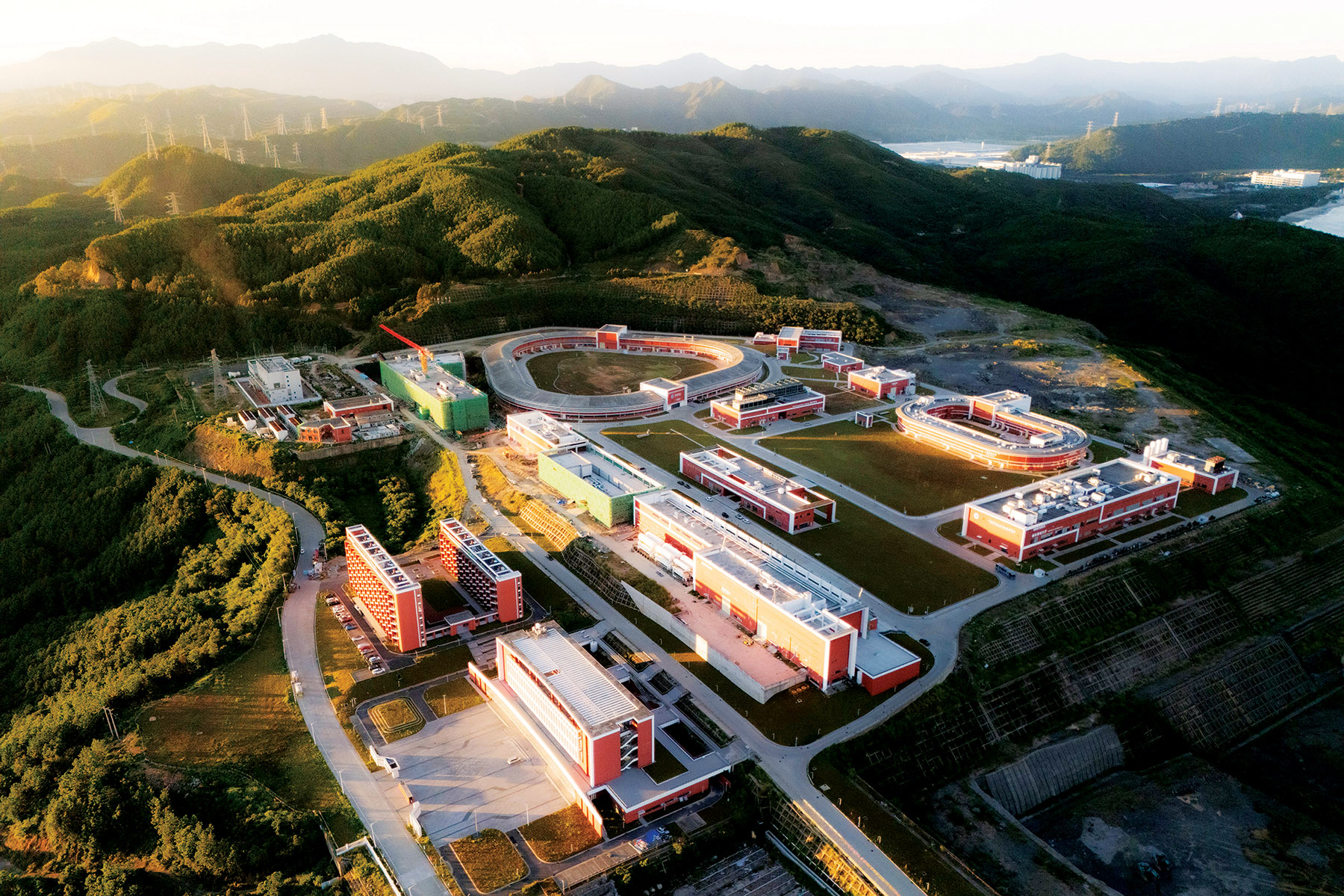
Nestled among the mountains by the sea in Huizhou, Guangdong province, one of the world’s largest all-ion accelerators is poised to go into operation, helping China to be at the forefront of nuclear science.
The High Intensity Heavy Ion Accelerator Facility (HIAF), which generated its first beam in October 2025 after seven years of construction, was developed by the Institute of Modern Physics at the Chinese Academy of Sciences.
Hundreds of researchers at the institute contributed their valuable experience in accelerator development that was accumulated by several generations of scientists from the nation’s northwestern inland regions to the southeastern coast.
Adopting innovative approaches to overcome complex construction challenges, the team has forged a unique “Chinese path” for developing major national scientific and technological infrastructure in the new era.
The facility is of vital importance to developing nuclear science, especially in exploring the limits of atomic nuclei, uncovering astrophysical nuclear processes, advancing nuclear energy development, and heavy-ion applications in various fields.
“After a century of development, particle accelerators have further deepened humanity’s understanding of the origins, structure, and properties of nuclear matter. Countries with strong technological capabilities, including China, are intensifying their efforts to advance accelerator-based technologies to seize the forefront of nuclear science,” says Yang Jiancheng, chief engineer of the HIAF and deputy director of the Institute of Modern Physics.
Such investments are promising for achieving breakthroughs in key technological challenges that could lead to revolutionary changes across a range of industries, Yang says.
For HIAF, a key objective in fundamental research is to be the first to synthesize elements 119 and 120 beyond the currently known 118 elements of the periodic table, thus initiating the eighth period — the horizontal row. Like the discovery of every new element, this is expected to have immeasurable implications for scientific research and industrial development.
The derived technologies and products could also facilitate cancer treatment and logistics preservation, addressing critical healthcare and livelihood issues.
During the nation’s 12th Five-Year Plan (2011-15), the HIAF was put on the agenda with the aim of establishing a new international nuclear science center in the Guangdong-Hong Kong-Macao Greater Bay Area, beyond Beijing, Shanghai and Hefei.
Leveraging the cluster’s extensive international relations, the institution hopes to attract global scientists to use the facility and deepen international collaboration to push nuclear science to new heights.
Breaking barriers, leading science
To complete this national-level project in the southeastern region, the institute has drawn upon decades of experience in accelerator construction and made innovative advancements, ultimately developing a device that leads the international development in this arena.
Based in Lanzhou, the capital of northwestern China’s Gansu province, the institute has been dedicated to advancing nuclear science since the 1960s. It has built several generations of particle accelerators, including the heavy ion research facility in Lanzhou, which was completed in 1988 and has achieved international advanced standards.
“Starting from scratch to build the scientific infrastructure, we have evolved from being a technological follower to a competitor that stands alongside international powerhouses. In the HIAF project, we have even emerged as a leader driving international advancement in various technologies,” says Yang.
For instance, the core equipment of HIAF requires high-performance magnetic alloy rings, and the component and related technology was dominated and blocked by Japan due to trade tensions between China and the United States.
The institute has pursued independent research and spent several years with domestic manufacturers to conquer this daunting challenge. “From very small materials, we progressed to small rings, then medium ones, and finally to large ones suitable for the accelerator. The team resolved a series of core technical difficulties bit by bit, ultimately achieving results that surpassed those of Japan,” recalls Yang.
Among the world’s largest accelerators, the HIAF covers an area of over 30,000 square meters, approximately the size of six football fields. It consists of over 6,000 large devices with the total length of pipelines exceeding one million meters.
The institution employed intelligent technologies to reduce the installation period from the typical two to three years to just eight months. The facility is also expected to achieve unmanned operation in the future.
During construction of the facility, the researchers’ determination and resilience, their pursuit of excellence, and their commitment to serving the country — the values passed down from their predecessors — have enabled them to accomplish the mission, says Yang.
In the past seven years, hundreds of researchers have continuously shuttled between Lanzhou and Huizhou, crossing half of China, with some bringing their families along.
Yang also highlights the role of young scientists in the project. “As the driving force of the research team, a cohort of young individuals around 30 years old have quickly advanced in their scientific careers through this project, becoming experienced and innovative talents in nuclear science both domestically and internationally. This is crucial for China’s future development in this area,” he says.
As an important component of the scientific facility cluster in the Greater Bay Area, Yang hopes the accelerator will contribute to the development of new quality productive forces in the region.
As China enters its 15th Five-Year Plan (2026-30) period, Yang says he would like the authorities to plan for the next generation of large scientific facilities soon and be leading internationally.
Contact the writer at bingcun@chinadailyhk.com
