

China leads call at UN for Washington to heed voice of international community, free Maduro
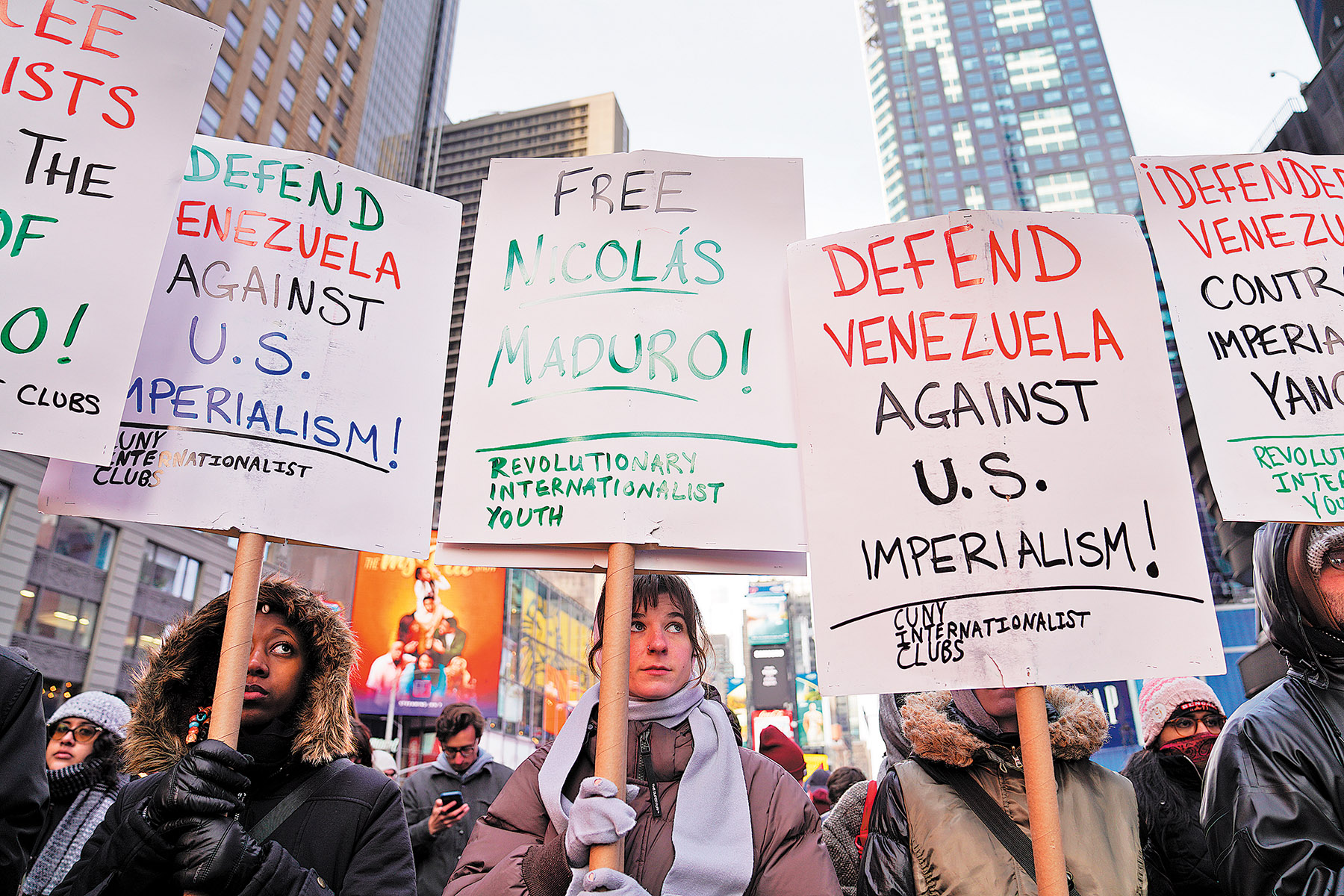
The United Nations Security Council’s first meeting of 2026 heard a global chorus of UN member states strongly denounce the United States’ military action against Venezuela as a grave violation of the UN Charter, though a US representative defended it as a “surgical law enforcement operation”.
At the emergency session on Jan 5, Sun Lei, China’s deputy permanent representative to the UN, urged Washington to heed the international community’s “overwhelming voice”, comply with international law and the UN Charter, halt actions that infringe on other countries’ sovereignty and security, stop toppling Venezuela’s government, and return to dialogue and negotiations as path to a political solution.
Venezuelan President Nicolas Maduro, seized and brought to the US on Jan 3 after a large-scale US strike in the South American nation, pleaded not guilty in federal court in New York on Jan 5 to charges of narco-terrorism.
Sun expressed China’s “deep shock” and strong condemnation of what he described as “unilateral, illegal and bullying acts” of the US, and he called for Washington to ensure the safety of Maduro and his wife, and to release them immediately.
“The US has placed its own power above multilateralism and military actions above diplomatic efforts,” Sun said, warning that such actions pose a grave threat to peace and security in Latin America and the Caribbean and even internationally.
He said the US military strikes “wantonly trampled” on Venezuela’s sovereignty and violated core tenets of the UN Charter, including the principles of sovereign equality, noninterference in internal affairs, peaceful settlement of international disputes, and prohibition of the use of force in international relations.
“The lessons of history are a stark warning,” Sun said, adding that military means are not the solution to international problems, and the indiscriminate use of force will only lead to greater crises.
He cited past US actions, such as bypassing the Security Council to launch military operations against Iraq, attacks on Iran’s nuclear facilities, and the imposition of economic sanctions, military strikes, and armed occupations in Latin America and the Caribbean.
Those actions caused persistent conflict, instability and immense suffering for ordinary people, he said.
The envoy reiterated that China firmly supports the Venezuelan government and people in safeguarding their sovereignty, security and legitimate rights and interests, and supports countries in the region in upholding Latin America and the Caribbean as a zone of peace.
Addressing the UN meeting, US economist Jeffrey Sachs said that the US military action and ongoing pressure violate Article 2, Section 4 of the UN Charter, which prohibits the threat or use of force against the territorial integrity or political independence of any state.
Sachs, president of the UN Sustainable Development Solutions Network and director of the Center for Sustainable Development at Columbia University, called these actions part of a long-standing US pattern of “covert regime change”, citing a historical record of 70 such operations between 1947 and 1989 alone.
At the meeting, Russia’s UN ambassador, Vassily Nebenzia, also called for the immediate release of Maduro and his wife.
The Russian envoy called the US military action in Venezuela a “crime cynically perpetrated” and a harbinger of a return to an era of “lawlessness”, stressing that any conflicts must be resolved through dialogue as enshrined in the UN Charter.
Backers of the US military operation in Venezuela, including Argentina, framed the action as a law-enforcement, anti-narco-terrorism step and argued it could open a path to restoring democracy.
Representatives of many countries pushed back by arguing that democracy cannot be delivered through force and coercion, and that any political outcome must be decided by Venezuelans through peaceful and lawful means.
Leonor Zalabata Torres, Colombia’s UN envoy, said that “democracy cannot be promoted or defended through violence or coercion”, and Venezuela deserves peace and democracy, prosperity and dignity, with a government whose sovereignty is defined by no one but the Venezuelan people and their institutions.
Mexico’s UN envoy, Hector Vasconcelos, warned that “regime change by external actors and the application of extraterritorial measures” is contrary to international law and that, historically, all such actions have done is to exacerbate conflicts and weaken the social and political fabric of nations.
Paula Narvaez Ojeda, Chile’s UN representative, noted that foreign interference caused extreme damage to her nation, and she stressed that democracy is best recovered through “the strength of organized citizens and through our institutions”.
Spain’s representative to the UN, Hector Gomez Hernandez, said that democracy “cannot be imposed by force” and “force never brings more democracy”.
Brazil’s UN ambassador, Sergio Franca Danese, said that international norms are “mandatory and universal” and do not allow for exceptions based on ideological, geopolitical, or economic interests, such as the “exploitation of natural or economic resources”.
France’s representative said that when a permanent member of the Security Council violates the UN Charter, it “chips away at the very foundation of the international order”.
South Africa warned that “no nation can claim to be legally or morally superior” to another.
Amir Saeid Iravani, Iran’s UN ambassador, said the US military move against Venezuela “constitutes state terrorism, a manifest violation of the UN Charter and peremptory norms of international law, and amounts to an internationally wrongful act and a full-fledged act of aggression”.
Venezuela’s UN Ambassador Samuel Moncada requested action from the Security Council, urging it to fully assume its responsibility and act in accordance with the mandate conferred on it by the UN Charter.
“Venezuela comes before this Council today with a deep conviction that international peace can only be sustained if international law is respected without exception, without double standards, and without selective interpretations,” he said.
Elsewhere, Malaysian Prime Minister Anwar Ibrahim said in a post on X that he was following the developments in Venezuela with “grave concern”, noting that Maduro and his wife were forcibly seized in a US military operation of “unusual scope and nature” and that such actions “constitute a clear violation of international law and amount to an unlawful use of force against a sovereign state”.
The Democratic People’s Republic of Korea strongly denounced the US action. A spokesperson from its foreign ministry said Washington “wildly violated the sovereignty of Venezuela” and the act shows “the rogue and brutal nature of the US”.
Singapore’s foreign ministry said in a statement that the country has consistently opposed actions contrary to international law by any parties, including foreign military intervention in any country.
Indonesia expressed grave concern “over any actions involving the use or threat of force, which risk setting a dangerous precedent in international relations and could undermine regional stability, peace, and the principles of sovereignty and diplomacy”.
The Philippines said it views with concern the events in Venezuela and “their consequential impact on peace and stability in the region and rules-based international order”.
Thailand’s foreign ministry urged all parties involved to resolve the conflict peacefully with full respect for the UN Charter and international law.
Australian Prime Minister Anthony Albanese said his country has long held concerns about the situation in Venezuela, and urged all parties to support dialogue and diplomacy to secure regional stability and prevent escalation.
India’s Ministry of External Affairs said in a statement that recent developments in Venezuela are a matter of deep concern. “We are closely monitoring the evolving situation,” it said.
In Japan, the US operation has met with criticism from political figures and the media, who warned that it undermines international law and the postwar rules-based order.
Agencies contributed to this story.
Contact the writers at huanxinzhao@chinadailyusa.com
