

South Korea’s parliament approved a 727.9 trillion won ($495.8 billion) budget for next year on Tuesday, endorsing President Lee Jae-myung’s sweeping plan to revive the economy through aggressive investment in artificial intelligence and other strategic sectors.
The outlay represents an 8.1 percent increase from this year’s initial budget plan and will increase at a rate more than triple the pace of expansion of the 2025 budget. The acceleration comes as the country confronts US tariff pressure and growing welfare costs associated with one of the world’s fastest-aging populations.
Lee has vowed to transform Korea’s industrial base, defense capabilities and public services by more than tripling AI-related investment to 10.1 trillion won next year. His administration views the technology as a foundation for future competitiveness, aiming to merge South Korea’s manufacturing strength with real-time data and “physical AI” capacity.
To fund the spending the administration will issue a record 232 trillion won in bonds. While that plan has raised concerns over fiscal sustainability, officials have said the borrowing is justified to spur long-term, technology-driven growth and correct regional imbalances.
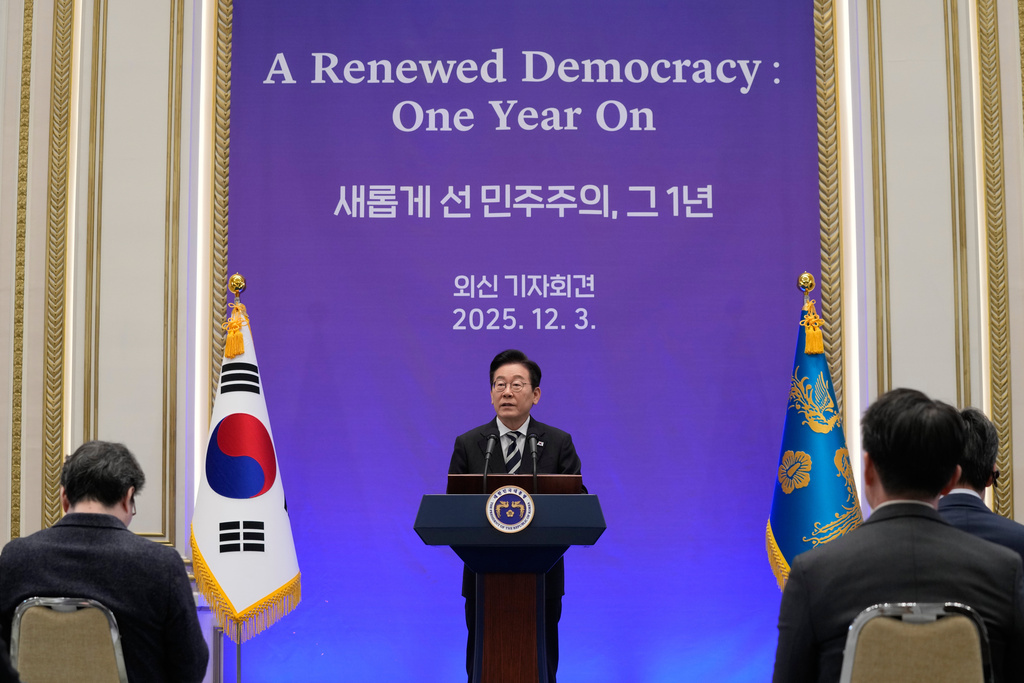
Speaking at a press conference marking the first anniversary of the declaration of martial law by the previous administration, President Lee said the economy is recovering at a fast pace and noted that the momentum could add pressure to consumer prices. Inflation has remained above the Bank of Korea’s 2 percent target for the past three months.
ALSO READ: S. Korea eyes bold investments in defense, aerospace industries
Meanwhile, the BOK said third-quarter gross domestic product was revised higher to 1.3 percent quarter on quarter from a preliminary 1.2 percent. The upward revision reflects stronger investment in construction, intellectual property and facilities, the bank said.

South Korea has one of the lowest debt burdens among developed nations, but its debt-to-GDP ratio has been climbing. If the proposal is implemented, the ratio is projected to reach 51.6 percent in 2026, compared with 49.1 percent this year following two extra budgets. The Finance Ministry forecasts the ratio will hit 58 percent by 2029.
The ministry said earlier that the budget prioritizes semiconductors, shipbuilding, K-culture and small businesses, aligning fiscal policy with the administration’s broader goal of “economic transformation”.
Tuesday’s relatively smooth approval process sharply contrasted with last year’s breakdown, when a deep partisan divide over the budget triggered parallel budget bills and political deadlock. The standoff infuriated then-president Yoon Suk-yeol and ultimately contributed to his controversial martial law declaration. This year’s relatively smooth passage reflects improved political stability under Lee about six months into his term.
Separately, the parliament approved revisions to the dividend-tax framework, cutting the top rate on large payouts from the level initially proposed and consolidating brackets for smaller earnings. The overhaul also shifts dividends to a separate tax regime rather than counting them toward total financial income that can trigger the highest comprehensive tax rate.
READ MORE: Korea eases equity rules for banks to spur high-tech investment
Dividend income above 5 billion won will now face a 30 percent rate instead of the originally planned 35 percent, while payouts at or below that level will be taxed between 14 percent and 25 percent. Dividends will no longer be folded into the system that imposes levies of up to 45 percent when financial income exceeds 20 million won.
