

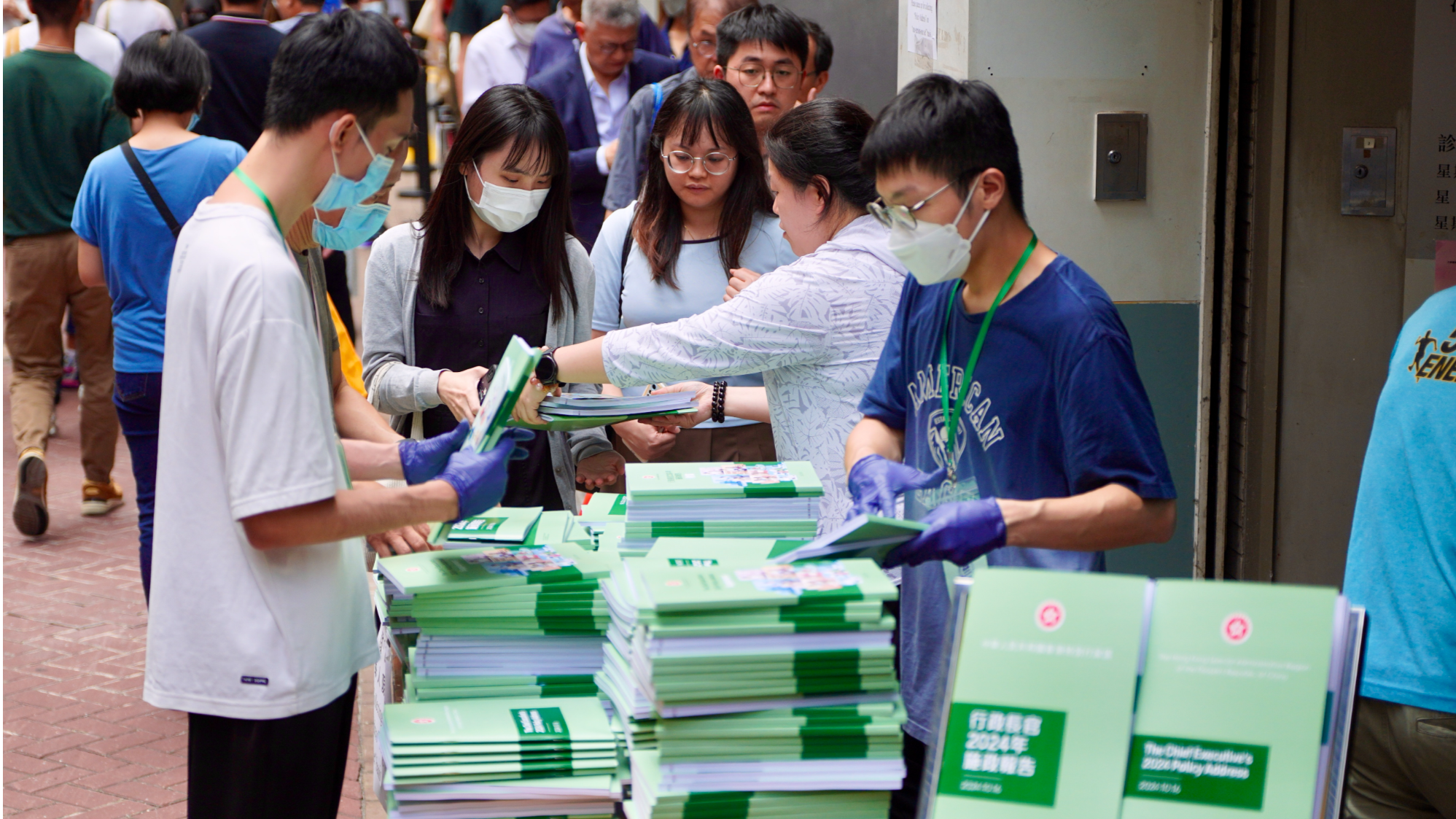
With the Hong Kong Special Administrative Region’s governance back on track after destabilizing elements were rooted out by the promulgation of national security laws and the overhaul of the electoral system, Chief Executive John Lee Ka-chiu has rightly focused on deepening reforms and exploring new growth areas in his latest Policy Address. The new policy blueprint can be said to herald an era for development and growth.
It goes without saying that new growth areas are urgently needed to inject momentum into Hong Kong’s sluggish economy, which is faltering on its journey to full recovery in the wake of the COVID-19 pandemic. Furthermore, new growth areas are essential for Hong Kong’s economy to expand and build up its prowess in the long term as its traditional pillars of growth have faced fierce competition from neighboring markets as well as challenges brought about by raging geopolitical rivalry.
Measures or strategies proposed include: developing the city into an operations center for international commodity trading, storage, delivery, shipping, logistics and risk management; building an international gold trading center; promoting high value-added maritime services; developing a low-altitude economy by creating a low-altitude airspace management system; and developing the city into an international biomedical innovation center and an international health and medical innovation hub.
READ MORE: Hong Kong needs to consider its future role and opportunities
Of course, it is likely to take years for these strategies or initiatives to bear fruit. But Hong Kong’s four traditional pillar industries, including financial services, trading and logistics, tourism and professional services, did not emerge overnight; they have grown to maturity and their current levels over a timespan of decades.
Recognizing the importance of Hong Kong’s status as an international financial center for both the city itself and the nation, Lee also came up with strategies to consolidate and enhance the city’s financial, shipping and trade sectors, the development of which, as he noted in his Wednesday address, are closely intertwined.
Measures will be introduced to enhance the mutual market access regime; reinforce the city’s status as the world’s largest offshore renminbi business hub by creating more RMB-denominated investment products, including RMB-denominated stocks, bonds and bond futures; enhance the city’s status as an international risk management center and an international asset and wealth management center.
In response to rising geopolitical threats, Lee is seeking to expand and deepen Hong Kong’s overseas networks, with measures to forge financial cooperation with the Middle East and the Association of South East Asian Nations; enhance the local securities market by tapping new sources of capital overseas, particularly from the Middle East; and attract more international enterprises and large-scale Chinese mainland enterprises to list in Hong Kong.
Meanwhile, the proposal to formulate medium to long-term development plans for new industrialization in Hong Kong based on new quality productive forces is a wise move to tackle the city’s longstanding economic problem of relying on a narrow industrial base, which has been blamed for low upward social mobility, particularly for young people.
READ MORE: Reform and innovation are the paths forward for Hong Kong
Both Hong Kong’s traditional pillar industries and the new growth areas proposed in the latest Policy Address are high value-added economic activities that rely on a large pool of talent. To build such a talent pool, Lee proposed a raft of initiatives to build Hong Kong into an international hub for high-caliber talent.
In response to residents’ housing woes, measures will be taken to boost the total public housing supply in the next five years to 189,000 units, or about 80 percent more than at the start of the current-term administration. Lee also promised to improve living conditions of subdivided units by legislating for a regulatory regime, while introducing measures to enhance the housing ladder.
To help small and medium-sized enterprises to tide over the current challenges they face, the Policy Address offers them several means of support. And in addressing weakening local consumption, Lee has sought the central government’s approval for further measures to boost the inflow of mainland visitors, including resuming the “multiple entry” Individual Visit Endorsements for Shenzhen residents, and expanding the coverage of pilot cities for the “one trip per week” Individual Visit Endorsements. These new measure are likely to come soon as the central government has advised that relevant departments are studying the expedited implementation of the proposal.
Overall, the new Policy Address puts an emphasis on laying the foundation for Hong Kong’s medium to long-term development, demonstrating visionary leadership, while also paying attention to the short-term problems of society.
The author is a current affairs commentator.
The views are not necessarily those of China Daily.
