

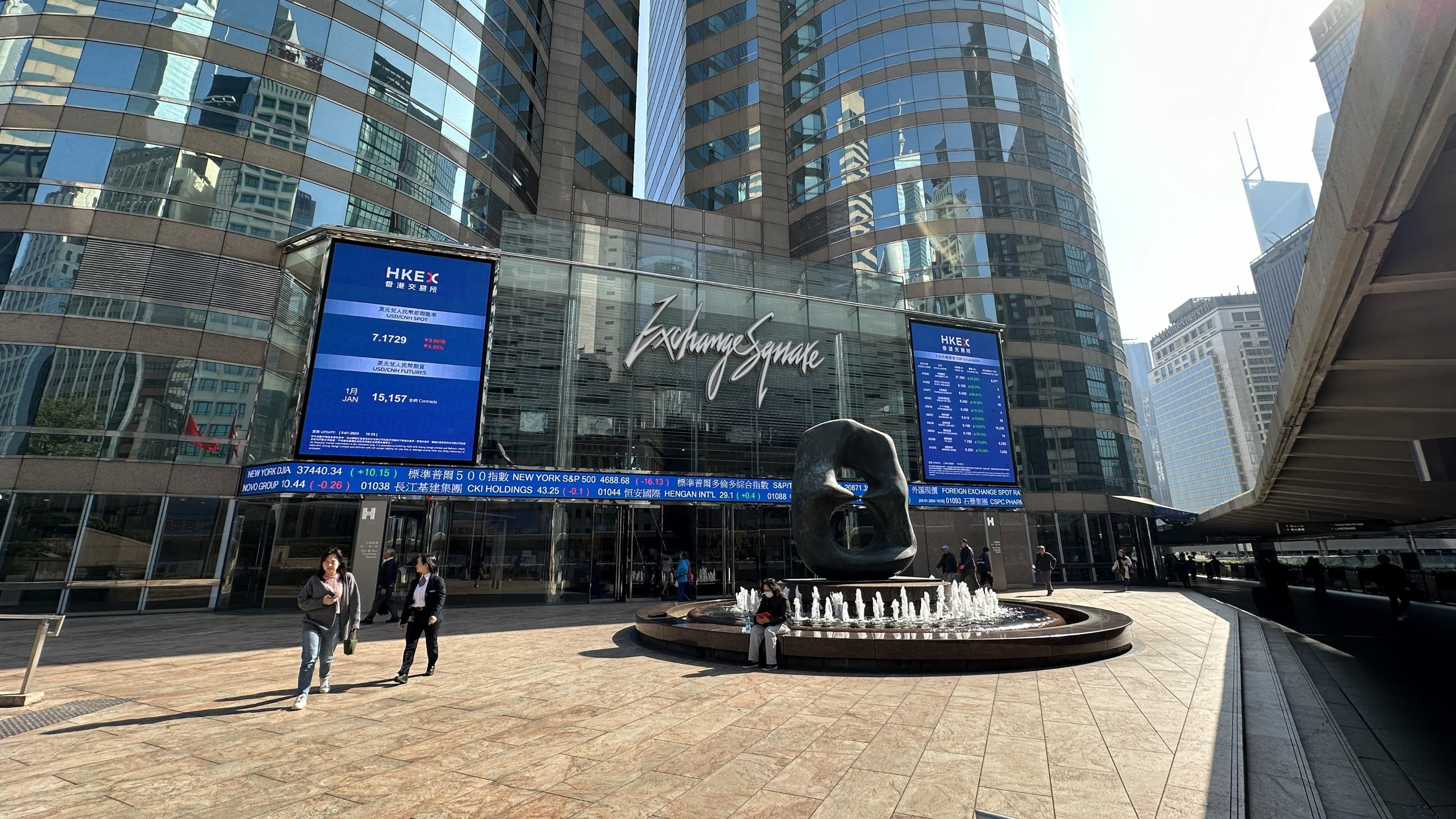
 In this Jan 5, 2024 photo, people walk past Exchange Square, which houses the Hong Kong Stock Exchange, in Central, Hong Kong. (SHAMIM ASHRAF / CHINA DAILY)
Hong Kong’s Hang Seng Index on Wednesday saw a reversal in the rally of the previous day as the market waits for a clear signal of policy support, with the benchmark decreasing 0.3 percent to close at 16,081 with a market turnover of HK$103.6 billion ($13.25 billion).
The HSI rallied 4 percent on Tuesday, closing above the 16,000 point level, with the expectation that the central government would launch more measures to stabilize the capital market.
Market optimism was also spurred by Central Huijin Investment Company’s commitment to increase its holdings of exchange-traded open-ended index funds; and China Securities Regulatory Commission’s pledge to coordinate and guide various institutional investors such as public funds, private equity funds, securities companies, social security funds, insurance institutions, and annuity funds to increase their holdings in A-shares.
Interest rate cuts will be the dominant theme driving the market this year. Regarding the mainland and Hong Kong market, the central government’s stimulus policies have provided some support to the stock market. But in the long term, the market still needs to monitor the impact of factors such as the real estate debt situation.
Hong Kong-based mandatory fund consultant firm GUM
Equity analysts argue that the fortune of the Hong Kong stock market hinges on the pace of US interest rate cuts, the performance of the domestic A-share market, and the liquidity of the HSI market.
“Interest rate cuts will be the dominant theme driving the market this year. Regarding the mainland and Hong Kong market, the central government’s stimulus policies have provided some support to the stock market. But in the long term, the market still needs to monitor the impact of factors such as the real estate debt situation,” Hong Kong-based mandatory fund consultant firm GUM explained.
ALSO READ: HSI plummets as A-share market weakens
UBS Investment Bank says the MSCI China Index has declined 10 percent year-to-date, underperforming global markets by 8 percent, and is currently trading at 8.2 times forward price-to-earnings ratio — on par with previous troughs reached since 2014.
“With trough valuation multiples, light investor positions and potential support from the 'national team', we believe risk-reward is attractive at this level,” said James Wang, head of China Strategy at UBS Investment Bank.
Wang believes that the most appropriate strategy for now is to have a core portfolio consisting of high dividend stocks with some growth potential which would benefit from potential inflows from insurance funds and the national team (state-owned financial institutions).
 A bus passes by commercial buildings in Central, Hong Kong, on Jan 8, 2024. (GARY CHIU / CHINA DAILY)
Luca Paolini, chief strategist at Pictet Asset Management, is more cautious, saying investors still doubt the willingness of the central government to deliver large-scale fiscal support to revive the stock market. The country’s property market also has not witnessed any turnaround that could improve market sentiment.
CCB International analyst Cliff Zhao and Wilson Zou maintain the view that the HSI will not fall below the bottom level of 14,597 points recorded October 2022, as liquidity conditions remain favorable for the HSI at current valuation levels.
“But before clearer policy signals and catalysts, bottom consolidation may resume in the coming months,” Zhao and Zou said.
READ MORE: CE: HK stock market orderly, no abnormalities
According to Hang Seng Indexes’ data, the HSI dived almost 27 percent in the Year of the Rabbit (Jan 22, 2023, to Feb 6, 2024) — the worst performing lunar year in the past 10 years and the worst performing Year of the Rabbit in history. It also saw the worst market plunge in three consecutive lunar years.
As of Wednesday, the HSI also had plummeted 5.5 percent year-to-date.
