

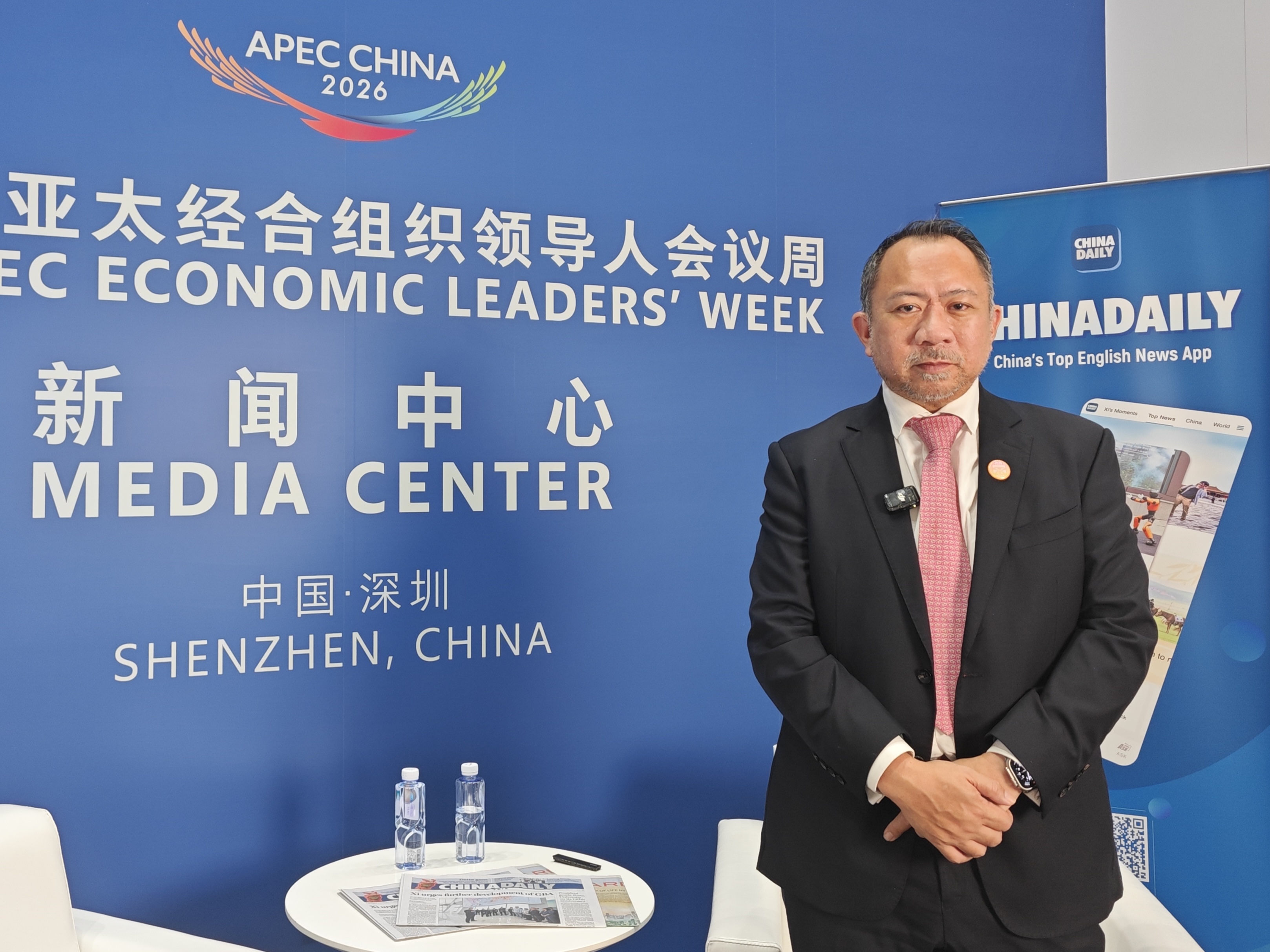
The 2026 Asia-Pacific Economic Cooperation Economic Leaders’ Week in Shenzhen offers the region’s economies an opportunity to identify shared challenges and find ways forward amid uncertainty and supply chain challenges, the APEC Secretariat chief said.
In an exclusive interview with China Daily on Tuesday, Eduardo Pedrosa, executive director of the APEC Secretariat, said representatives are working toward productive outcomes from the gathering in Shenzhen, Guangdong province, while reviewing the year’s work and discussing problems facing the region.
Against a backdrop of uncertainty, supply chain fragility and complex geopolitical and geo-economic challenges, “it would be helpful for APEC economic leaders to come together, agree on what those challenges are, and identify ways of moving forward on how do we address them as part of the Asia-Pacific community”, Pedrosa said.
“APEC provides that platform for that conversation to continue to take place,” he said. “That, I think, is an inherent value of APEC that should not be understated.”
RELATED ARTICLES
- APEC is primed to chart a path toward inclusive AI-driven growth
- Shenzhen APEC meeting is about pragmatism
- PwC China executive: APEC brings practical benefits for regional businesses
- CE pitches GBA as model of open cooperation at APEC CEO Summit
- GBA seen contributing more to Asia-Pacific prosperity
During his fourth visit to Shenzhen this year, Pedrosa said the city’s innovation and pace of change are impressive.
“The innovation system is very clear on how important it has been, not just in terms of innovation, but it’s how innovation is blended into manufacturing processes and how different products use artificial intelligence that is embedded in them,” he said.
Pedrosa pointed to the Guangdong-Hong Kong-Macao Greater Bay Area as an example of connectivity, citing the multiple transport links between its 11 cities.
He stressed the importance of improving connections between different modes of transport, noting that gaps in multimodal connectivity are among the challenges addressed by APEC’s supply chain facilitation action plan.
“APEC is a process, it’s a dialogue,” he said, describing the ability to sustain communication among economies as one of the organization’s most tangible achievements.
This year’s work has included about 300 meetings, 15 high-level dialogues and continuing engagement with business, he said, with the 2026 APEC Economic Leaders’ Week in Shenzhen marking the culmination of these efforts.
Pedrosa added that APEC is working to advance paperless trade to reduce time-consuming paperwork for businesses, particularly smaller firms.
Moving documents online could help, but digitization alone is not enough, as digital records also need to be recognized by other economies and trading partners, which Pedrosa said makes trust essential to the transition.
“You might have the documents online, but I don’t necessarily trust the documents that you have,” he said. “So we need to build that trust in the system as well.”
Although the Asia-Pacific region performs relatively well in paperless trade, the shift remains difficult because companies and authorities rely on systems they have used for decades, he said.
APEC can help economies navigate the transition. “Some economies have moved totally online and what APEC does is it enables economies to share that whole experience and see if there’s anything that we can learn from each other or do collectively as an organization,” Pedrosa said.
An APEC Centre of Excellence for Paperless Trade, proposed by the APEC Business Advisory Council, is moving forward. But further momentum is needed, along with efforts to identify capacity-building needs and ensure the benefits are widely shared, he added.
Wang Zhen contributed to this story.
Contact the writer at irisli@chinadailyhk.com
