

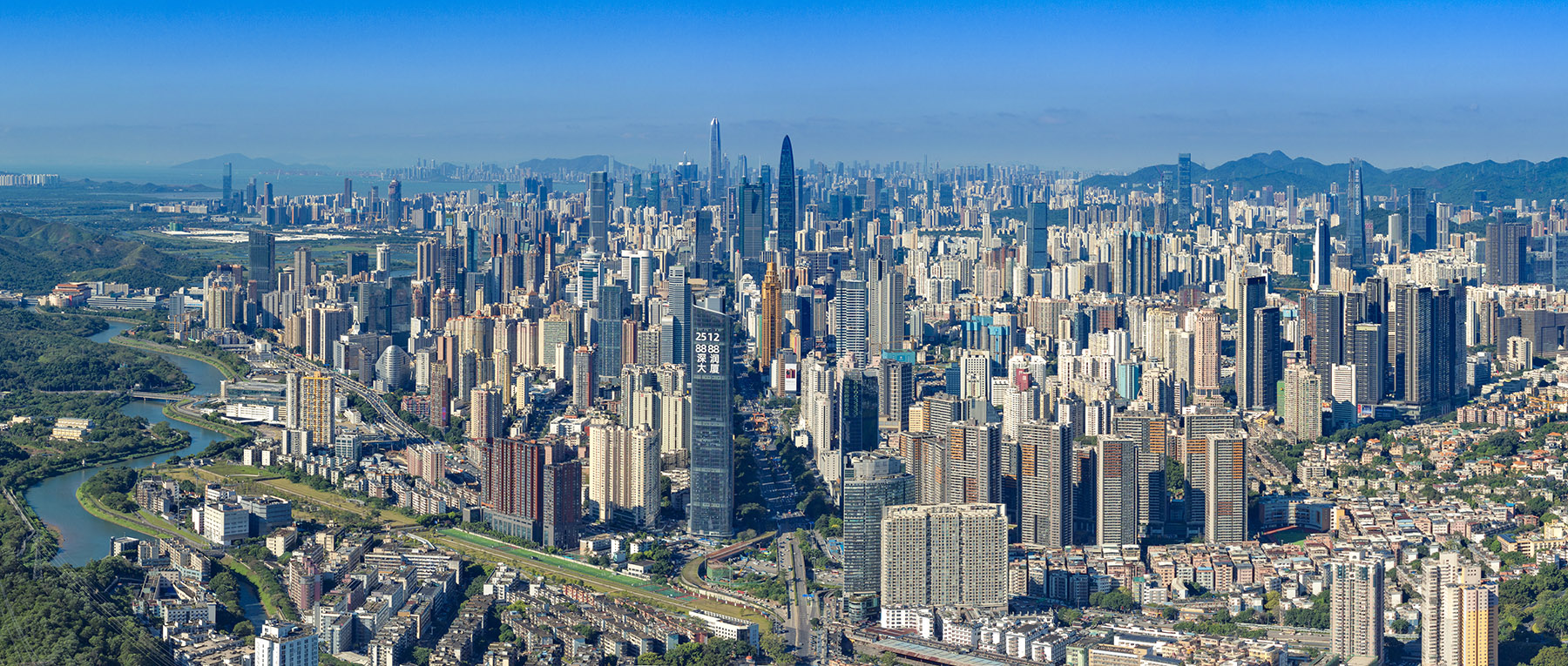
At 7 am on weekdays, Luohu Port in Shenzhen is bustling with cross-border schoolchildren. Commuters heading to work and Hong Kong residents pulling suitcases pass through alongside them. The crowd makes a vibrant scene.
Luohu is Shenzhen's earliest built-up district. It is a major trade hub, a financial district and a busy commercial center. With ecological assets such as mountains and water blending with high-quality public services, the district connects downtown Shenzhen and Hong Kong and other areas in the Guangdong-Hong Kong-Macao Greater Bay Area.
Leaving the Luohu Port, visitors can see a mint-green-and-blue minibus approach. Without a driver, conventional rearview mirrors or windshield wipers, it moves smoothly through a crowded commercial district.
ALSO READ: APEC reporters tour Shenzhen tech showcases
The driverless bus operates around the clock in the central urban area, integrating an L4 autonomous driving system into the city's public transport system with intelligent connected-vehicle technology at its core.
Elsewhere in Luohu, driverless logistics vehicles are hard at work, dodging obstacles, recognizing traffic lights, planning routes and delivering goods accurately.
In Luohu, tech-laden unmanned scenarios have become embedded in daily life. These are not only the practical application of innovative technology but an example of industrial upgrading and scenario application reinforcing each other.
In recent years, Luohu has been implementing a series of initiatives to boost the usage of artificial intelligence. It has recruited application scenarios in government services, transportation, healthcare, education, urban management, trade and culture and tourism.
So far in 2026, it has identified 75 potential applications and helped launch 22 projects.
The gold and jewelry industry is another signature industry of Luohu. During the 14th Five-Year Plan (2021-25), its revenue exceeded 200 billion yuan ($30 billion). The gold and jewelry craft design and smart manufacturing cluster was named a national characteristic industrial cluster for small and medium-sized enterprises.
Recently, the industry is moving from being scale-focused to value-centered. Shenzhen Xipuni Precision Technology is a homegrown Luohu gold and jewelry enterprise. It was listed on the main board of the Hong Kong Stock Exchange in 2025 and posted operating revenue of about 611 million yuan in 2025.
Based in Shuibei market, Xipuni has explored a new model driven by AI to open up a new product category, supported by the cluster's industry-chain advantages.
In September, Xipuni launched a pure-gold "smart ring". Relying on its self-developed AI agent, integrated AI chip and biosensor array, the ring records exercise trajectories, sleep states and heart-rate data. It then generates professional analysis reports, offering users a consumer experience that combines fashion, an intelligent assistant and health management.
ALSO READ: APEC comes to Shenzhen: Where ‘China Opportunity 2.0’ meets the world
Xipuni has joined hands with several professional institutions to initiate the drafting of a group standard for "smart jewelry". It aims to unify production processes, material definitions, functional parameters, quality inspection standards and safety norms, laying down rules for the industry's systematic and scaled development.
The financial services sector in Luohu is also raising its new content and quality. The district holds its base as a traditional headquarters for financial enterprises, using the sound business environment to attract licensed financial institutions such as banks, securities enterprises and insurers.
At the same time, it aims to expand its digital finance industrial park, bringing in innovative enterprises in digital finance, supply-chain finance and fintech and seizing the new opportunities of AI and the digital economy.
