

Late artist studied abroad but returned to the capital city to bring dignity and preservation to its ancient architecture through vivid hues, Lin Qi reports.
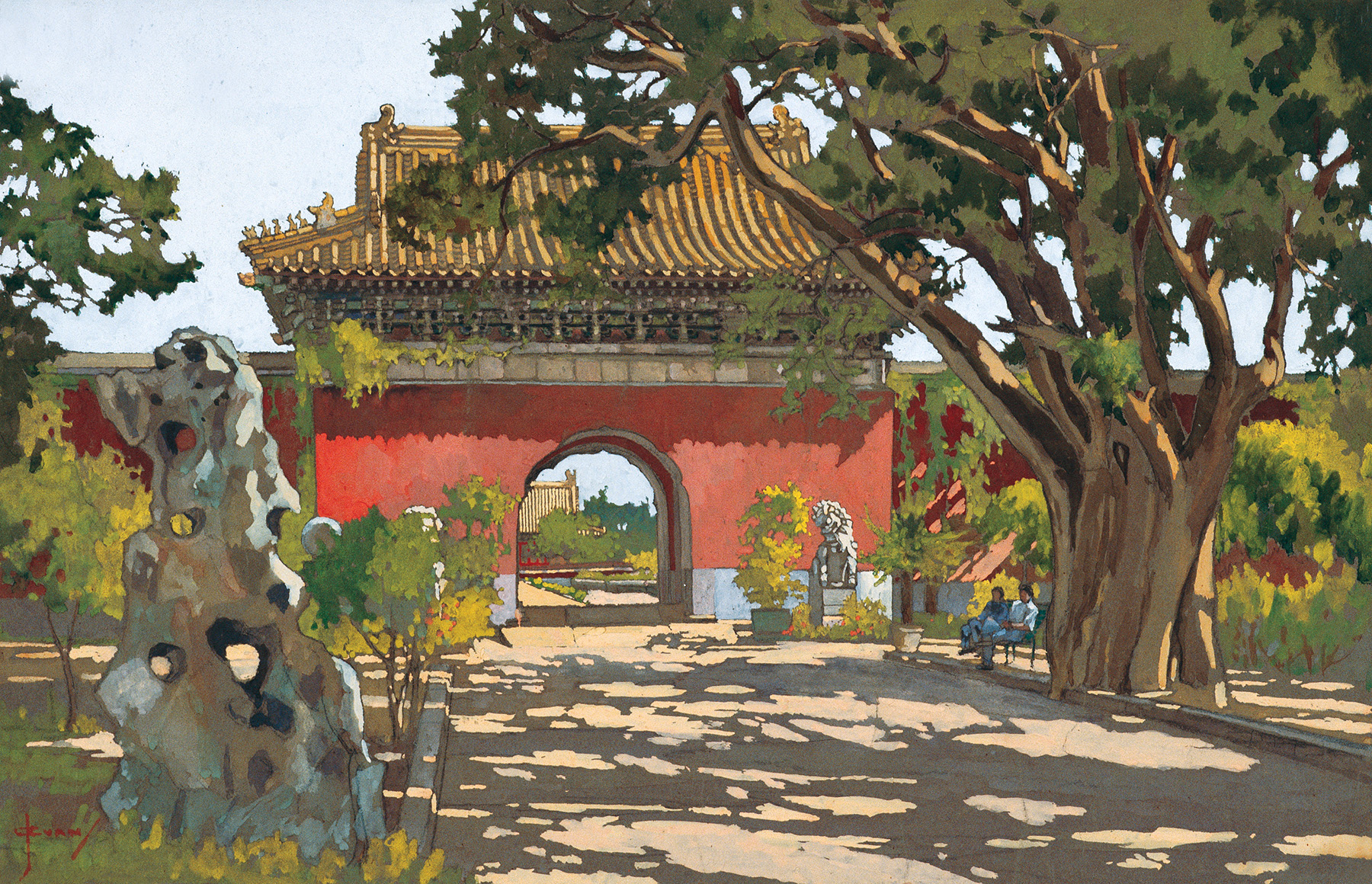
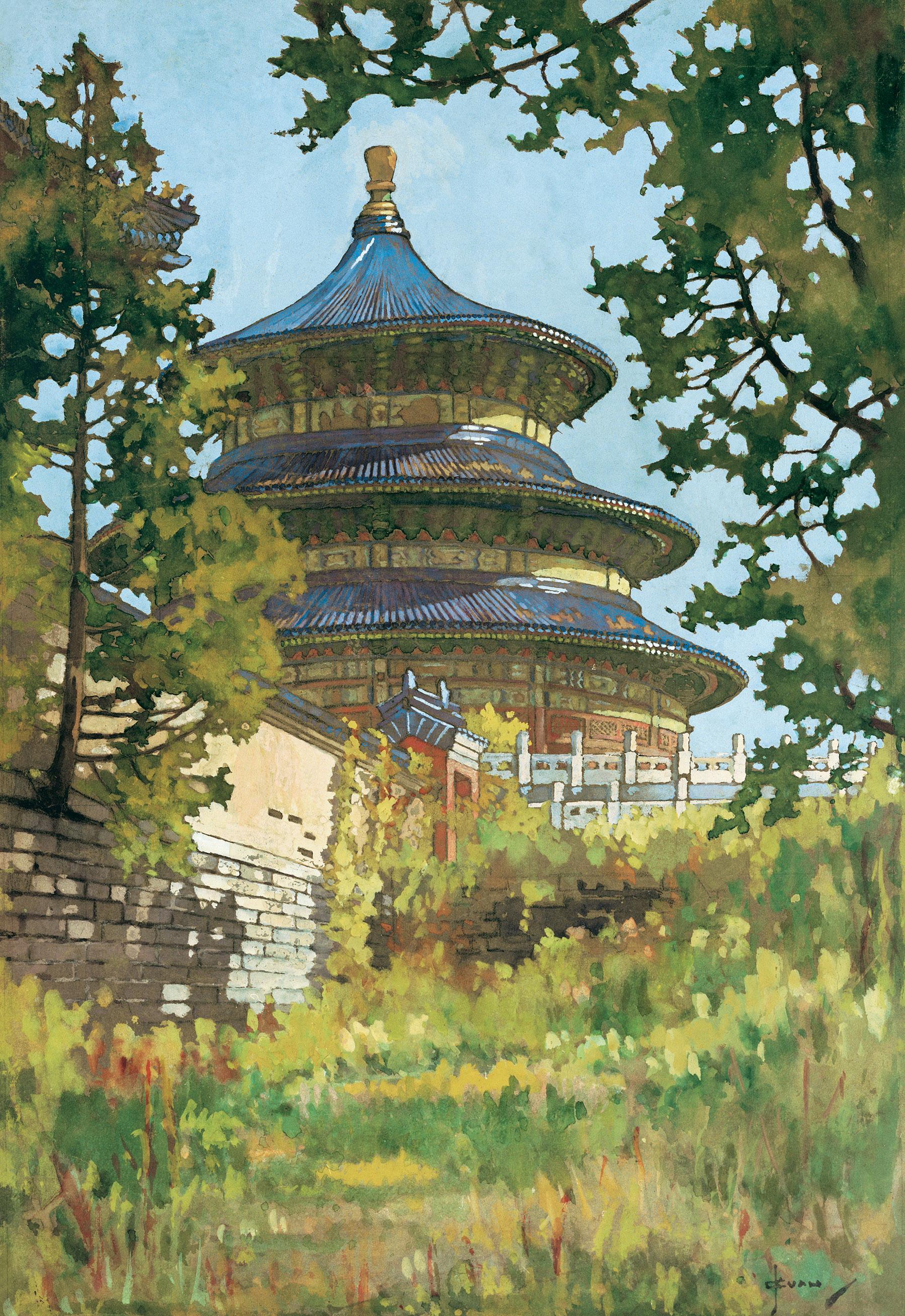
Standing at 38 meters tall, Qinian Dian, or the Hall of Prayer for Good Harvests, the central building at the Temple of Heaven complex in Beijing, commands imperial solemnity. The hall was once used as a place where monarchs of the Ming (1368-1644) and Qing (1644-1911) dynasties held ceremonies to pray for good weather and bountiful harvests.
Today, this majestic three-tiered circular structure, once exclusive to the ruling class, is one of the capital city's most favored tourist spots. People share various photographic perspectives on social media, capturing its gilded golden top, deep-blue glazed tiles and red pillars that define Beijing's awe-inspiring historic aura.
ALSO READ: The therapeutic power of lotus flowers
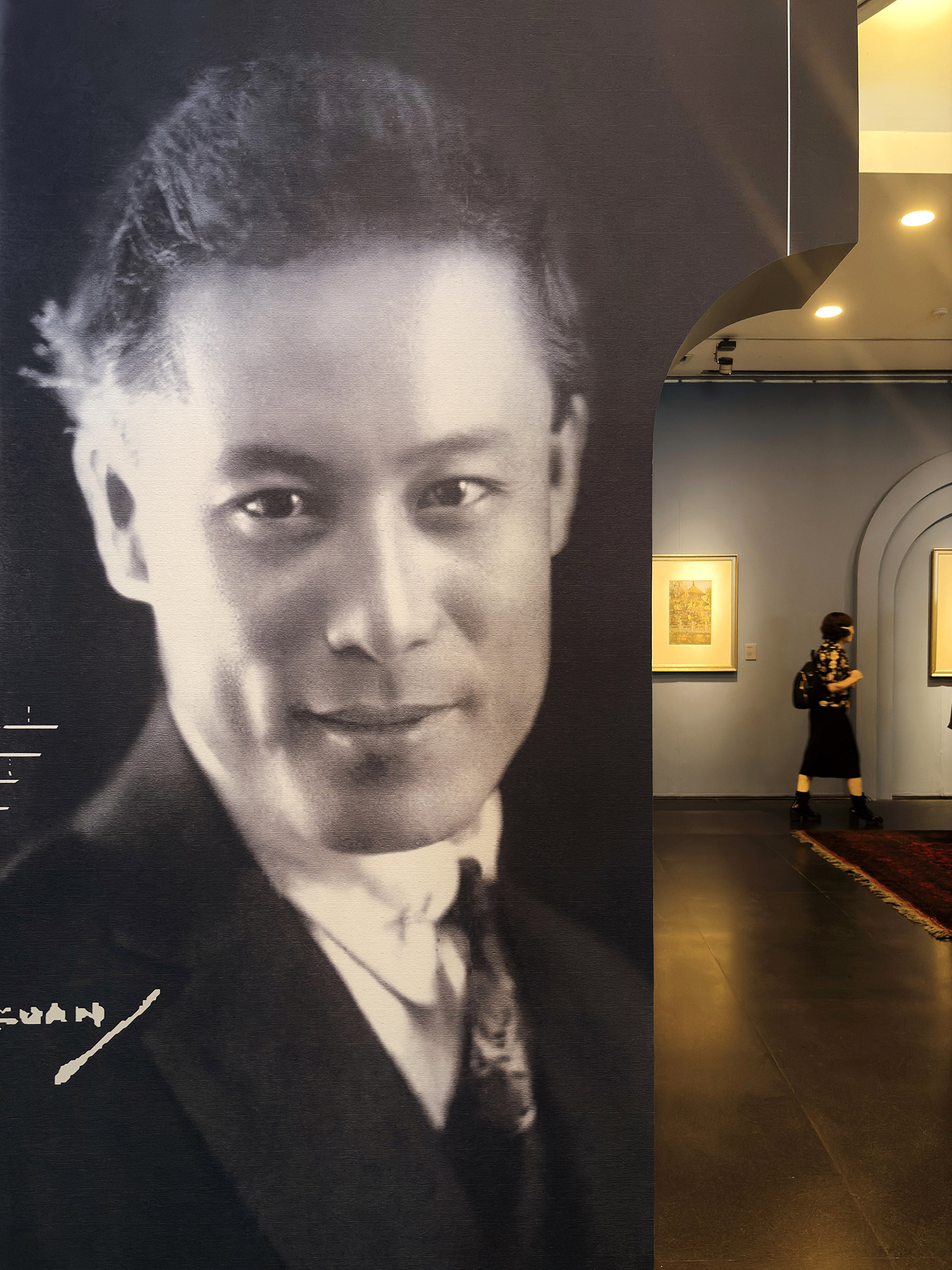
Eight decades ago, watercolorist Guan Guangzhi (1896-1958) was one of those who frequently visited the Temple of Heaven. He preserved the magnificence of the Hall of Prayer for Good Harvests through vivid colors and restrained brushwork. One of his extant works from the 1940s depicts a serene summer scene in which the building is shrouded by verdant, scattered cypresses on both sides and an expansive grassy field at the front. The thickness of the pigments accentuates the solemn mood of the site, while the shifting chiaroscuro — the contrast of the shadows of tree leaves against the light on the dappled wall — renders to the composition a graceful, composed sensibility.
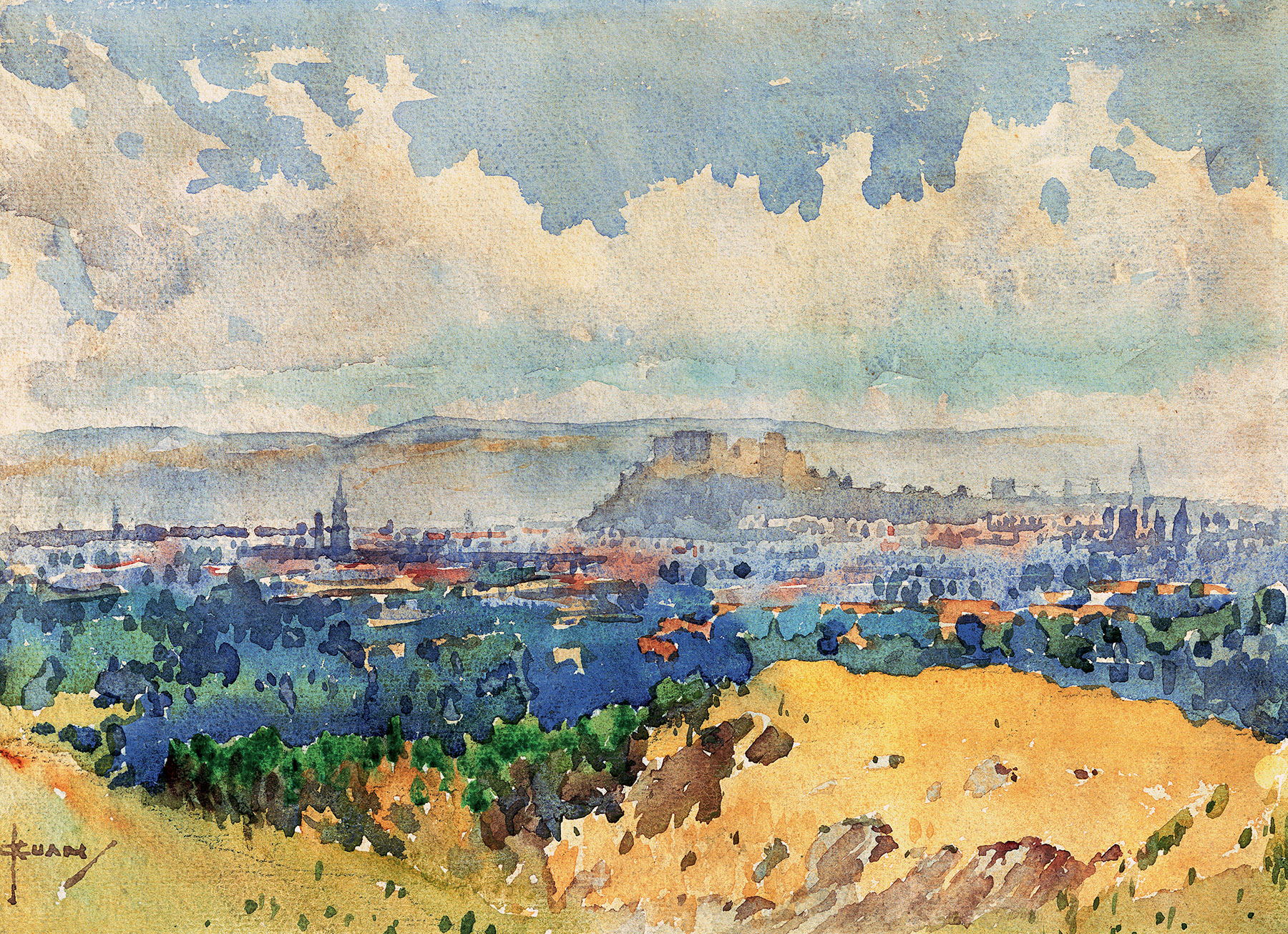
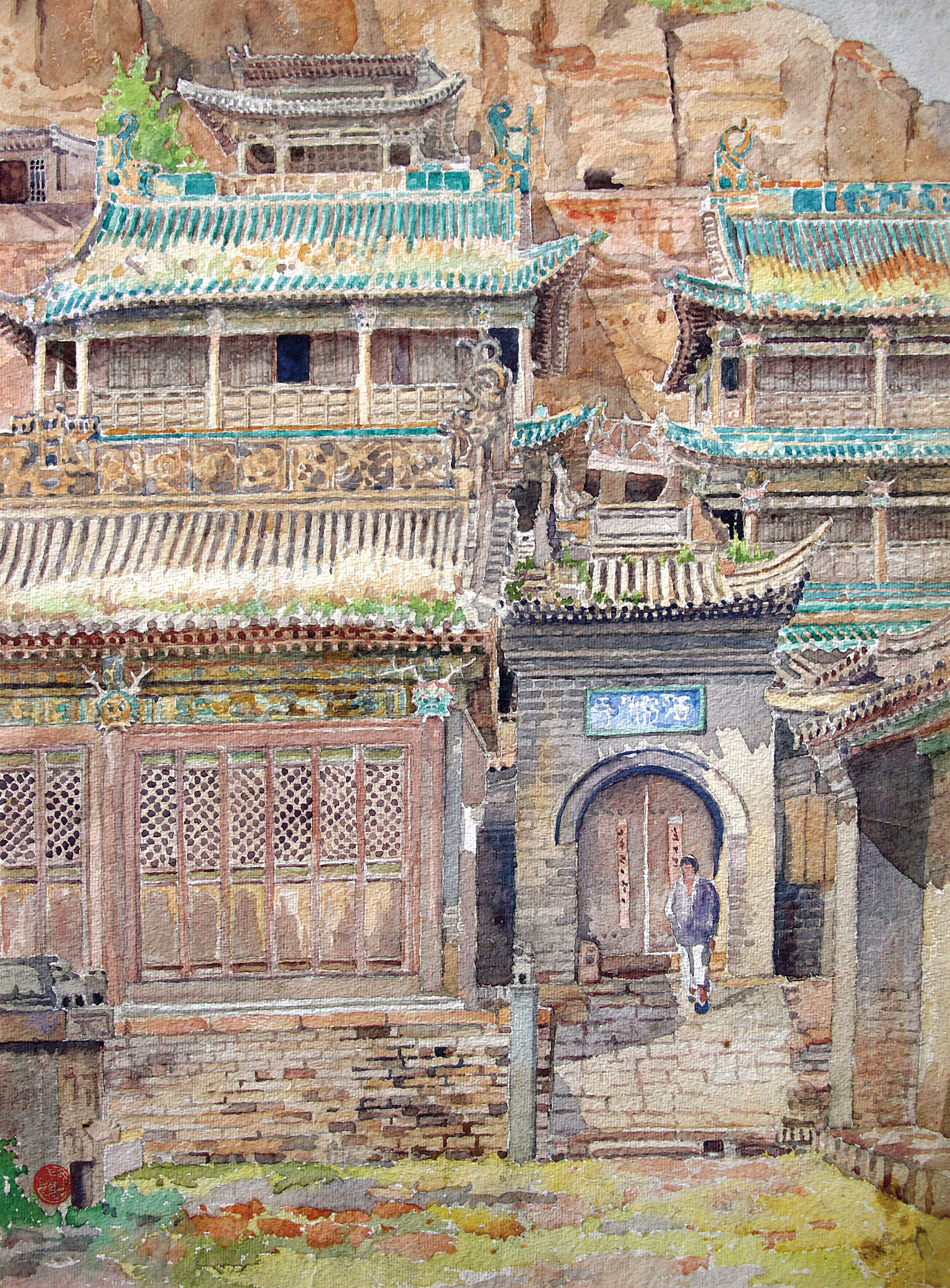
Guan would have been a high-quality content creator with many followers in the social-network age, but in real life, he was a devoted teacher at art schools and an avid painter and printmaker of the imperial architecture and gardens of centuries-old Beijing where he lived from the mid-1920s until his death.
The Splendid Realm of Diligence: Art of Guan Guangzhi, an ongoing exhibition at the Art Museum of the Beijing Fine Art Academy, invites viewers into his watercolor world. Visitors will be immersed in the understated beauty composed of the imperial palaces' eaves emerging in daylight, while trees, flowers and lake ripples radiate vitality. Over 70 watercolors and copperplate prints, including his most iconic Hall of Prayer for Good Harvests works, are on show until Sept 6.
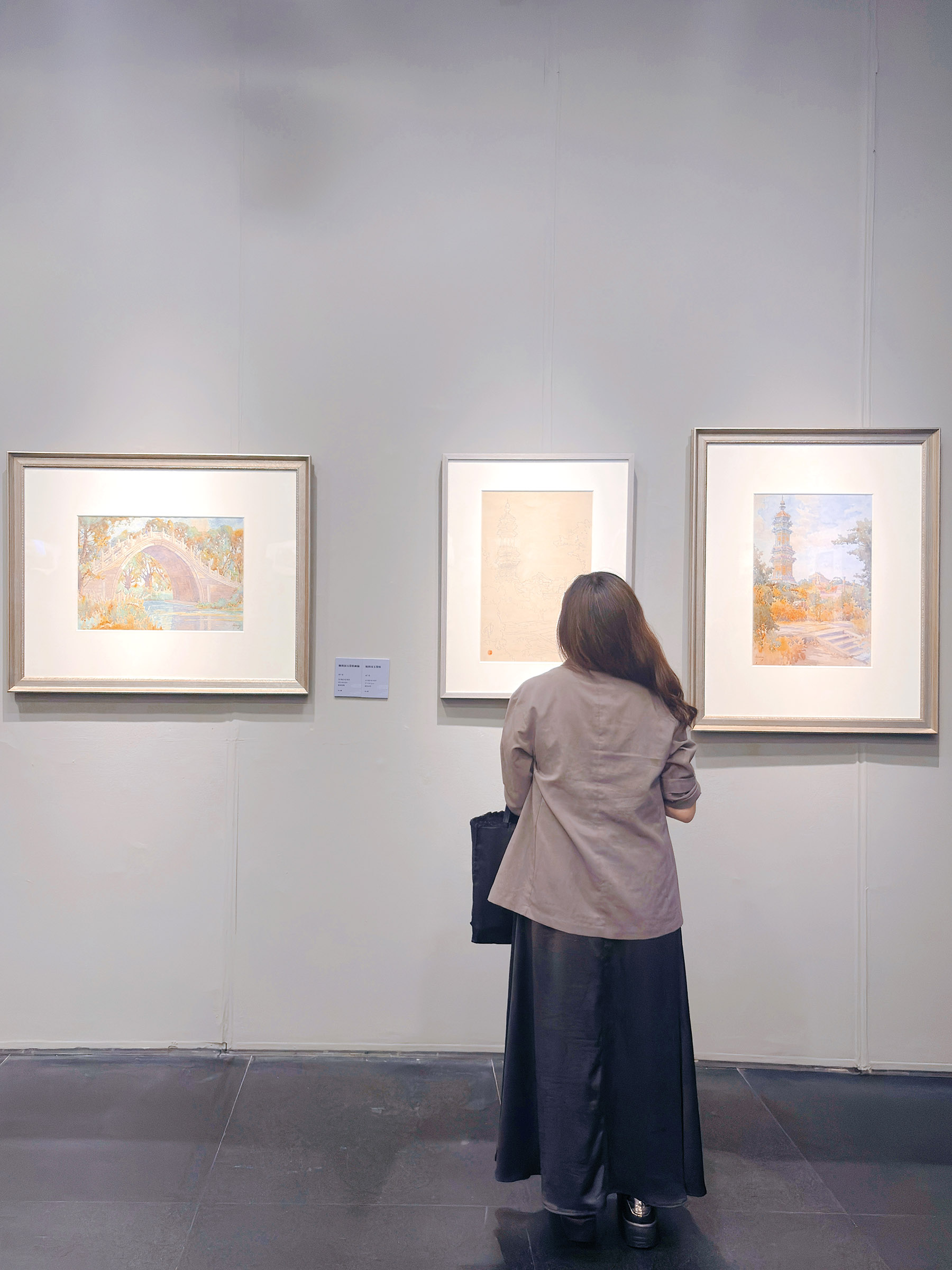
Born in Jilin province, Guan developed an initial interest in classical architecture while studying at an art school in Shenyang, Liaoning province. He often accompanied his watercolor teacher, a British woman, to sketch at the Zhao Mausoleum, commonly known as Beiling, the burial tomb of Emperor Taizong of the Qing Dynasty and his empress. After relocating to Beijing, he began creating watercolors of its ancient architecture as a vivid testament to the city's imperial past.
At age 36, he made a life-changing decision to study abroad. He enrolled at the Royal College of Art in London. He was, under the name Kuan Kuang Chin, one of the first Chinese students to attend this institution.
Fu Yiwei, the exhibition's curator, says Guan particularly admired the way William Turner (1775-1851), the noted English landscape artist known as "the painter of light", presented light and color. "Guan's works on show, Morning in Edinburgh and Belfast Beach, bear a considerable Impressionist influence. The light and translucent texture show the distinctive qualities of British watercolor."
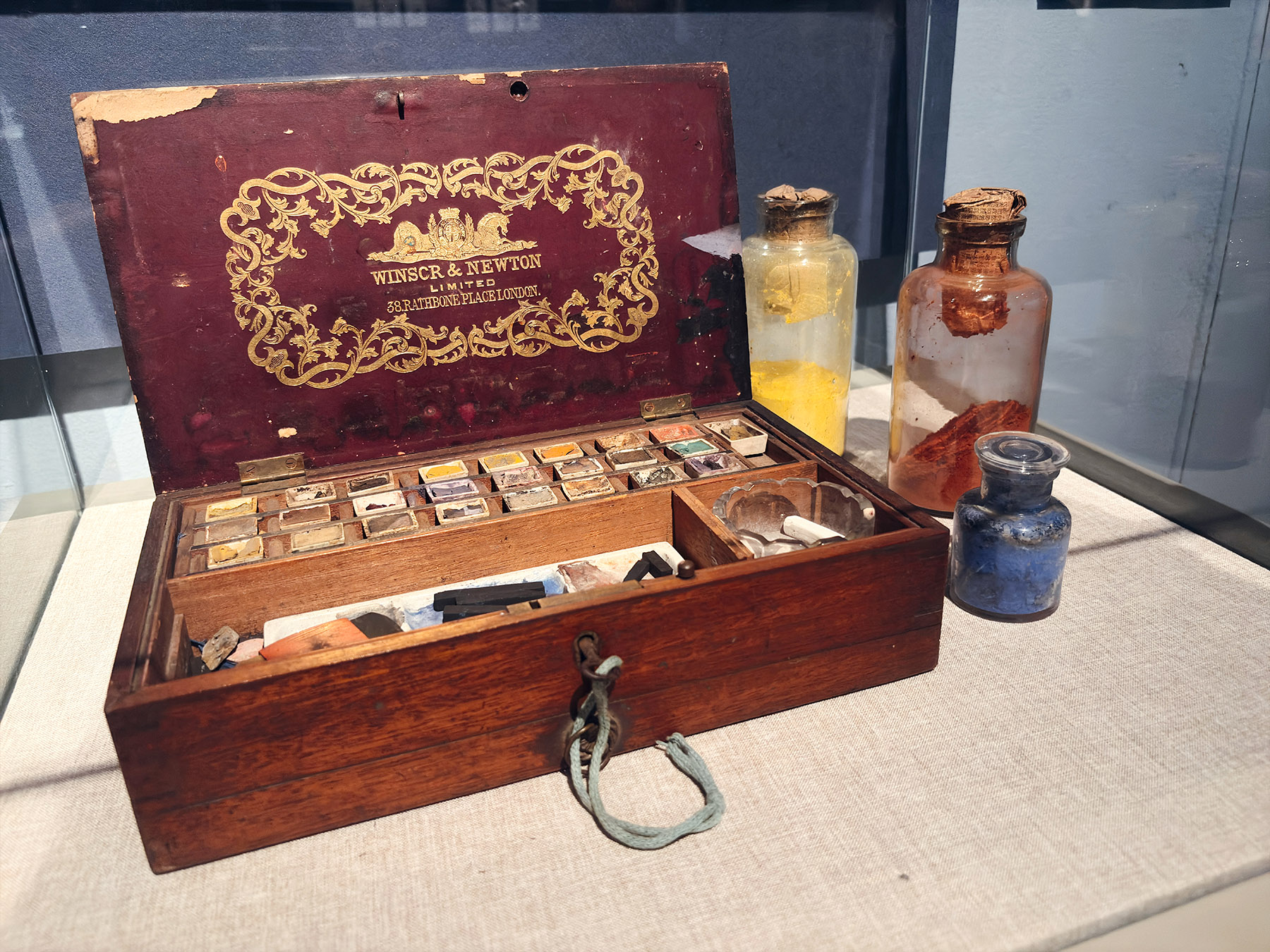
While in Britain, Guan also studied etching techniques and traditions traced to 17th-century Dutch painter and printmaker Rembrandt van Rijn. When he left London, he carried with him a machine and tools for copper engraving. At home, he produced dozens of prints exhibiting the ever-changing atmosphere of ancient buildings.
Guan returned to Beijing in 1934. His wife, Wang Rulan, once recalled that during his trips to Britain and back, Guan visited art galleries and museums in Paris, France; Brussels, Belgium; Naples, Italy; Alexandria, Egypt; and Mumbai, India. "It broadened his horizons and made him realize that the art of every nation, with its own distinctive features, has added splendor to world culture. At the same time, he deeply appreciated that in art, one should not only possess national and individual characteristics, but also must study extensively to integrate diverse influences, to progress and achieve innovations," she said.
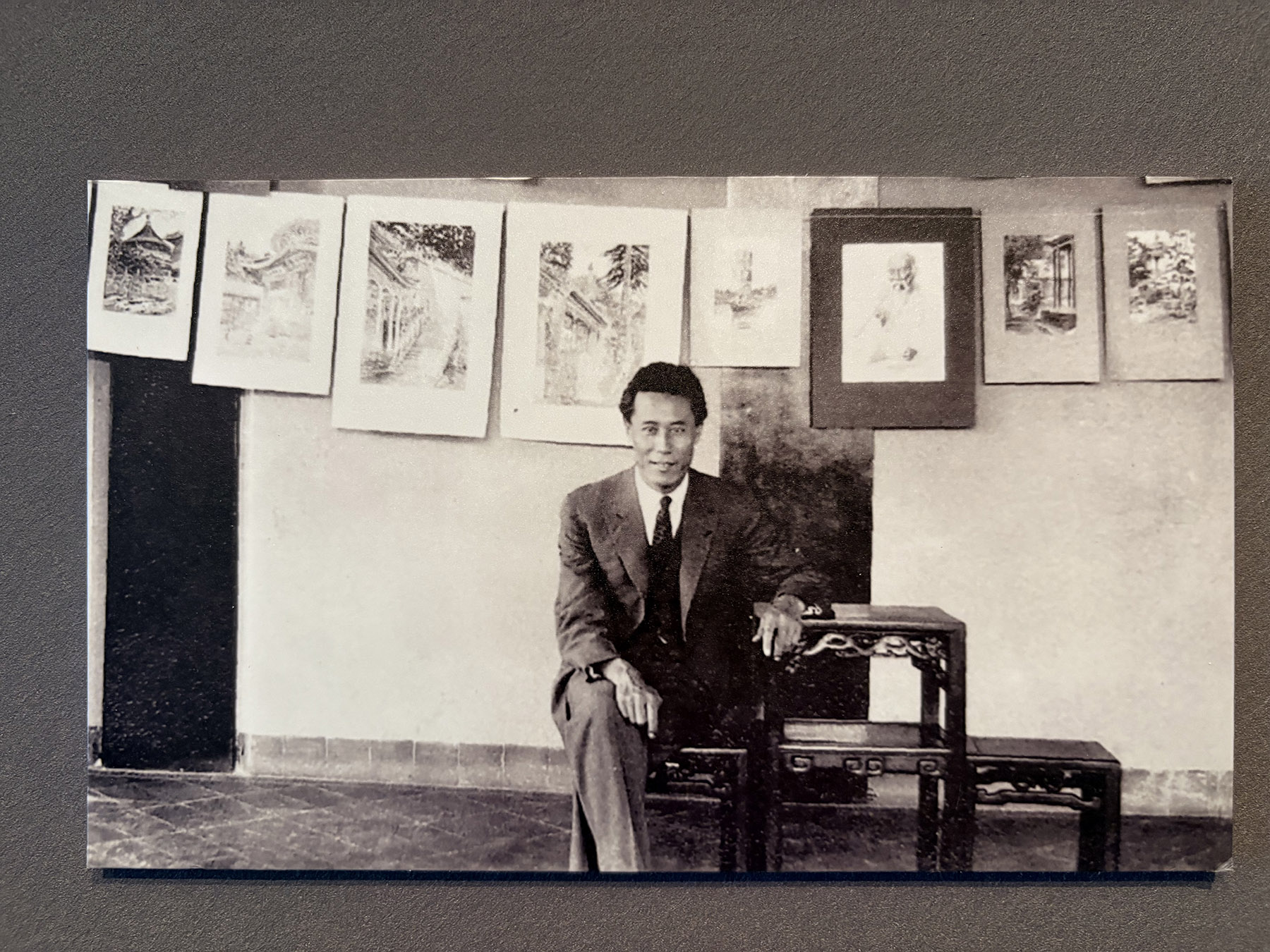
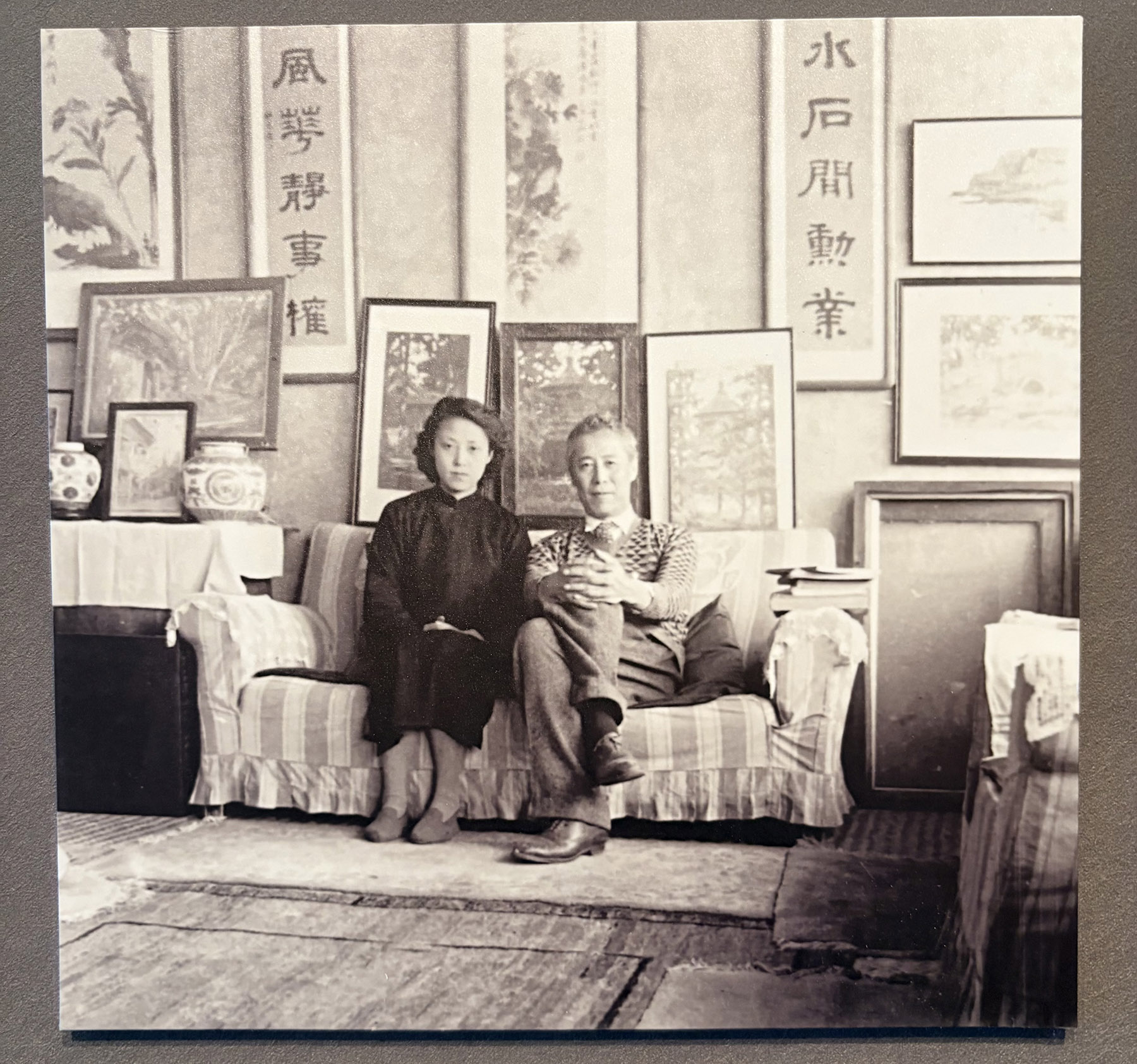
Back in Beijing, Guan taught at various schools. Meanwhile, he also deviated from his earlier depiction of British scenery and developed his own watercolor style in depicting Beijing's historic structures.
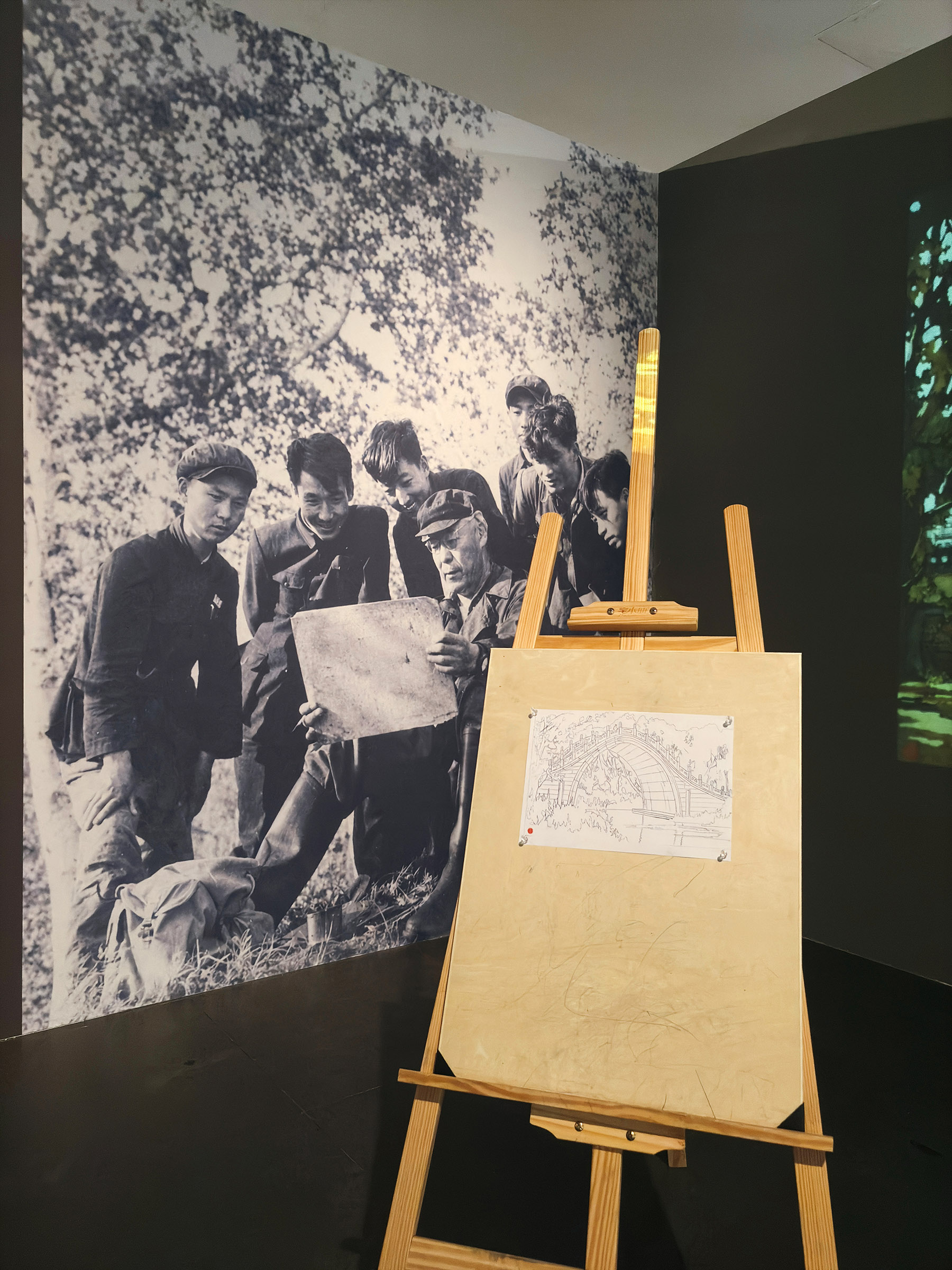
His subjects include the Jade Belt Bridge at the Summer Palace and the Nine-Dragon Wall in Beihai Park. He placed his subjects in a harmonious, beautiful environment. When depicting the Corner Towers of the Forbidden City, he would add cleaners working on a boat in the moat on the outer perimeter; in another painting of Beijing Zhongshan Park, where an imperial altar sits, he focused on the blooming wisteria outside the long corridor.
ALSO READ: Finding cultural resonance with printmaking
Fu says his strokes render these ancient buildings dignity and a refreshing resplendence that touches people across generations.
Dai Shihe, a retired professor of painting at the Central Academy of Fine Arts, says, "Although Guan's landscapes are smaller in size, he delivered the poise and ease inherent in Chinese culture."
Contact the writer at linqi@chinadaily.com.cn
