

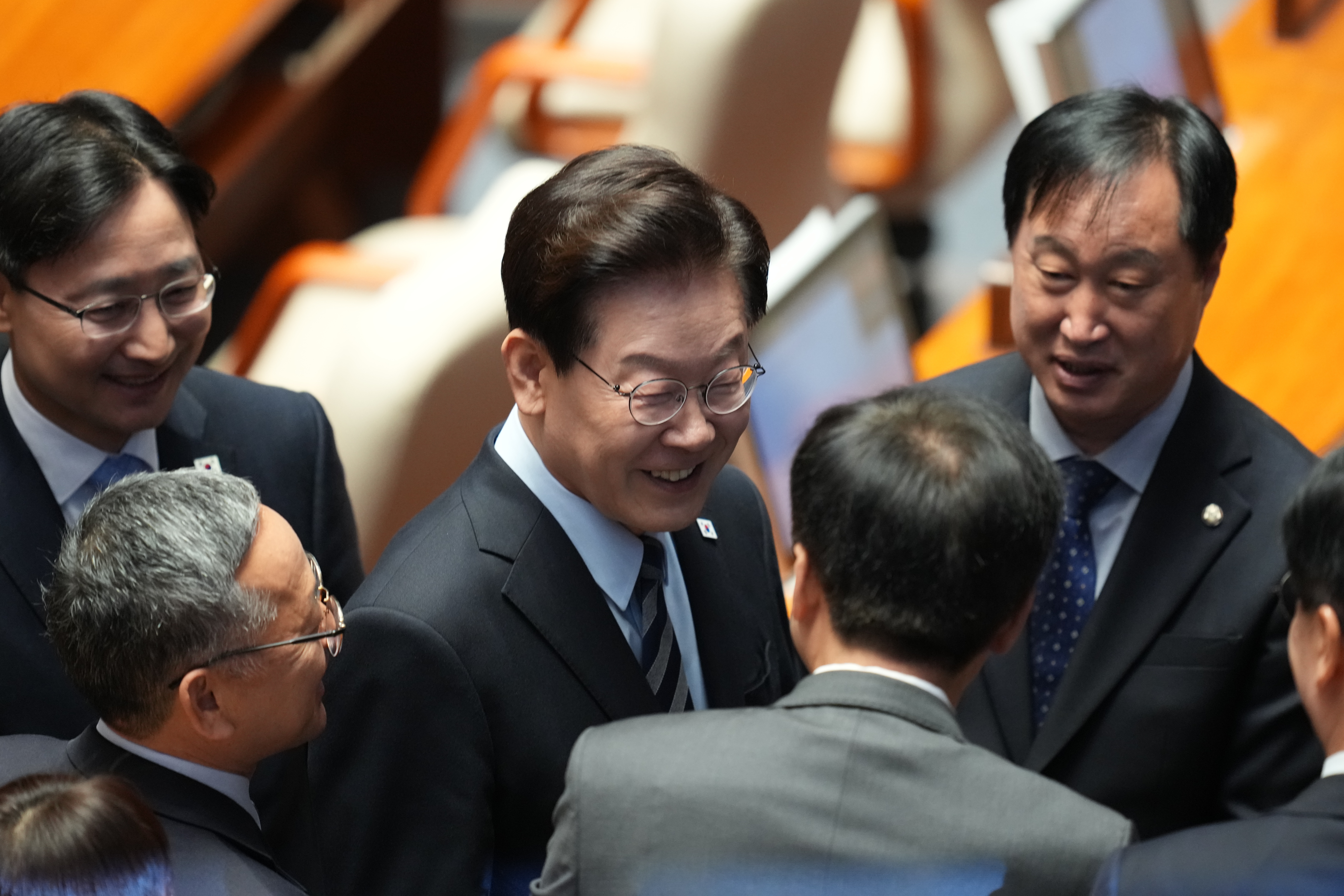
SEOUL – South Korean President Lee Jae-myung vowed on Monday to make bold investments in artificial intelligence to boost the country's economic growth potential, in an address to parliament seeking approval for next year's budget.
"We will invest 21.3 trillion won ($15.97 billion), nearly twice this year’s amount, in AI and the three megaprojects of semiconductors, physical AI and AI data centres," Lee said.
His administration proposed in September increasing government spending by a record 12.8 percent next year to 820.9 trillion won aiming to strengthen South Korea’s technological edge as global competition over AI intensifies.
South Korea's economy has been heavily boosted by demand for advanced chips used in AI, lifting exports and the earnings of memory chip makers Samsung Electronics and SK Hynix.
READ MORE: Samsung Electronics posts record Q3 profit, revenue on surging chip demand
Asia's fourth-largest economy grew faster than expected in the third quarter on chip exports and investment. From January to October, exports totalled $930 billion, on track to exceed $1 trillion this year and make South Korea the fourth country in the world to reach the milestone after the United States, China and Germany.
Lee said annual exports of $1 trillion were now within reach, but warned that the benefits were not being shared evenly.
"We must make a great transition from ‘growth for the few,’ in which opportunities and gains are concentrated among certain regions, classes and a small number of companies, to ‘growth for all,’” he said.
"Fiscal foundation is also becoming stronger," Lee said, noting that next year's fiscal deficit will narrow to 0.1 percent of gross domestic product, the lowest in two decades, from 3.9 percent this year, with the debt-to-GDP ratio down to 48.3 percent from 51.6 percent.
Such improvements and the role of a proposed Future Response Fund were seen "very positively" by international organizations and major credit ratings agencies, Lee added.
The budget includes a 162.3 trillion won Future Response Fund, financed largely by additional tax revenue from the semiconductor boom, to support growth industries, young people, regional development and education while providing a buffer against future revenue shortfalls.
Lee is simultaneously pursuing nationwide megaprojects centered on chips, physical AI and data centres, including an 800 trillion won private-sector chip buildout led by Samsung and SK Hynix in the country's southwest.
Kim Jin-wook, an economist at Citi, said in a report on Monday that there were upside factors for credit ratings agency Fitch, which rates South Korea one notch lower than Moody's and S&P, to potentially upgrade South Korea's credit ratings from the current "AA-" towards "AA" in the coming years.
"We see the cumulative funding source for the Future Response Fund reaching up to KRW215trn for 2026–2027," Kim said, expecting it to raise both potential economic growth and fiscal sustainability.
