

No longer simply about humanoid robots or spacecraft, but about remaking system
At a limestone mine run by Anhui Conch Cement, a massive dump truck winds along a road with nobody behind the wheel. Guided by the Beidou Navigation Satellite System, 5G and laser radar, it can drive, park, unload and take dispatch orders on its own, while one worker in a control room can oversee five vehicles at once.
The driverless mine is a small but telling example of what China increasingly means by "advanced manufacturing". It is no longer simply about making electric vehicles, humanoid robots or spacecraft, but about remaking the industrial system itself — using artificial intelligence, data and green technologies to upgrade everything from cement and steel to cars, chips and robotics.
That strategy was pushed to the forefront as top Chinese leadership called for sustained efforts to expand and strengthen advanced manufacturing, and make the country's industrial chains more self-supporting and risk-resilient at a national advanced manufacturing conference in Beijing earlier this month.
READ MORE: China to further prioritize AI-driven manufacturing
The emphasis is significant for the world's biggest manufacturing economy. After decades in which China built its industrial strength around enormous production capacity, infrastructure, supply chains and a vast domestic market, its next manufacturing challenge is moving deeper beneath the finished product, industry experts said.
Wang Peng, a researcher with the Beijing Academy of Social Sciences, said: "Advanced manufacturing increasingly depends on how much of that underlying system a country can master. An EV is also a collection of automotive chips, batteries, sensors, algorithms, industrial software and precision components. A humanoid robot depends on reducers, servo systems, force sensors, dexterous hands and AI models. A semiconductor fabrication line draws on a still broader ecosystem of equipment, materials, electronic design automation software and specialist parts."
Zhang Li, president of the China Center for Information Industry Development, said after the Beijing conference that, as international competition in technology and industry intensifies, strengthening advanced manufacturing has become tied both to industrial security and China's ability to move up global value chains.
Chen Xuedong, an academician at the Chinese Academy of Engineering, identifies basic components, electronic parts, materials, software, manufacturing processes and industrial technology infrastructure as the foundation beneath the country's manufacturing machine.
China has made progress in filling gaps, Chen said, but some domestic products still lag in consistency, stability, lifespan and reliability, while areas such as industrial software remain weaknesses.
China accounted for roughly 30 percent of global manufacturing output in 2025 and has been the world's largest manufacturing country for 16 consecutive years. That scale creates enormous advantages, but it also means future productivity gains increasingly have to come from technology, quality and coordination rather than simply adding factories.
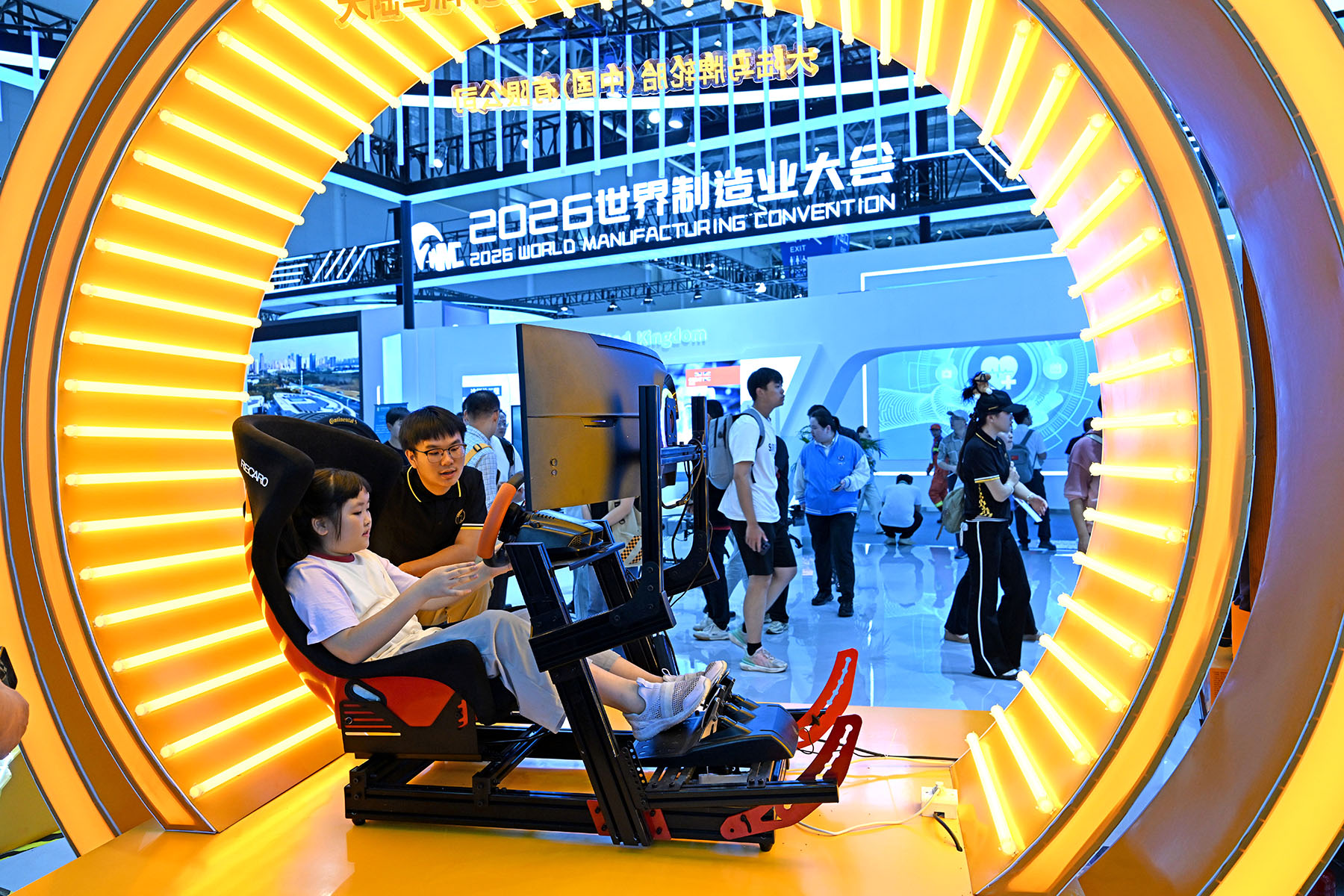
Three days after the national conference ended, the World Manufacturing Convention opened on Sept 20 in Hefei, capital of Anhui province, providing a local test case for that transition.
Once better known as an agricultural province and raw-materials base, Anhui has in little more than a decade built clusters spanning EVs, displays, chips, AI and robotics, while trying to digitalize traditional businesses such as cement and machinery.
The Anhui provincial government said that during the 14th Five-Year Plan (2021-25) period, revenue from Anhui's large industrial companies climbed to 5.9 trillion yuan ($879.6 billion) from 3.8 trillion yuan, taking the province to fifth place nationally.
That transition is particularly visible in Anhui. Liang Yanshun, then Party secretary of Anhui, said that every minute, factories across Anhui produce about 190 home appliances, 50 laptop computers and four new energy vehicles.
"Such momentum benefits from Anhui's decades of technological innovation and intelligent transformation. More and more Anhui-made products are setting sail overseas and benefiting consumers around the world," Liang said.
One of the latest examples is ChangXin Memory Technologies. The Hefei-based memory-chip maker said on Sept 20 that it has begun mass production of its fifth-generation DRAM technology platform that has reached the industry's most advanced manufacturing processes.
CXMT said that each wafer can now produce more than 50 percent more usable memory chips than the previous-generation platform. Its 24 gigabit LPDDR5X mobile memory chips based on the new platform are also in mass production and have been adopted by mainstream Chinese flagship smartphones.
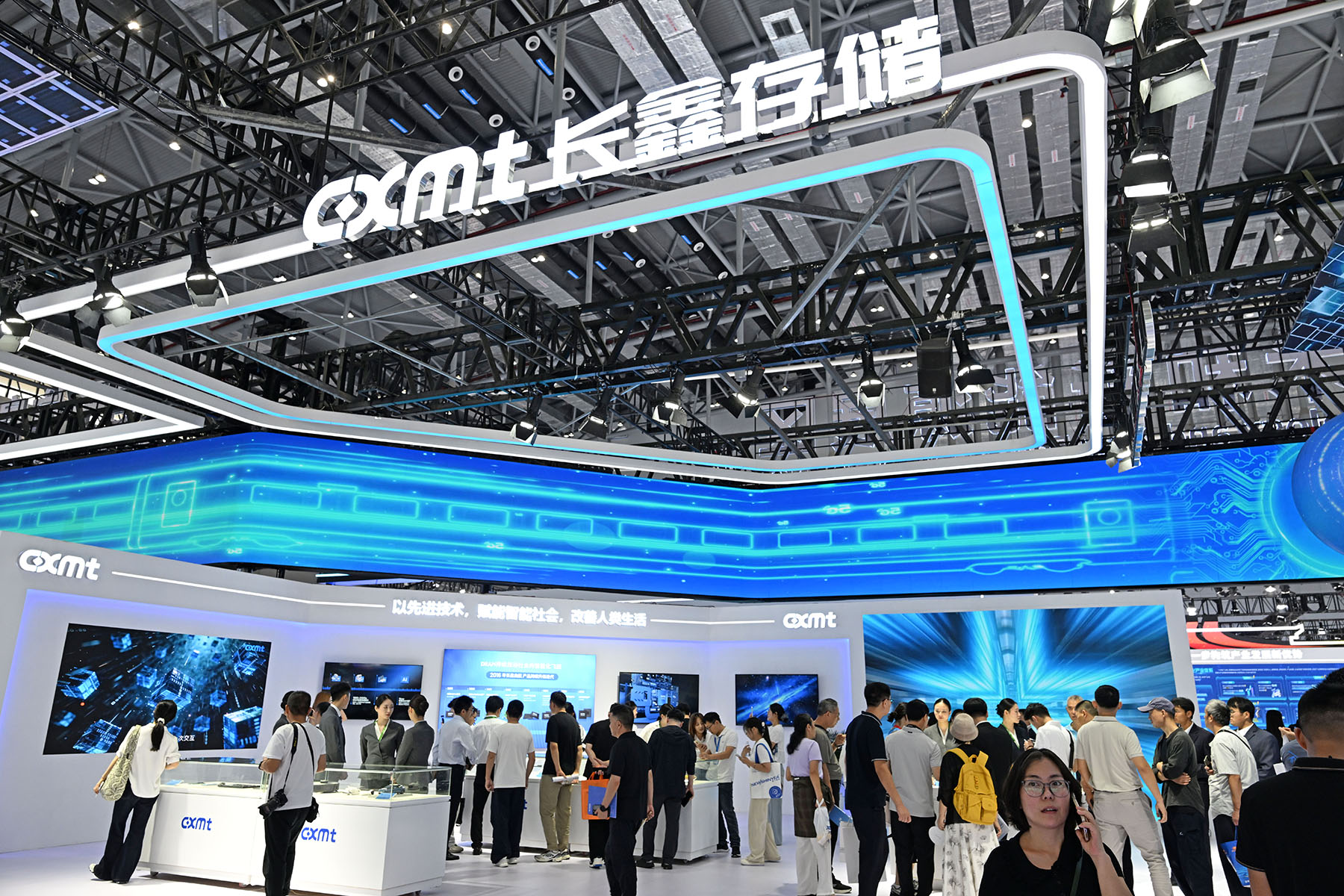
LPDDR5X is a type of high-speed, low-power memory widely used in premium smartphones, where higher capacity and faster data transfer are increasingly important for AI and other computing-intensive applications.
Luo Xiaodong, vice-president of CXMT, said the company had reduced the half-pitch of the active area in its memory array to 11.95 nanometers, putting CXMT close to the most advanced DRAM manufacturing technologies currently in mass production worldwide. The figure refers to the spacing between key structures inside a memory chip: the smaller the spacing, the more memory cells can be packed onto the same area of silicon.
Display panels offer another example. When Hefei brought in BOE Technology Group in 2008, China still depended heavily on imported flat-panel displays. What began as a major panel investment gradually pulled in glass, equipment, materials, chips and downstream manufacturers.
Today, Anhui accounts for about 10 percent of global new-display production capacity and has developed production lines spanning high-generation liquid-crystal displays, OLED and micro-displays, according to provincial industry data.
In Hefei Xinzhan High-tech Industrial Development Zone, the supply chain has become almost physical architecture.
A Corning display-glass factory is connected by an enclosed corridor to BOE's 10.5-generation panel production line, allowing glass substrates to move directly from one plant to the other. The two companies have also begun collaborating on next-generation materials including perovskite and glass-based packaging.
More than 120 display-related companies now operate in the zone, covering materials, equipment, control systems, panels and finished products.
That density matters because advanced manufacturing increasingly rewards industrial depth: not just a dominant leader, but enough specialized firms underneath it to solve engineering problems quickly, lower logistics costs and keep more value inside the cluster.
Horizon Robotics founder and CEO Yu Kai said at a separate conference that companies needed to continue investing in research and tackling core technologies to create new competitive advantages in frontier industries. Yet China's push also exposes the areas where that industrial depth remains incomplete.
ALSO READ: Evolution of Anhui's manufacturing sector
Chen, the engineering academician, has said some high-end chips, specialized sensors, basic control software and precision components used in major equipment still rely heavily on imports. Closing those gaps, rather than simply increasing final-product output, is one reason Beijing is putting renewed emphasis on "industrial foundation" technologies.
Perhaps the less obvious part of China's manufacturing strategy is that "advanced" does not necessarily mean "new".
Beijing has explicitly paired support for emerging industries with calls to renovate traditional ones. That matters in an economy where steel, chemicals, machinery, building materials and textiles remain enormous employers and industrial consumers of energy.
It brings the story back to the driverless mine. For a cement producer, advanced manufacturing may not result in a product that looks radically different to the customer. A bag of cement remains a bag of cement.
But behind it, the mine can become autonomous, kilns can be adjusted with algorithms, equipment can be monitored before it fails and energy consumption can be optimized in real time.
That kind of upgrade, repeated across China's immense base of traditional factories, could matter as much for industrial productivity as a new generation of humanoid robots.
Contact the writers at chengyu@chinadaily.com.cn
